The siege of Fort Ticonderoga ( Eng. Siege of Fort Ticonderoga ) in 1777 occurred between July 2 and 6 and was the first battle of the Saratoga campaign of the American War of Independence.
| The Battle of Ticonderoga (1777) |
|---|
| Main Conflict: US War of Independence |
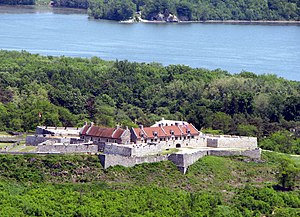
Fort Ticonderoga, view from Mount Defines |
| date of | July 2–6, 1777 |
|---|
| A place | Ticonderoga Fort, New York , USA |
|---|
| Total | UK victory |
|---|
|
 USA USA
|  United Kingdom United Kingdom
|
|
|
Arthur St. Claire | John Bergoyne
William Phillips |
|
|
about 3000
(regular troops and militias) [1] | about 7000 (regular troops) [2] ,
about 800 Indians and Canadians [3] |
|
|
7 killed, 11 wounded [4] [5] | 5 killed [5] [6] |
|
|
Fort Ticonderoga is located near the southern tip of Lake Champlain in New York State . 8,000 army men, Lieutenant General John Bergoyne, occupied heights above the fort and almost surrounded it. These movements accelerated the withdrawal of the Continental Army forces from Ticonderoga - 3,000 men under the command of General Arthur St. Clair . There was shooting and some casualties, but there was no formal siege or battle. Bergoyne's troops occupied Fort Ticonderoga and Fort Independence without resistance on July 6, and the advance detachments pursued the retreating Americans.
The surrender of Ticonderoga caused a storm of indignation in the American public and in military circles, since it was widely believed that Ticonderoga was important and almost inaccessible. General St. Clair and his commander, General severely criticized by Congress . Both were eventually rehabilitated in military courts, but their careers suffered. Schuyler was removed by Horatio Gates from command for the duration of a military court, and St. Clair commanded no more than field units until the end of the war.


