The Cimbrian War ( Latin Bellum Cimbricum , 113 - 101 years BC ) - the war of the Roman Republic at the end of the II century. BC e. with the German tribes of the Cimbri , Teutons and a number of Celtic tribes [1] .
| Cimbr war | |||
|---|---|---|---|
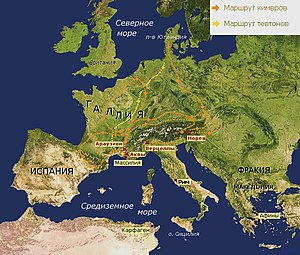 Map of the Cimbre War. Major battle locations | |||
| date | 113 - 101 years BC e. | ||
| A place | Narbonne Gaul , northern Italy | ||
| Total | victory of Rome | ||
| Opponents | |||
| |||
| Commanders | |||
| |||
The Cimbre War was the first war of the Romans with Germanic tribes. In the first battle in 113 BC e. the Cimbrians defeated the Roman troops that attacked them in the northeastern Alps , after which they passed through the Rhine to Gaul , where in 109 BC e. inflicted another defeat on the Roman legions. Autumn 105 BC e. the Romans tried to block the way for the barbarian tribes (the Cimbri, as well as the Germans and Gauls who joined them) from Gaul to Italy , however, two Roman armies were successively destroyed near Arausion . After the battle, the barbarians abandoned the immediate invasion of Italy and remained in the Celtic part of Gaul.
Only seven years later, in 102 BC. e. , the Cimbri, Teutons, Ambrons and Helvetites-Tigurins went to Italy, divided into three columns. In the summer of that year, the Teutons and Ambrons were defeated by Consul Gaius Marius at the Aquas of the Sextievs ( Narbonne Gaul ), and in 101 BC. e. at Vercelli (the headwaters of the Po river), the combined forces of the consul Gaius Maria and the proconsul Katula completely destroyed the Cimbrians.
There were no territorial changes during the Cimbre War, but the Romans repelled one of the largest invasions of the barbarian tribes. The scale of the war and the death of several Roman armies made a huge impression on the Romans. In the future, they were seriously afraid of the invasion of Germanic tribes in Italy, without fear of more numerous Celts. During the war, a radical reform of the Roman army was carried out, as a result of which the militia was replaced by a combat-ready professional army. In the future, this led to the transformation of the Roman army into an independent political force, which later Roman commanders used to fight for power.
Prehistory of the Cimbre War
Roman Republic
In the 120s BC e. the possessions of the Roman Republic expanded towards Gaul. After the defeat of the Gallic tribes of the Salluvians (Sallies), allobrogs and Arverns, Rome founded in the occupied territories the coastal province of Narbonne Gaul, located along the Mediterranean Sea from the Western Alps to the Pyrenees . Most of Gaul still remained under the control of the Celtic tribes.
In the Balkans, after the conquest of Macedonia and Greece, Roman possessions continued to expand northward towards the Danube . The Romans conquered Dalmatia and fought the Thordic in Thrace .
In 113 BC e. in North Africa , a power struggle has intensified between the Numidian rulers Yugurt and Adgerbal . After the execution of Yugurt in 112 BC. e. the senate of Rome, Adgerbala, the Senate sent four legions to Africa. The Yugurtin war (111-105 BC) was at that time the main thing for the Roman Republic. However, even before its successful conclusion, Italy was in danger of an invasion by the Cimbrians, who destroyed two Roman armies in a battle near Arausion on the lower Rhone . Plutarch wrote:
“Along with the news of the capture of Yugurta, rumor came to Rome about the Cimbri and Teutons; at first, they did not believe the rumors about the strength and multiplicity of the approaching hordes, but then they became convinced that they were even inferior to reality. In fact, only three hundred thousand armed men walked, followed by a crowd of women and children, which were said to exceed their number. They needed land that could feed so many people, and cities where they could live ...
As for the number of barbarians, many argue that there were not less, but more than what was said above ” [2] .
Cimbri
The exact origin of the Cimbri is unknown. Strabo wrote: “ As for the Cimbri, some of the things that are told about them are inaccurate, and other stories are completely unbelievable ” [3] . Although ancient authors attributed the Cimbri to the Germans, pointing to their previous stay in Jutland , modern historians pay attention to a number of features that bring the Cimbri to the Celts, in particular the names of their leaders [4] .
The route of the movement of the Cimbrians before the collision with the Romans was laid out by Strabo, referring to Posidonius [5] . According to the latter, the Cimbri went on a hike when the North Sea began to flood their land on the coast. Initially, they entered the land of battle ( Bohemia , modern Czech Republic ), but were driven out by local tribes. Having crossed the Danube, the Cimbri moved south to the lands of the Skordisk inhabiting Pannonia , from where they went west, invading Norik .
The invasion of the Cimbri. 113 BC e.
The beginning of the Cimbre War is known from the fragment from the “Roman History” by Appian [6] , which is preserved in the treatise of Konstantin Bagryanorodny “On Embassies”.
In 113 BC e. the Cimbrians invaded Norik (present-day Austria ), alpine land on the south bank of the Danube, inhabited by Celtic and Illyrian tribes . In Norik, the Cimbri captured the Romans-friendly trading and craft city of the Tauris of Norea . The city was plundered, many residents died, and the survivors were sold into slavery.
The Roman Senate , alarmed by this attack, ordered the consul Gnei Papyrius Carbon with an army of 30,000 to stop the barbarians. To block their path from Norik to Italy, the consul occupied the mountain passages in the Northeast Alps. He accused the barbarians of assaulting the norics [7] , the allies of Rome. Knowing the military power of Rome, the Cimbri sent ambassadors to Carbon, promising not to attack the allies of the Romans. After the negotiations, Carbon ordered the guides to lead the ambassadors back and, having gone with the troops in the shortest possible way, attacked the Cimbrians. However, the Romans were defeated in the battle. Only suddenly a thunderstorm forced the Cimbri to interrupt the battle, which helped the surviving soldiers of Carbon to hide.
Strabo claimed that the battle took place near the city of Norea [8] , whose location was not exactly established. It is assumed that ancient Norea could have been on the site of the Austrian city of Neumarkt .
After the battle, the Cimbri continued on to the west. Having passed through the lands of the Helvetites (present-day Switzerland ), where the tribes of Tigurins and Tougens joined them [5] , the Cimbri crossed the Rhine and entered Gaul.
Cimbri in Gaul. 112 - 106 years BC e.
In 109 BC e. Consul Mark Junius Silan entered into negotiations with the Cimbrians. The barbarians demanded " land and housing where they left off, " promising in return to become allies of Rome. The Roman Senate refused the Cimbri, fearing the presence on the borders of Italy of such a large barbarian tribe. In the battle, the details of which were unknown, the army of Mark Silan was defeated, and his camp was captured [9] [10] .
In 107 BC e. allies of the Cimbri helveti-tigurin led by the leader Divicon defeated the army of the consul Lucius Cassius on the lands of the Gallic tribe of allobrogs (the consul himself died in battle). The barbarians, who surrendered to the Romans, were humiliated by conducting them under the yoke of the , and also seized half of the seized property [9] [11] .
In 106 BC e. Rome sends a new army to South Gaul under the command of the Consul Quintus Servilius Cepion . The legionnaires captured Tolosa , having plundered the Celtic temple of Apollo (which 2 years later served as one of the grounds for bringing Cepion to trial, since the gold captured in the temple disappeared [12] ).
Despite the fierce resistance of the Gallic tribes, the Cimbri and their allies were defeated only in a clash with the Belgian tribes (they lived in the territory of modern Belgium ) [13] . Most of Gaul was ravaged. Julia Caesar , who conquered Gaul 50 years after the Cimvr War, in his Notes on the Gallic War, cited the speech of the arverne Critognatus about the events of the war with the Cimbrians:
“To do what our ancestors did in the far less significant war with the Cimbri and Teutons: driven into their cities and suffering from the same need for food, they supported their lives with the corpses of people recognized by their age as unfit for war, but not surrendered to enemies ” [14] .
Battle of Arausion. 105 BC e.
In 105 BC e. the army of the proconsul [15] of Quintus Servilius Cepion defended Narbonne Gaul to the west of the Rhone River, and the passage to Italy from Gaul was kept by the army of the consul Gnei Mallia , whose camp was on the east bank of the Rhone. The ancient Roman historian Granius Licinian [16] , who referred to the work of the second consul in 105 BC, wrote about those events . e. , Rutilia Rufa .
A detachment [17] of the consular legate Aurelius Skavra was defeated by the Cimbrians, he himself was thrown off the horse by the barbarians in battle and captured. At the tribal council, the Cimbri invited him to become their commander. But when, in response, Skavr began to dissuade them from invading Italy, speaking of the invincibility of the Romans, the young Cimbri chief Boyorig ( lat. Boiorige ) killed the legate.
Alarmed by this defeat, Consul Mally Maxim urged the Consul Servilius Cepion to join forces. Cepion moved to the east coast of the Rhone, but refused to unite the armies and set up camp separately, not even wanting to discuss a joint plan of warfare. The Cimbri sent ambassadors to Cepion with a proposal to make peace on the condition that they be given land. However, Cepion rudely drove out the ambassadors, and the next day the Cimbri attacked the Romans.
The battle took place on October 6, 105 BC. e. [18] at Arausion (Aravsion), a Celtic settlement on the left bank of the Rhone, which later became the stronghold of the Romans. Oroziy reported that the Romans were opposed by the combined forces of the Cimbri, Teutons, Tigurins (Helvets) and Ambrons (Plutarch also wrote about the participation of Ambrons in the battle). The course of the battle remained unknown, however, ancient authors described its result. Orosius gave the most complete picture of the catastrophe of the Roman armies:
“There they [consul and proconsul] ... were defeated, bringing great disgrace and risk to the Roman name ... Enemies, having captured both camps and huge booty, in the course of some unknown and unprecedented priesthood destroyed everything they possessed. The clothes were torn and thrown away, gold and silver were thrown into the river, the military shells were chopped off, the horse falses were corrupted, the horses themselves were thrown into the abyss of water, and people were hanged in the trees - as a result, neither the winner enjoyed any of the captured, nor the vanquished saw any mercy " [19] .
Titus Livy and Orozius (referring to Valery Antsiat ) call the same number of dead Romans: 80 thousand soldiers and 40 thousand servants, conscripts and merchants (which numerically exceeded the losses of the Romans after the battle of Cannes ). Granius Licinian leads to the loss of 70 thousand legionnaires and lightly armed soldiers of auxiliary troops. Oroziy reports that out of 2 armies, only a dozen people survived who brought the news of the defeat. Two sons of the consul Mullius Maxim died, although the commanders themselves escaped and were later sentenced to exile.
Modern historians suggest that during the battle, the barbarians pressed and dropped Roman troops into the Rhone River, which explains the almost complete destruction of two large armies [20] .
After the battle, the barbarians did not attack Italy and devastated Narbonne Gaul, which remained without Roman troops. From there, they invaded Spain, where the Celtiberians forced them to return to Gaul. Titus Livy believed that it was then that the German tribe of the Teutons joined the Cimbri [21] . The Cimbrians' refusal to invade Italy gave the Romans the necessary time to prepare.
Force Mobilization and Military Reform
Position of the Roman Republic
The death of two consular armies at Arausion on the western border of Italy forced Rome to take emergency measures. An order was issued along the coast and ports of Italy prohibiting boarding of ships under 25 years of age. The oath was taken from the young men that they would not leave the borders of Italy. The second consul, Publius Rutilius Rufus, began hastily to assemble a new army:
“Unlike all previous military commanders, he called in the troops of the trainers from the gladiatorial school of Guy Aurelius Skavr, so that they would introduce in the legions a more sophisticated technique of striking and evading them. That is, he combined courage with art and, conversely, art with courage in order to strengthen the quality of both of them ” [22] .
The new army was led by Consul Gaius Marius . It was her, and not the troops who participated in the war with Yugurt, that Mari chose to fight with the Cimbrians [23] .
In 102 BC e. the combined forces of the barbarians in 3 columns went to Italy. The Teutons and Ambrons traveled the shortest path along the coast. The Cimbri went through Norik , bypassing the Alps. The tigurins lingered in the alpine foothills and scattered after the news of the defeat of the allies [24] .
Guy Maria War Reform
The territorial expansion of the Roman Republic forced Rome to wage numerous wars in different parts of the world at the same time. Under these conditions, the maintenance of an army recruited from free citizens, became extremely difficult for Rome.
In 107 BC e. When the Cimbri were in Gaul, the Senate instructed Consul Gaius Maria to end the protracted war with the Numidian king Yugurt . With the permission of the Senate, Mari changed the principle of manning the army, into which it was now allowed to recruit citizens without property qualifications (poor urban proletarians). The lack of soldiers' own economy allowed to increase the period of military service to 20-25 years. After the service, veterans were allocated a plot of land from the state. As a result, the militia of citizens was replaced by a standing professional army.
The level of training of soldiers allowed to unify the types of weapons, light infantry and cavalry from citizens were replaced by troops of the Roman allies.
The structure of the legion also changed - instead of manipula (200 soldiers), a larger cohort (600 soldiers) became the main tactical unit in the Roman army.
Elected Consul for the 2nd time in 104 BC. e. (and even three times after that) Gaius Marius got the opportunity to prepare an army for war with the Cimbrians at the time when they ravaged Gaul and Spain.
The Battle of Aqua Sextius. 102 year BC e.
The defeat of the Teutons and Ambrons
The Teutons and Ambrons set off for Italy along the coast and in the summer of 102 BC. e. approached the well-fortified camp of Guy Maria near the mouth of the Rhone . When the barbarian attempts to storm the camp were repulsed, they decided to go around it from the north to go to Italy. Gaius Marius followed them, waiting for the right moment for the battle.
Near the city of Aqua, the Sexties (north of modern Marseilles ) in the foothills of the Alps, the Romans camped on a high hill. When slaves and messengers descended to the river to get water, they were attacked by ambrons located in the same places. Roman legionnaires and allied Italian soldiers rushed to the rescue. Амброны были опрокинуты в реку и бежали к своему лагерю, где среди повозок римлянам также пришлось сражаться и с женщинами варваров. После сумерек римляне отступили в свой лагерь.
Спустя три дня после боя римлян атаковали тевтоны с уцелевшими амбронами. Римляне расположились на выгодной позиции, варварам приходилось подниматься по крутому склону. Вскоре легионеры оттеснили тевтонов вниз на равнину, где те начали готовиться к бою, строясь в боевой порядок. И в этот момент на варваров с тыла из леса напал заранее поставленный Марием в засаду 3-тысячный отряд Клавдия Марцелла. Среди тевтонов началась паника, и они обратились в беспорядочное бегство. Римляне пленили вождя тевтонов Тевтобад, позднее он стал украшением триумфа в Риме. Плутарх оценивал количество погибших и захваченных варваров в 100 тыс. человек, Веллей Патеркул сообщал о 150 тыс. «истреблённых врагов» [25] , а Тит Ливий писал о 200 тыс. убитых и 90 тыс. пленных [26] :
«Во всяком случае, жители Массилии костями павших огораживали виноградники, а земля, в которой истлели мертвые тела, стала после зимних дождей такой тучной от наполнившего её на большую глубину перегноя, что принесла в конце лета небывало обильные плоды.» [27]
Иероним в поучительном письме к знатной галльской матроне упоминал историю о 300 замужних тевтонских женщинах, пленённых римлянами при Аквах Секстиевых. Когда на просьбу сделать их служанками при храмах римляне ответили отказом, они убили своих детей и в одну ночь задушили друг друга [28] .
Вторжение кимвров в Италию
Устремившихся в Италию кимвров попытался сдержать второй консул 102 года до н. e. Квинт Лутаций Катул , расположившийся с войсками в северо-восточных Альпах. Во время сражения он начал отходить с перевалов к реке Адидже , но под напором кимвров легионеры впали в панику. Об одном из эпизодов того поражения римлян сообщал писатель начала I века Валерий Максим :
«Когда у реки Эч ( Адидже ) римские всадники, не выдержав натиска кимвров, в страхе прибежали в Рим, Марк Эмилий Скавр , светоч и краса отечества, послал сказать своему сыну, участвовавшему в бегстве: „Охотнее я увидел бы тебя убитым на своих глазах в честном бою, чем виновником постыдного бегства. Итак, если в тебе осталась хоть капля стыда, ты должен избегать взоров обесчещенного отца“ . Получивши известие об этом, сын вонзил себе в грудь тот самый меч, который он должен был употребить против врагов.» [29]
Катул был вынужден занять оборону на южном берегу реки По , оставив север Италии между По и Альпами на разграбление варваров. Согласно Плутарху , римляне заключили с кимврами перемирие.
Битва при Верцеллах. 101 год до н. э.
В следующем, 101 год до н. e. вновь избранный консулом Гай Марий объединил свои войска (32 тыс.), переброшенные из Галлии, с армией проконсула Катула (20 300 солдат). Переправившись на южный берег По, Марий попытался начать сражение с кимврами. Варвары сначала уклонялись от боя, но когда им стало известно о разгроме тевтонов, потребовали назначить время и место битвы.
Сражение состоялось 30 июля 101 года до н. e. [30] на Равдинском поле у Верцелл (верховья реки По ).
Армия Катула заняла центр, Марий расставил свои войска по флангам. Кимвры построили своё войско огромным квадратом, длина каждой стороны которого составляла 30 стадий (почти 5 км, что скорее всего является преувеличением) [31] . На правом фланге кимвры поставили конницу:
«А конница, числом до пятнадцати тысяч, выехала во всем своем блеске, с шлемами в виде страшных, чудовищных звериных морд с разинутой пастью, над которыми поднимались султаны из перьев, отчего ещё выше казались всадники, одетые в железные панцири и державшие сверкающие белые щиты. У каждого был дротик с двумя наконечниками, а врукопашную кимвры сражались большими и тяжелыми мечами.» [31]
В битве на широкой равнине легионы Мария потеряли из вида войско кимвров, разгромленное силами армии Катула. В сражении пали вожди кимвров Бойориг ( Boiorix ) и Лугий ( Lugius ), Клаодик ( Claodicus ) и Кесориг ( Caesorix ) были захвачены в плен [32] . Как и женщины амбронов, жёны кимвров защищались отчаянно, и покончили с собой, как и женщины тевтонов:
«Битва с женами варваров была не менее жестокой, чем с ними самими. Они бились топорами и пиками, поставив телеги в круг и взобравшись на них. Их смерть была так же впечатляюща, как и само сражение. Когда отправленное к Марию посольство не добилось для них свободы и неприкосновенности, — не было такого обычая, — они задушили своих детей или разорвали их на куски, сами же, нанося друг другу раны и сделав петли из своих же волос, повесились на деревьях или на оглоблях повозок.» [33]
Флор сообщает о 65 тыс. павших кимвров и только 300 римлянах. Веллей Патеркул писал о 100 тыс. убитых и пленных кимвров, а Плутарх увеличивает потери варваров до 120 тыс. убитых и 60 тыс. пленных.
Итоги Кимврской войны
Во время войны вторгшиеся племена были полностью разгромлены, несмотря на то, что количество погибших и захваченных в плен варваров сильно отличается у античных историков. В I веке ещё сообщалось об обитании на берегах Северного моря небольшого племени кимвров, но после I века упоминания о них исчезают. После разгрома римлянами тевтоны как племя исчезли, хотя их название продолжает использоваться как обобщающее наименование современных немцев.
В после Кимврской войны римляне столкнулись с германцами спустя почти 50 лет, когда Юлий Цезарь после завоевания Галлии направился к Рейну .
Sources
Труды, в которых подробно излагался ход Кимврской войны, не сохранились. События войны были восстановлены на основе фрагментарных сведений различных античных авторов.
- Вторжение кимвров и сражение при Норее ( 113 год до н. э. ): Страбон , «География» (7.2.2, 5.1.8); Тит Ливий , «История Рима от основания города» (кн. 63); Аппиан , «О войнах с кельтами» (фр. 13).
- Сражения в Галлии: Тит Ливий (кн. 65); Юлий Цезарь , «Галльские войны» (1.7, 1.12—13, 2.4, 7.77); Флор (1.38).
- Битва при Араузионе ( 105 год до н. э. ): Граний Лициниан (фрагм., кн. 33); Тит Ливий (кн. 67); Орозий (5.16).
- Сражения при Аквах Секстиевых ( 102 год до н. э. ) и Верцеллах ( 101 год до н. э. ): Плутарх , «Гай Марий»; Флор (1.38); Тит Ливий (кн. 68); Веллей Патеркул (2.12); Орозий (5.16).
In Culture
- Колин Маккалоу . «Первый человек в Риме».
See also
- История древних германцев
- Битва в Тевтобургском Лесу
- Скифская война III века
Notes
- ↑ Принадлежность кимвров к германцам оспаривается современными историками, см. ниже
- ↑ Плутарх , «Гай Марий», 11
- ↑ Страбон, 7.2.1
- ↑ Щукин М. Б., Еременко В. Е. К проблеме кимвров, тевтонов и кельтоскифов . // АСГЭ. — 1999. — № 34. — С. 134—160.
- ↑ 1 2 Страбон, 7.2.2
- ↑ Александрийский историк Аппиан писал о вторжении тевтонов в землю нориков. Более ранний Тит Ливий , в периохах к кн. 63 сообщает: « В Иллирик вторгаются с разорением кочевые кимвры, ими разбит консул Папирий Карбон с войском. » Здесь Иллирик — обширная римская провинция на среднем Дунае, куда одно время территориально входил и Норик . Сама книга 63 не сохранилась.
- ↑ Страбон (7.2.2) со ссылкой на современника нашествия Посидония называет племена нориков: тавриски (Ταυρισκους) и теврисы (Τευριστας).
- ↑ Страбон , 5.1.8
- ↑ 1 2 Тит Ливий. Периоха к кн. 65
- ↑ Флор , «Эпитомы», кн.1, 38
- ↑ Ю. Цезарь, «Галльские войны», 1.7, 1.12—13
- ↑ О пропавшем золоте и суде на Цепионом см. у Т. Моммзена (История Рима, кн. 3, гл. 5).
- ↑ Ю. Цезарь, «Галльские войны», 2.4
- ↑ Ю. Цезарь, «Галльские войны», 7.77
- ↑ Квинт Сервилий Цепион был консулом в 106 году до н. э. , в следующий 105 г. консулами стали Гней Маллий Максим и Публий Рутилий Руф
- ↑ Граний Лициниан — римский историк II века , из его «Римской истории» фрагментарно сохранились на нескольких страницах палимпсеста лишь несколько книг, которые покрывают период от 163 до 78 г. до н. e.
- ↑ Тит Ливий и Лициниан называют отряд Аврелия Скавра армией или войском. Ранг консульского легата давал право Скавру командовать легионом, но скорее всего под его началом был крупный разведывательный отряд.
- ↑ Точный день сражения указан у Грания Лициниана: в день перед октябрьскими нонами . То же самое у Плутарха в «Изречениях царей и полководцев» (87. Лукулл).
- ↑ Орозий , 5.16.
- ↑ The History of Rome by Theodor Mommsen. Book IV, ch. V
- ↑ Titus Livy. Периоха к кн. 67
- ↑ Валерий Максим. «Девять книг замечательных деяний и изречений», 2.3.2
- ↑ Фронтин , «Стратегмы», 4.2.2
- ↑ Флор , 1.38
- ↑ Веллей Патеркул , 2.12
- ↑ Titus Livy. Периоха к кн. 68
- ↑ Плутарх , «Гай Марий», 21
- ↑ Jerome. Letter CXXIII.8, To Ageruchia : письмо датируется 409 годом .
- ↑ Валерий Максим. «Девять книг замечательных деяний и изречений», 5.8
- ↑ Дату битвы назвал Плутарх: в третий день перед календами месяца секстилия
- ↑ 1 2 Плутарх , «Гай Марий», 25
- ↑ Орозий , 5.16.20
- ↑ Флор , кн. 1.38