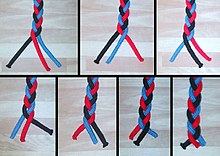
A braid group is a group that abstractly describes the braid weaving. Similarly, knot theory is related to knots .
The braid group on n threads is usually denoted by B n .
Content
- 1 History
- 2 Intuitive Description
- 3 Definitions
- 4 Properties
- 5 Literature
- 6 notes
- 7 References
History
The braid group was first explicitly described by Emil Artin in 1925. [one]
Intuitive description
Consider the case n = 4, from this example it will be easy to understand what constitutes an arbitrary braid group. Consider two parallel lines ( they are vertically located in the figure ), each of which has four numbered points, so that the points with the same numbers are opposite each other. We divide the points into pairs and use the threads to connect them. If you depict the resulting picture in a plane, some threads can pass under each other (we can assume that the threads always intersect transversally ). It is important to take into account the sequence of threads at the intersection:
| differs from |
On the other hand, two such configurations, which can be made the same by moving the threads without affecting the end points, we will consider the same:
| no different from |
All threads must be directed from left to right, that is, each of the threads can cross a vertical line ( parallel to lines with numbered points ) at no more than one point:
| not oblique. |
For two braids, you can consider their composition by drawing the second next to the first, that is, gluing the corresponding four end points:
| × | = |
The group B 4 is a factor of the set of all such configurations on four pairs of points with respect to the equivalence relation given by continuous transformations of the plane on which the group operation is specified by the above method. This operation satisfies all the axioms of the group; in particular, the neutral element is the equivalence class of four parallel threads and for each element the inverse to it can be obtained by symmetry with respect to the vertical line.
Definitions
Strictly formalize the above description in several ways:
- The geometric method uses the concept of homotopy , namely, B n is defined as the fundamental group of the space of n- point subsets on a plane with a natural topology.
- It is also possible to give a purely algebraic description by specifying generators and relations .
- For example, B n can be defined by ( n - 1) generators and ratios:
- For example, B n can be defined by ( n - 1) generators and ratios:
In particular, any element of B 4 can be written as a composition of the following three elements (and inverses to them):
To understand why this is intuitively obvious, we “scan” the image by moving the vertical line from left to right. Whenever the i- th from above ( on this line ) the thread passes under the ( i + 1) -th, we will write σ i , and if over the ( i + 1) -th, then σ i −1 .
Obviously, the relation σ 1 σ 3 = σ 3 σ 1 holds, while it is slightly more difficult to see that σ 1 σ 2 σ 1 = σ 2 σ 1 σ 2 (this is most easily verified by drawing lines on a piece of paper).
It can be proved that all relations between elements of the braid group follow from relations of this form.
Properties
- The group B 1 is trivial , B 2 is infinite (like all subsequent braid groups) and is isomorphic to Z , B 3 is isomorphic to the group of the trefoil knot .
- All elements of B n , except neutral, have infinite order; that is, B n is torsion-free .
- There is a surjective homomorphism B n → S n from the braid group to the permutation group . Indeed, each element of the group B n can be associated with a permutation of the set of n vertices, in which the left end of each “thread” is associated with it.
- The kernel of this homomorphism is called the group of colored braids; it is usually denoted by .
- For groups of colored braids there is a short exact sequence
- Where denotes a free group with generatrix.
- A braid group can be defined as a group of classes of mappings of a disk with punctured points . More precisely, the braid group with n threads is naturally isomorphic to the group of transformation classes of the disk n punctured points.
Literature
- Deligne, Pierre (1972), " Les immeubles des groupes de tresses généralisés ", Inventiones Mathematicae T. 17 (4): 273–302, ISSN 0020-9910 , DOI 10.1007 / BF01406236
- Birman, Joan, and Brendle, Tara E., Braids: A Survey , revised February 26, 2005. In Menasco and Thistlethwaite.
- Carlucci, Lorenzo; Dehornoy, Patrick; and Weiermann, Andreas, “Unprovability results involving braids” , November 23, 2007
- Kassel, Christian; and Turaev, Vladimir, Braid Groups , Springer, 2008. ISBN 0-387-33841-1
- Menasco, W., and Thistlethwaite, M., (editors), Handbook of Knot Theory , Amsterdam: Elsevier, 2005. ISBN 0-444-51452-X
Notes
- ↑ Artin E. Theorie der Zopfe, Abh. Math. Sem. Hamburg Univ. 4 (1925), 47-72.
Links
- CRAG: CRyptography and Groups at Algebraic Cryptography Center Contains extensive library for computations with Braid Groups
- P. Fabel, Completing Artin's braid group on infinitely many strands , Journal of Knot Theory and its Ramifications, Vol. 14, No. 8 (2005) 979–991
- P. Fabel, The mapping class group of a disk with infinitely many holes , Journal of Knot Theory and its Ramifications, Vol. 15, No. 1 (2006) 21-29
- Chernavskii, AV (2001), "Braid theory" , in Hazewinkel, Michiel, Encyclopedia of Mathematics, Springer, ISBN 978-1-55608-010-4
- Java application modeling group B 5 .
- C. Nayak and F. Wilczek's connection of projective braid group representations to the fractional quantum Hall effect [1]
- Presentation for FradkinFest by CV Nayak [2]
- N. Read's criticism of the reality of Wilczek-Nayak representation [3]