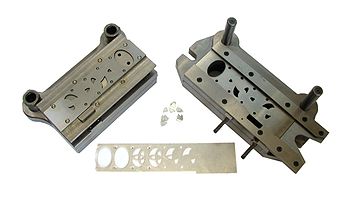
A stamp is a tool for obtaining identical products (parts, blanks, forgings) by plastic deformation .
Content
Principle of Operation
The dies plastically (i.e., not elastically) deform the workpiece material, giving it the shape of the working part of the stamp. The stamp is installed on the stamping equipment - presses, hammers - which drives it.
Device
Typically, a stamp consists of two halves - top and bottom. The upper one is driven by the working part of the equipment (e.g. a slider or a hammer). However, the device of the stamp varies greatly depending on its purpose. Conventionally, they can be divided:
- By technology:
- Stamps for cold stamping
- Hot stamping dies
- By equipment:
- Molotovye
- For the press
- Other
Hammer Stamps
This type of stamps is characterized by a small number of details, since molding takes place in streams - surface sections of the stamp part, whose shape follows the shape of the final product. The stamp consists of two massive halves attached to the headstock and the hammer’s blade with the help of dovetail shanks. The two halves always completely converge on the Stamp Section Surface (CRP). There can be several streams on the PRS:
- Final (fair). It has the form of a finished forging and is located in the center of the pressure of the stamp.
- Landing, lingering and rolling. Harvesting streams that optimize the shape of the workpiece, bringing its shape closer to the shape of the final product. They are located at the corners of the stamp.
- Chop. Separates the workpiece. Also located in one of the corners.
- Bending. Bends the workpiece.
- Sedimentary. “Flatten” the workpiece, also bringing its shape closer to the final product. Usually it’s flat and is called a “settlement site”
Press Stamps
There are a huge variety of presses , and not all of them need stamps as a working tool. Stamps in sheet stamping are especially common. They have the most characteristic device:
- Two plates, the upper of which is attached to the slider with the help of a cylindrical shaft, while the lower one is mounted on the press table.
- Working details - punch and matrix of various designs.
- 2 - 4 guides in the corners of the plates.
However, there are also quite unusual stamp designs. For example, stamps for KGShP consist of the upper and lower blocks, equipped with pushers, in the grooves of which are inserted the brook inserts , in which, actually, the forming elements are located (1 operation per insert) [1] .
Cutting dies
Cutting dies can be divided into:
- fine cutting dies,
- consecutive
- bending
- exhaust
- edged
- punching
- gauge.
See also
- Punch
Notes
- ↑ Semenov E.I., Forging and stamping, vol. 2