Water clock , clepsydra ( Greek: κλεψύδρα from κλέπτω “steal, hide” + ὕδωρ “water”), hydrology (from ὕδωρ “water” + λόγος “word, doctrine”) - known from the time of Assyro-Ancient Babylon [1] a device for measuring time intervals in the form of a cylindrical vessel with a flowing stream of water. It was in use until the XVII century .
Content
History
The Romans had in full swing the water clock of the simplest device, for example, they determined the length of the speeches of the speakers in court. The first water clock was arranged in Rome by Scipio Nazica ( 157 BC ). Pompey's water clock was famous for its jewelry made of gold and stones. At the beginning of the VI century, Boethius's mechanisms were famous, which he arranged for Theodorich and (at the request of the latter) for the Burgundian king Gundobad. Then, apparently, this art fell into decay, since Pope Paul I sent Pipin Korotkoy a water clock as a rarity. Harun ar-Rashid sent Charlemagne to Aachen (809) a water clock of a very complex device (metal balls, falling out, beat the clock). Apparently, a certain monk Pacificus in the IX century began to imitate the art of the Arabs. At the end of the 10th century , Herbert (Pope Sylvester II) became famous for his mechanisms, also partly borrowed from the Arabs.
The water hours of Oronius Phineus and Kircher , based on the principle of siphon, were also famous. Many mathematicians, including in recent times, Galileo , Varignon , Bernoulli , solved the problem: "what should be the shape of the vessel so that the water flows out quite evenly."
In the modern world, clepsydra is widely used in France in the Fort Boyard television game during the passage of players' trials and is a rotary mechanism with blue tinted water.
Device
- The time interval was measured by the amount of water flowing drop by drop from a small hole made at the bottom of the vessel. Such were the water clocks of the Egyptians [1] , the Babylonians , the ancient Greeks .
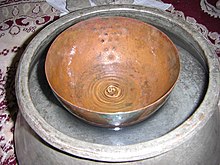
- For the Chinese , Indians, and some other peoples of Asia , on the contrary, an empty hemispherical vessel floated in a large pool and gradually filled with water through a small hole (the heroine of the poem throws a pearl into the bowl to slow down the movement of water). [2]
Because of the visible property of clepsydra, the saying “Time is up” appeared.
The first type of watch has undergone significant improvements. Plato describes a mechanism of two cones entering one into the other; with their help, an approximately constant level of water in the vessel was maintained, and thereby the rate of its flow was regulated. [3] Full development of similar mechanisms, so-called. clepsydra, received in Alexandria in the III century BC. e. The clepsydra Kteziby , the teacher of Heron , is especially famous. The device of clepsyders installed in the temple of Arsinoe consisted of the following.
a - appearance;
b - section;
1 - tube for supplying water from an extraneous source;
2 - a figure from the eyes of which water drop by drop evenly flows through the tube 3 into the reservoir 4;
5 - cork with figure 6 fixed on it, showing the time on the cylindrical dial 7 with a stick;
8 - siphon tube, through which at the end of the day water flows from the filled reservoir 4, turning the cylinder 7 around the vertical axis by 1/365 of the circumference.
When water accumulated (see. Fig.) In the chamber, the float 5 with the figure 6 located on it, rose and indicated the hour on the column. Water dripped from the eyes of another figure (2). After a day, water using a siphon device 8 flowed out and rotated the gear wheel 7, and with it the entire column. The full turn of the column took place a year. Curved “hour” lines drawn on the column were designed so that the uniform rise of the float was consistent with unequal day and night hours at different times of the year. They were unequal, since the hour of the ancient Greeks and Romans was defined as 1/12 of the time interval from sunrise to sunset, and this interval is different on different days of the year (in middle latitudes).
- In the Middle Ages, water clocks of a special device, described in the treatise of the monk Alexander, became widespread. The drum, divided by walls into several radial longitudinal chambers, was suspended by the axis so that it could lower, deploying the ropes wound around the axis, that is, rotating. Water in the side chamber pressed in the opposite direction and, gradually pouring from one chamber to another through small holes in the walls, it slowed down the unwinding of the ropes so much that time was measured by this unwinding, that is, lowering the drum. [3]
Notes
- ↑ 1 2 Alabaster water clock of King Amenhotep the Third ( Amenhotep III )
- ↑ Serafimov V.V. , Lermantov V.V. Clock // Encyclopedic Dictionary of Brockhaus and Efron : in 86 volumes (82 volumes and 4 additional). - SPb. , 1890-1907.
- ↑ 1 2 CLEPSYDRA from Rees's Clocks, Watches and Chronometers, 1819