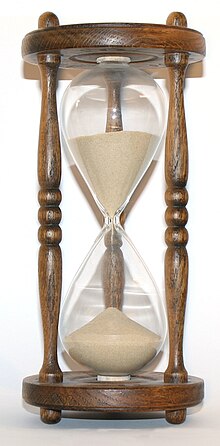

An hourglass is the simplest device for counting time intervals, consisting of two transparent vessels connected by a narrow neck, one of which is partially filled with sand . The time during which sand is thrown into the other vessel through the neck can range from a few seconds to several hours .
History and Modernity
One of the first references to such a watch is a message found in Paris , which contains instructions on the preparation of fine sand from black marble powder , boiled in wine and dried in the sun [1] .
Currently, hourglasses are used in some medical procedures, in photography , and as souvenirs .
On Windows operating systems , the hourglass symbol used by the mouse pointer is used to indicate that the system is busy.
⌛ - Unicode hourglass symbol ( HOURGLASS , code U+231B ).
Advantages
Simplicity of design.
Weaknesses
The disadvantage of an hourglass is the short time interval that can be measured with their help. Watches that became widespread in Europe were usually designed to work for half an hour or an hour. There were hours working for 3 hours, very rarely - 12 hours. To increase the measurement interval, hourglass sets were compiled in one case (case).
The accuracy of the hourglass depends on the uniform granularity and flowability of sand, the shape of the bulb, the quality of its surface. The flasks were filled with annealed and sieved through a fine sieve and carefully dried fine-grained sand. Ground eggshell, zinc and lead dust were also used as starting material. With prolonged use, the accuracy of the hourglass deteriorates due to sand damage to the inner surface of the flask, an increase in the diameter of the hole in the diaphragm between the flasks, and crushing of the sand grains into smaller ones.
Record Watches
- in Budapest .
- In the sand museum of the Japanese city of (now part of Oda ) there are watches with a height of 8.6 meters and with an empty cycle of 1 year [2] .
See also
- Water clock
Notes
- ↑ Michal S. Watches. From the gnomon to the atomic clock = Hodiny (od gnomonu k atomovým hodinám) / Scientific Ed. V.A. Shpolyansky. Abbr. translation from Czech Melner R. E .. - M .: Knowledge, 1983. - 256 p. - 80,000 copies.
- ↑ Nima Sand Museum .
Literature
- Serafimov V.V. , Lermantov V.V. , -. Hours // Brockhaus and Efron Encyclopedic Dictionary : in 86 volumes (82 volumes and 4 additional). - SPb. , 1890-1907.
- Michal S. Watch. From the gnomon to the atomic clock = Hodiny (od gnomonu k atomovým hodinám) / Scientific Ed. V.A. Shpolyansky. Abbr. translation from Czech Melner R. E .. - M .: Knowledge, 1983. - 256 p. - 80,000 copies.