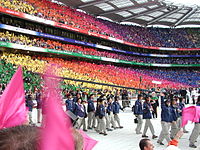
Special Olympics International is an international organization dedicated to organizing sports events for people with intellectual disabilities. He is the main organizer of the Special Olympics World Games , held every 4 years. The organization was founded in 1968 in Chicago by physical education teacher Anna McGlone Burke.
Content
History of the Special Olympic Movement
A special Olympic movement arose on the initiative of Eunice Kennedy Shriver, sister of US President John F. Kennedy . In 1957, she led the Joseph Kennedy Foundation. The fund has two main goals: to find protection against mental retardation by identifying its causes and to improve ways of society treating citizens with intellectual disabilities.
In 1963, Eunice and her husband Sargent Shriver decided to change the situation of people who were considered superfluous in society. To this end, they adapted their home in Maryland as a sports day camp for children and adults with intellectual disabilities to learn their abilities. The very first results of working with them showed how sensitive these people are to caring and how, with the support and patient training, their inner potential is revealed. People with mental retardation were much more capable in various sports and physical education than experts thought before.
In July 1968, the first international Special Olympic Games organized by Anna Burke at the expense of the Kennedy Foundation took place on the Military Field in Chicago. In December of the same year, the Special Olympics organization was created, which received the status of a charitable organization. Over the years, more than three million people from 180 countries of the world have become participants in the special Olympic movement.
Until 1989, the games were held exclusively in the United States under the name International Special Olympics. Then other countries began to host the games, and they were renamed the World Special Olympics.
Competition Principles
Special Olympiads are held solely for the purpose of adapting people with intellectual disabilities. In competitions, there is no goal to identify the strongest and record sports records.
All participants are divided into divisions depending on their sports training. Thus, to participate in the competitions of Special Olympiads it is not required to show any sporting achievements. The difference in results between the athletes of the same division should not be more than 10% (15% is allowed with a small number of athletes). In each division no more than 8 participants compete. At the same time, there are also 8 places on the podium - that is, in principle, there are no losers.
Three athletes are selected for competitions of a higher level, taking the top three places in each division, as well as partially other participants by drawing lots. As a result, everyone has a chance to get to the World Special Olympics - regardless of sports achievements.
At Special Olympiads, there is no fixation of the nationality of participants and there are no “team events" between different countries.
See also
- 2011 World Summer Special Olympics