
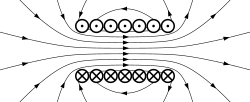

A solenoid (from the Greek. Σολήνα (salt) - channel, pipe and ειδός (eidos) - similar, similar ) - a kind of inductor .
Structurally, long solenoids are made both in the form of a single-layer winding (see. Fig.), And multi-layer.
If the length of the winding significantly exceeds the diameter of the winding, then in the cavity of the solenoid, when an electric current is supplied to it, a magnetic field is generated that is close to uniform.
Also often called solenoids are electromechanical actuators , usually with a retractable ferromagnetic core . In such an application, the solenoid is almost always provided with an external ferromagnetic magnetic circuit , commonly called a yoke.
An infinitely long solenoid is a solenoid whose length tends to infinity (that is, its length is much larger than its transverse dimensions).
DC Solenoid
If the length of the solenoid is much larger than its diameter and no magnetic material is used, then when the current flows through the winding inside the coil, a magnetic field is created, directed along the axis, which is uniform and equal to [1] for direct current:


Where 


Due to the fact that the two halves of the infinite solenoid at the point of their connection make the same contribution to the magnetic field, the magnetic induction of the semi-infinite solenoid at its edge is half as much as in the volume. The same can be said about the field at the edges of a finite, but rather long solenoid [1] :
( SI )
When current flows, the solenoid stores energy equal to the work that must be done to establish the current . The value of this energy is equal to
Where - flux linkage - magnetic flux in the solenoid, - inductance of the solenoid.
When the current changes in the solenoid, an EMF of self-induction occurs, the value of which
- .
Solenoid Inductance
The inductance of the solenoid is expressed as follows:
- ( SI )
- ( GHS )
Where - magnetic permeability of vacuum , - the number of turns per unit length of the solenoid, - the number of turns, Is the volume of the solenoid, - the length of the conductor wound on the solenoid, - the cross-sectional area of the solenoid, Is the length of the solenoid, - diameter of a turn.
Without the use of magnetic material, magnetic induction within the solenoid is actually constant and equal to
Where - current strength. Neglecting the edge effects at the ends of the solenoid, we obtain that the flux linkage through the coil is equal to magnetic induction times the cross-sectional area and the number of turns :
From here follows the formula for the inductance of the solenoid
- equivalent to the previous two formulas.
AC Solenoid
With alternating current, the solenoid creates an alternating magnetic field. If the solenoid is used as an electromagnet , then on alternating current the magnitude of the attractive force changes. In the case of an anchor made of soft magnetic material, the direction of the attractive force does not change. In the case of a magnetic anchor, the direction of the force changes. On alternating current, the solenoid has a complex resistance , the active component of which is determined by the active resistance of the winding, and the reactive component is determined by the inductance of the winding.
Application
DC solenoids are most often used as a translational power electric drive. Unlike conventional electromagnets, it provides a long stroke. The power characteristic depends on the structure of the magnetic system (core and body) and can be close to linear.
Solenoids set in motion scissors for cutting tickets and checks in cash registers, tongues of locks, valves in engines, hydraulic systems, etc. One of the most famous examples is the “traction relay” of a car starter. Solenoids are widely used in power engineering, having found wide application in drives of high-voltage circuit breakers.
Alternating current solenoids are used as an inductor for induction heating in induction crucible furnaces .
Note
- ↑ 1 2 Saveliev I.V. (1982), p. 148-152.
Sources
- Saveliev I.V. Course in General Physics. - T. 2. Electricity and magnetism. The waves. Optics.
See also
- Magnet
- Electromagnet
- Inductance
- Inductor
- Rumkorf Coil
- Henry, Joseph