Holidays ( saints, holidays, winter holidays, carols ; other. Russian. St. ) - Slavic folk holiday complex of the winter calendar period, consisting of twelve holidays "from star to water" (Russian cuban), that is, from the appearance of the first star on Christmas Eve and before the Epiphany consecration of water .
| Christmas time | |
|---|---|
 Makovsky K. E. " Holy Fortune-telling ." 1900s | |
| Type of | folk christian |
| Otherwise | Kolyady, Kalyadnyaya Svyatki (Belarusian) |
| Installed | Tours Cathedral (567 year) [1] , ritualism has pre-Christian roots [2] [3] |
| Is celebrated | Slavs |
| date | from December 24 (January 6) |
| Celebration | festivities |
| Traditions | a ban on work, caroling , praise , sowing , mowing , ritual atrocities of youth, divination by a betrothed, going to a visit, ceremonies for prosperity and fertility, parties , horseback riding [4] |
| Associated with | Nativity of Christ , Epiphany |


In some areas of Polesie, they are considered to be Christmas time one and a half days after Baptism, that is , January 7 (20) (the Winter Wedding ) and half of the day January 8 (21) , which is called the Created Day , since it falls on the same day of the week as Christmas [5] .
In the Christian tradition - the time from Christmas to the Baptism of the Lord .
Content
Etymology and Names
Christmas time (from Praslavl. * Svętъ, * svętъj [6] ) is an Old Slavonic word meaning saints, holidays. The plural indicates that the holiday lasts more than one day (cf. Red Chervonok [7] , Green Christmas ).
- Russian Christmas time , holy evenings, candles, carols, carols (Z.-Rus., S.-Rus.) , Christmas decorations (Bryan.) , flowers (Udmurtia) [8] , okrutniks (nov.) [9] , Kudes ( Nov., Vologda.) [10] , Saturdays [10] (Pskov.);
- zap .- belor. Kalyadnya Christmas ; middle-aged , middle-aged (i.e. 'between carriages'); either kalyadnya svyatki , kalyadnya nyadzeli ;
- woodland. carols, carols, switches, holy evenings, holy holy, Christmas ;
- polish Gody, Godnie Święta [11] , Szczodre Gody, świeczki, święte wieczory ;
- Czech Vánoce ("holy nights"), Hody [11] ;
- Slovak Vianoce, Hody, sviatky [12] ;
- Slovene. Volčje noči ( pin ) [13] (see also Preservation );
- serbohorv. nekrsten tributes [14] ;
- V.- Bolg. days (nights), trash days ; C. - Bolg. no days, no tributes ; in the Rhodopes — karakonger’s days, devilishly den, vampiric den’ov, dumb days, bogey den [15] .
Church Celebration
The church began to celebrate twelve days after the feast of the Nativity of Christ from ancient times. This can be indicated by 13 conversations of Ephraim the Syrian (d. 373), delivered by him from December 25 to January 6, as well as the sermons of Ambrosius of Mediolansky and Gregory of Nyssa . The ancient twelve-day celebration of Christmas time is confirmed by the church charter of Sava the Sanctified (d. 530), according to which during the days of Christmas time “there is no fasting, lower kneeling, lower in the church, lower in the cell”, and the sacrament of marriage is forbidden. The same is confirmed by the Justinian Code , published in 535. The Second Turonian Council in 567, all days from the Nativity of Christ to the Epiphany are called festive.
Ever since the times of the Roman Empire , fortune telling and other folk customs were often practiced these days, with which the church fought. Against this directed, among other things, 61 and 62 of the rules of the Sixth Ecumenical Council . Act in force in the Russian Empire forbade “in the wake of the Nativity of Christ to continue Christmas time, according to ancient idolatrous legends , to have fun and, dressing up in idol's clothes, to dance and sing seductive songs along the streets” [16] .
Ritualism
The beginning of the winter Christmas time and the end of the Christmas Lent in many places of the Russian Empire coincided with Nikolin's Day [17] . Under the influence of the Christian church, Christmas time began to be associated with Christmas rites and celebrated on the church calendar - from Christmas to Baptism. Their coincidence in time (the beginning of the year) contributed to the rapprochement of the Slavic holy ritual with the church [18] .
The Eastern Slavs believed that the first day should be spent at home or with relatives. In the second, called young people (day of infants), all women with children under one year old carried them to the communion church. On the third day, visits to relatives and friends began with a plentiful treat [19] .
Christmas time is especially full of magical rites , fortunetelling , prognostic signs, customs and prohibitions that govern the behavior of people, which distinguishes Christmas time from the entire calendar year . The mythological significance of Christmas time is determined by their “borderline” character - at this time the sun turns from winter to summer; daylight shifts from darkness to light; the old ends and the new year begins; the Savior is born, and the world of chaos is replaced by divine ordering. With the “borderline” of the period between the old and the new financial year, the notions of the arrival of the souls of the dead from the other world, of rampant unclean forces in the middle of winter are associated. According to popular beliefs, the invisible presence of spirits among living people provided an opportunity to look into their future, which explains the numerous forms of holy fortune telling [20] .
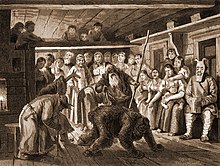
In Novgorod, from the second day of Christmas time ( Epistles ) to Epiphany, the dressed up go around the city to those houses where candles are lit on the windows as an invitation and amuse the hosts with jokes, satirical performances, songs and dances. In Tikhvin at Svyatki, a large boat is made, which is put on several sledges, and a lot of horses are carried along the streets, on which the "hooters" are riding. In the boat are mummers in masks ("holy men") with multi-colored flags, which are called okrutniki, magicians, waders, goldfinches . During the trip, they sing, play various instruments, joke. They are accompanied by many people, wealthy citizens treat them with wine and food [21] .
In the Pskov province (in Toropets ), girls bought a widow from Svyatki, put benches to the ceiling in the form of an amphitheater, in the middle they hung a huge lamp with many candles, made of colored paper and decorated with colorful ribbons. On the sides they put benches for guys. When all the places in the amphitheater are occupied by girls, they open the gates and let the guys in, and each guest is greeted with songs with a refrain:
Danube, Danube, perennial!
And with your lover!
Guests pay for this - fees go to the mistress of the hut. Married men are not allowed on Toropetsky Saturdays [22] .
The Glow Period
In many Slavic traditions, Christmas time was divided into two halves - before the New Year and after. The first week of Christmas time was often considered more significant, during which time prohibitions and regulations were strictly observed. If the entire holy season in eastern Polesie was called holy evenings , then the first week - great saints . Sometimes only the first week was considered “holy”: “The Holy Weeks are before the New Year, and after the New Year's Eve, the Holy Weeks” (cf. also Ukrainian, holy day ). In Polesie for two weeks the Christmas time could be called Parshy svichki and Other svichki (Brest.), Respectively . In the Russian North, the first week of Christmas time was called holy evenings , and the second - terrible evenings . Among the Russians of Udmurtia, they were also called rye blossoms and spring blossoms , respectively , which actualized parallelism with the summer green cristmas , during which earing and flowering of cereals took place [8] . At the same time, Christmas time is perceived as a single cycle, as evidenced not only by the composition of the rites and their mythological content, but also by a common terminology, for example: Persha Kutia 'Christmas Eve', Friend or Middle Kutia 'New Years Eve', Trety or Last Kutia ' eve of Baptism '(woodland); Wed also: “We had Three Carols. Kolyada was the first before the seventh of January - Rozhstvianskaya. And the other Kolyada was called fatty, and the third Kolyada was called hungry ” [5] .
The exile of Christmas time
The rites of the “exile of Christmas time” (kutya, carols), dedicated to Baptism, are widespread among the Western and Eastern Slavs. In Ukraine, the burning of Christmas straw or garbage accumulated during the Christmas time on New Year's Eve was called felling or felling . In the Nizhny Novgorod region in the Epiphany Eve they lit a sheaf of straw and drove it on a sled in the village shouting: “Mitrofanushka is burning!”; it was called "accompanying the Christmas time" [23] .
Proverbs and sayings
- Only Christians are married to Christmas time [24] .
- From Christmas to Baptism, hunting animals and birds is a sin - misfortune will happen to a hunter [25] .
- One kutya for people, another for cattle , and a third for harvest ( woodland Adná kuttya for people, and another for thinness, and a third for fence ) [26] .
- Christmas time passed, it’s a pity to leave, Olive came to ride (Voronezh.) [27] .
- Wet Christmas time - a little crop (half. Silesian. ) [28] .
- Clear Christmas time - full barns (half. Silesian.) [28] .
See also
- Marching
- Ritual atrocities
- Divine Fortune Telling
- Obscene Songs
- Snowstorm (dance)
- Holy evil spirits
- Bright week in the Slavic tradition
- The Marriage of Tereshka is a ceremonial Belarusian game
- Carols
- Vasilyev evening
- Generous evening
- Epiphany evening
- Shorykyol
Notes
- ↑ A. Strakhov. The Night Before Christmas: Popular Christianity and Christmas Rituals in the West and among the Slavs. Cambridge-Mass., 2003.S. 242.
- ↑ Nikiforov, 2006 , p. 596.
- ↑ Perevezentsev, 2001 , p. 182.
- ↑ Kimeeva T. I., Glushkova P. V. The reified components of the holy calendar rite of Russians as an object of intangible cultural heritage // Bulletin of the Kemerovo State University of Culture and Arts - Kemerovo, 2015
- ↑ 1 2 Vinogradova, Plotnikova, 2009 , p. 584.
- ↑ Chernykh, 1999 , p. 557.
- ↑ Balmont K.D. Red Hearts
- ↑ 1 2 Starodubtseva, 2001 , p. nineteen.
- ↑ Snegiryov, 1838 , p. 33.
- ↑ 1 2 Snegiryov, 1838 , p. 34.
- ↑ 1 2 Gantskaya et al., 1973 , p. 208.
- ↑ Vinogradova, Plotnikova, 2009 , p. 585.
- ↑ Kabakova, 1995 , p. 428.
- ↑ Tolstoy, 1978 , p. 114.
- ↑ Plotnikova, 2004 , p. 254.
- ↑ Code of Laws XIV. - Part 4. - S. 33—34. See: prot. G. S. Debolsky . Days of worship of the Orthodox Catholic Eastern Church. - T. 1. - St. Petersburg. , 1882.
- ↑ Manukovskaya, 2012 , p. 95.
- ↑ Korneeva, 2007 , p. 114.
- ↑ Tereshchenko, 1999 .
- ↑ Myachin, 2004 , p. 557.
- ↑ Snegiryov, 1838 , p. 33–34.
- ↑ Snegiryov, 1838 , p. 34–35.
- ↑ Vinogradova, Plotnikova, 2009 , p. 588.
- ↑ EFRK, 1996 , p. 72.
- ↑ Voskoboinikov, Gol, 1997 , p. 35.
- ↑ Tolstaya, 2005 , p. 133.
- ↑ Puhova, Christ, 2005 , p. 44.
- ↑ 1 2 Vinogradova, Plotnikova, 2009 , p. 587.
Literature
- Christmas time / Vinogradova L.N., Plotnikova A.A. // Slavic antiquities : Ethnolinguistic dictionary: in 5 volumes / under the general. ed. N. I. Tolstoy ; Institute of Slavic Studies RAS . - M .: Int. Relations , 2009. - T. 4: P (Crossing the water) - C (Sieve). - S. 584-589. - ISBN 5-7133-0703-4 , 978-5-7133-1312-8.
- Gantskaya O.A., Grazianskaya N.N., Tokarev S.A. Western Slavs // Calendar Customs and Rites in the Countries of Foreign Europe . Winter holidays. - M .: Nauka, 1973. - S. 204–234 .
- Wolf days / Kabakova G.I. // Slavic antiquities : Ethnolinguistic dictionary: in 5 volumes / under the general. ed. N. I. Tolstoy ; Institute of Slavic Studies RAS . - M .: Int. Relations , 1995. - T. 1: A (August) - G (Goose). - S. 109–111. - ISBN 5-7133-0704-2 .
- Calendar customs and rituals of peasants of the Voronezh province at the beginning of the XX century // Scientific reports of Belgorod State University. - Belgorod: BelSU, 2007. - T. 4 , No. 8 . - S. 114–120 . - ISSN 1990-5327 .
- Calendar ceremonies and ritual poetry of the Voronezh region . Afanasyevsky collection. Materials and research. - Vol. III / Comp.: T.F. Pukhov, G.P. Hristov. - Voronezh: Publishing House of the Voronezh State University, 2005.
- Maksimov S.V. Christmas time // Unclean, unknown, and the cross power . - SPb. : Partnership R. Golike and A. Vilvorg, 1903. - 529 p.
- Manukovskaya T.V. Image of St. Nicholas the Wonderworker in spiritual verses and life // Afanasyevsky collection. Materials and research. Issue XII. Popular culture today and the problems of its study. Digest of articles. Materials of the 2012 regional scientific conference . - Voronezh: Voronezh State University, 2012. - P. 91–98 .
- World of Russian Culture / Scientific. ed. A.N. Myachin. - M .: Veche, 2004 .-- 608 p. - ISBN 5-9533021-2-6 .
- Perevezentsev S. V. Dual Belief // Great School Encyclopedia “Russika”. History of Russia IX — XVII centuries / scientific. ed. V.M. Karev , E.I. Kuksina , S.V. Perevezentsev . - M .: Olma-press , 2001 .-- S. 181-182. - (Russika). - 5,000 copies. - ISBN 5-224-01258-9 .
- Plotnikova A.A. Ethnolinguistic geography of South Slavia . - M .: Indrik, 2004 .-- 768 p. - ISBN 5-85759-287-9 .
- Snegirev I. Russian folk holidays and superstitious rites. (Issue 2). - M .: University Printing House, 1838. - 142 p.
- Starodubtseva S.V. Russian round dance tradition of the Kama-Vyatka interfluve / Scientific. ed. T. G. Vladykina . - Izhevsk: UdMIIAL , 2001 .-- 419 p. - ISBN 5-85759-287-9 .
- Tereshchenko A. V. Genesis of the Russian people: fun, games, round dances place = M. . - Russian book, 1999 .-- 245 p.
- Tolstaya S. M. Polessky folk calendar. - M .: Indrik , 2005 .-- 600 p. - ( Traditional spiritual culture of the Slavs . Modern research). - ISBN 5-85759-300-X .
- Tolstoy N.I. and S.M. Notes on Slavic paganism. 2. The cause of rain in Polesie // Slavic and Balkan folklore: Genesis. Archaic. Traditions / Resp. Editor I. M. Sheptunov. - M .: Nauka, 1978. - S. 95–130 .
- Chernykh P. Ya. Historical and etymological dictionary of the modern Russian language. - M .: Russian language, 1999. - ISBN 5-200-02684-9 .
- Encyclopedia of Russian Holidays / Comp. V. Voskoboinikov, N. Gol. - SPb. : Respex, 1997 .-- 448 p. - (Great Russia). - ISBN 5-7345-0094-1 .
- Ethnography and Folklore of the Ryazan Territory: Materials of the Russian Scientific Conference on the Centenary of the Birth of N.I. Lebedeva: 1st Lebedev readings, December 6-8, 1994 - Ryazan, 1996 .-- 216 p.
- Paganism of the ancient Slavs // Russia: Illustrated Encyclopedia / Edited by K. and. n Yu.A. Nikiforov. - M .: OLMA Media Group, Olma-press Education, 2006. - S. 595–596 . - ISBN 5-373-00239-9 .
Links
- Christmas time // Russian Ethnographic Museum
- Fortune telling . The lifestyle of the Russian people . Folklore .
- Kolyady (Kalyady) (inaccessible link) . On the official website of “Belarusians of Ugra” . Archived on April 7, 2013.
- Anuchina T. Kholmogorskiye roe . Press of the Arkhangelsk region (2003-1-5).
- About the holy divination and signs