Vaccinium ( lat.Vaccínium ) - a genus of evergreen and deciduous shrubs , shrubs and shrubs (occasionally trees , vines )Heather family ( Ericaceae ) . Most species come from the Northern Hemisphere , but some species are also found in the Southern Hemisphere. . In Russian-language literature, various Russian names are used for this genus, including “blueberries” and “berry” .
| Vaccine | |||||||||||||||||||||||
|---|---|---|---|---|---|---|---|---|---|---|---|---|---|---|---|---|---|---|---|---|---|---|---|
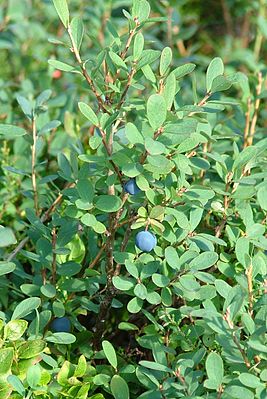 Blueberry ( Vaccinium uliginosum ) | |||||||||||||||||||||||
| Scientific classification | |||||||||||||||||||||||
| |||||||||||||||||||||||
| International scientific name | |||||||||||||||||||||||
Vaccinium L. , 1753 | |||||||||||||||||||||||
| Type view | |||||||||||||||||||||||
Vaccinium uliginosum L. , 1753 [2] [3] | |||||||||||||||||||||||
| Subgenuses, sections, types | |||||||||||||||||||||||
| |||||||||||||||||||||||
Content
- 1 Name
- 2 Distribution
- 3 Biological Description
- 4 Chemical composition
- 5 Application
- 5.1 Cooking
- 5.2 Medical use
- 5.3 Cultivation
- 5.3.1 Industrial gardening
- 5.3.2 Amateur gardening
- 5.3.3 Agricultural technology
- 6 Classification
- 6.1 Taxonomic position
- 6.2 Subgenus and sections
- 7 Views
- 7.1 Subgenus Cranberries
- 7.2 Subgenus Vaccinium
- 8 Notes
- 9 Literature
- 10 Links
This genus includes many plants that are interesting and useful for humans - lingonberries , tall blueberries, common blueberries , cranberries , redberries , blueberries : the berries of these species are edible and have a number of valuable properties . Some species are cultivated for edible berries, including on an industrial scale (first of all, this refers to large-fruited cranberries and tall blueberries ) . Other parts of plants are used for medical purposes - for example, leaves of lingonberry and blueberry . Some plants find application in decorative gardening .
Title
The scientific name of the genus is taken from classical Latin : in Pliny the Elder, the word vaccinium is found as the name of the plant ("type of berry"; perhaps it was blueberries ; Latin bacca - berry ) [4] . Occasionally, a version is given that the name Vaccinium comes from the Latin word vacca - cow ( vaccinus - cow) and is explained by the beneficial properties of berries, comparable to the benefits of a cow on the farm [5] .
There are several Russian names of this kind in the literature: by transliteration of the scientific name - vaccinium [6] [7] ; as a translation of the scientific name - berry [8] ; according to Russian names of the most famous species of this genus ( lingonberries , blueberries and blueberries ) - lingonberries , lingonberries [9] , blueberries , blueberries [10] , blueberries , cranberries .
The synonymy of vaccinium includes the following names [11] :
- Hornemannia Vahl (1810)
- Hugeria Small (1903)
- Neojunghuhnia Koord. (1909)
- Oxycoccus Hill (1756)
- Rigiolepis Hook.f. (1873)
1 - shoot with flowers, 2 - berries, 3 - cutaway flower, 4 - stamen (two horns typical for all heathers are visible)
Distribution
The natural range of the vast majority of species is regions with a cold and temperate climate of the Northern Hemisphere ; There are species that grow in the Andes , as well as tropical species common in the Hawaiian Islands , Madagascar , and South Africa .
The plants representing this genus grow mostly in open spaces or in light forests , prefer acidic soils . Some species have adapted to life on sphagnum bogs: for example, common blueberry , representatives of the Cranberry subgenus . Some types of vaccinium form continuous thickets: for example, common blueberries in the subalpine zone of the Carpathians , cranberries in sphagnum bogs [12] .
Biological Description
Representatives of the genus are usually shrubs or shrubs , occasionally small trees . There are also unusual life forms: for example, laurel blueberry ( Vaccinium laurifolium ) is a semi - epiphyte - this species begins its development as an epiphyte , but when the drooping roots reach the surface, the plant begins to grow like an ordinary ground plant and reaches a height of 5 m, leaning against it trunk to the tree on which it began to grow.
The rhizome is usually long, cord-like, with numerous bushes on it. In ordinary blueberries, the rhizome has a length of up to 3 m, in some types of vaccinium the length of the rhizome reaches 10 m. Like other heather, the vaccinium is characterized by mycorrhiza - mutually beneficial coexistence of plant roots with fungal mycelium [13] .
Shoots or erect, or creeping.
Leaves can fall both in winter and winter; edges with even edges, and with serrated; the adaxial (upper) side of the leaf is bright green, the abaxial (lower) side is of different colors, from bright green to white. At a young age, the leaves are sometimes red, in the fall in some species also red (for example, tall blueberries ); often leathery [8] [14] . In some species, the leaves coagulate when a dry period occurs: in particular, lingonberries have this property [13] .
Double perianth flowers . Corolla to a greater or lesser extent spontaneous, in species from the subgenus, the vaccine has a bell-shaped ( goblet , barrel-shaped ) form; in species from the subgenus Cranberry, a fully developed flower resembles a cyclamen flower ( Cyclamen ): its petals are bent backward. The color of the petals is from white to bright red. Flowers are often four-membered, less often five-membered (despite the fact that in most heather flowers are five-membered). The number of stamens is twice as many as the shares of the corolla [4] . Stamens are free, two-nosed; like other heathers, with two "horns"; opened by pores; pollen grains are connected in four [9] [13] . The flowers are bisexual, but sometimes the phenomenon of functional same-sex behavior is observed. For example, common bilberry is characterized by a weak proterandria (the maturation of androecium before gynoecium ) [13] . Lower ovary [15] .
Flower formula : [16] .
Pollination occurs with the help of insects . The stamens are equipped with appendages that look like horns; when they visit a flower with insects, the appendages serve as levers by which the insects themselves pour pollen on themselves. Fruits are formed in the case of the impossibility of cross-pollination, but only if the flowers are shaken; in nature, shaking occurs with the help of wind, therefore, in places protected from the wind by surrounding plants, there are usually fewer blueberries and blueberries [13] .
The fruit is a juicy berry . The color of ripe berries is either red or blue (various shades, from bluish to dark blue, almost black). Representatives of the genus are characterized by endozohoria - a method of seed distribution in which animals ( birds and mammals ) eat the whole fruit, and the seeds inside them, passing through the digestive tract , come out intact along with excrement [13] .
Types of vaccinium are the first link in many food chains , in particular, they are food plants for caterpillars of many species of butterflies [17] .
Chemical Composition
The chemical composition is well studied primarily in those types of vaccinium that are actively used for medicinal purposes. One of the most medically important components is glycoside arbutin , a urinary tract antiseptic : in the body, it breaks down into sugar and hydroquinone , which has bactericidal properties . Arbutin was found in lingonberry and blueberry leaves (in lingonberry - up to 9%), in lingonberry berries [18] [19] . Arbutin (vaccine) explains the bitter taste of cranberries and cranberries [20] .
Ascorbic acid (up to 250 mg% in blueberries), tannins , flavonoids , triterpene compounds , and quinic acid were found in the leaves of lingonberry and blueberry [18] .
Sugars , citric , ascorbic (found in lingonberries - up to 17 mg%) and other acids, glycosides were found in cranberries, cranberries and blueberries. Lingonberry and cranberry berries contain antiseptic benzoic acid , but it is absent in the blueberry fruit [18] , this explains the fact that lingonberry and cranberry berries, unlike blueberries, can be stored in a soaked form for a long time without adding any preservatives.
Blueberries are noteworthy because they occupy first place among all fruits and berries in terms of manganese content [18] .
On the left photo: fruits of plants from the genus Vaccinium - cranberries , small-leaved blueberries , blueberries , lingonberries (clockwise, starting from the upper right corner). In the center and to the right are the fruits of tall blueberries . | ||||||||||
Application
Cooking Use
The berries of so many types of vaccinium are edible both in raw and in processed form; from them prepare jams , jams , jellies , syrups , fruit drinks , extracts , jelly , as well as wine [18] .
Cranberries, blueberries and lingonberries are part of the classic Russian dishes and drinks , including sbiten and jelly .
Finnish meat dishes are characterized by the use of lingonberry jam, lingonberry jelly or soaked berries (cranberries, lingonberries) as a sauce or side dish for meat and game dishes; with soaked lingonberries, one of the traditional Finnish dishes is also served - cereal sausages (from rice and pearl barley ) [21] .
Cranberry jam, which Americans call cranberry sauce, is traditionally served in the USA with Thanksgiving turkey meat .
Lingonberry and cranberry leaves can be used instead of tea [18] .
Cranberries and blueberries are used in the food industry , and cranberries are also used in distillery [18] .
Medical use
The most famous medicinal plants of the Vaccinium genus are blueberries and lingonberries .
Bilberry in scientific medicine is used as an astringent, blueberry shoots are part of the anti-diabetic collection . Blueberries are used as a source of vitamins necessary for normal eye function.
Lingonberries use leaves in scientific medicine - their decoction and infusion are used as a disinfectant and diuretic . Due to the fact that arbutin (a urinary tract antiseptic ) was found in lingonberries, an extract from dry leaves is used to treat urinary tract disorders (but if the dosage is incorrect, such an extract can cause poisoning) [19] .
Cultivation
Industrial gardening
Some types of vaccinium are grown on an industrial scale on special plantations .
The cultivation of plants from the genus vaccinium began with large-cranberry ( Vaccinium macrocarpon ) in the early XIX century in the United States and Canada . Currently, in these countries, large areas are occupied by industrial plantations of this type. Over the years, more than two hundred varieties have been bred. The maximum yield of cranberry plantations is 220 kg / ha, the average - 180 kg / ha [22] . The peculiarity of large-fruited cranberries, grown in large quantities in the USA and Canada, is that its fruits have air chambers, so this is one of the few berries floating on the surface of the water. This makes picking a berry significantly less time-consuming than conventional manual picking: at the end of the season, checks with ripe berries are filled with water and special harvesters are added that beat this water, while ripe berries come off. After that, all berries are driven to one edge of the check, where it - clean and washed - is scooped out for further processing [23] .
Since the 1960s, lingonberries ( Vaccinium vitis-idaea ) have also been introduced into the culture; First of all, breeding of this species was carried out in Sweden , Finland , Germany and the Netherlands . The approximate productivity of industrial plantations is 70 kg / ha [22] .
Another species widely cultivated on an industrial scale (primarily in the USA) is tall blueberries ( Vaccinium corymbosum ). Currently, its plantations are available in the USA , Western Europe , Australia and New Zealand [22] . The global harvest of tall blueberries is approximately 50 thousand tons per year [20] . There are also plantations of narrow-leaved blueberries ( Vaccinium angustifolium ).
Amateur gardening
In addition to cranberries, lingonberries and tall blueberries (primarily in Russia ), ordinary or marsh ( Vaccinium uliginosum ) is also used as berry crops in amateur gardening. In yield, this species is significantly inferior to tall blueberries (the yield of ordinary blueberries is up to 1 kg from a bush versus 3 kg from a bush in tall blueberries in the Moscow Region and up to 10 kg from a bush in the homeland of tall blueberries, in North America ), but significantly exceeds it in frost resistance [22] .
Some vacciniums are grown as ornamental plants , first of all, this refers to undersized, flowering shrubs, which are planted in rockeries and rock gardens : monetum vaccinium ( Vaccinium nummularia ) and lingonberry ( Vaccinium vitis-idaea ). Relatively tall decorative species are also found in gardens - tall blueberries ( Vaccinium corymbosum ) up to 1.8 m high, cylindrical vaccines ( Vaccinium cylindraceum ) up to 3 m high, and tree-like vaccines ( Vaccinium arboreum ) [8] .
Agricultural Engineering
Plants of the genus Vaccinium, as well as other heather, for successful growth require a drained acidic soil that retains moisture well and has good breathability. In culture, vacciniums are propagated by seeds , as well as semi-lignified cuttings . Dry and thickened branches are cut at the end of winter [14] [22] .
Classification
Taxonomic position
Previously, the genus Vaccinium was isolated into a separate family of Vacciniaceae, or Cowberry ( Vacciniaceae ), substantiating this primarily by the fact that in plants of this genus, unlike other heather, the ovary is not upper , but lower [12] .
Now the genus Vaccinium, as well as more than thirty genera, is included in the tribe Vaccinium ( Vaccinieae ) of the subfamily Vaccinium, or Lingonberry ( Vaccinioideae ) of the Heather family ( Ericaceae ) [11] :
- Taxonomic scheme
| Flowering or Angiosperms department (classification according to APG II System ) | ||||||||||||||||||||||
| heather flowers order | another 44 orders of flowering plants, of which Geranium , Kizilotsvetnye , Krossosomotsvetnye and Myrtotsvetnye are closest to heathers | |||||||||||||||||||||
| heather family | 25 more families, including Actinidium , Balsamic , Primrose , Sapot , Tea and Ebony | |||||||||||||||||||||
| subfamily Vaccinioideae ( Vaccinioideae ) | ещё семь подсемейств: Арбутусовые (роды Земляничное дерево , Толокнянка …), Кассиопеевые ( Кассиопея ), Подъельниковые ( Аллотропа , Грушанка , Зимолюбка , Одноцветка , Ортилия , Подъельник …), Стифелиевые ( Змеелистник , Прионотес , Ричея , Эпакрис …), Хариманелловые ( Хариманелла …), Энкиантовые ( Энкиантус …), Эриковые ( Вереск , Водяника , Рододендрон , Эрика …) | |||||||||||||||||||||
| триба Вакциниевые ( Vaccinieae ) | ещё четыре трибы, в том числе Гаультериевые ( Гаультерия , Хамедафне …), Лиониевые ( Пиерис …), Подбеловые ( Зеновия и Подбел ) | |||||||||||||||||||||
| род Вакциниум | ещё более 30 родов, в том числе Агапетес , Кавендишия | |||||||||||||||||||||
| два подрода с общим числом видов более двухсот; среди них: брусника , голубика , клюква , красника , черника | ||||||||||||||||||||||
Таксономия рода находится в стадии разработки. К примеру, в результате генетических исследований обнаружено, что значительное число азиатских видов, которые сейчас включены в род Вакциниум, находятся намного ближе к видам рода Агапетес ( Agapetes ), чем к другим видам рода Вакциниум [24] [25] .
Подроды и секции
Род Вакциниум делится на два подрода — Клюква (subgen. Oxycoccus ) и подрод собственно Вакциниум (subgen. Vaccinium ) . К первому подроду относятся всего несколько видов , все остальные виды относятся ко второму подроду.
Список подродов и секций [11] .
- Subg. Oxycoccus
- Sect. Oxycoccus (виды Vaccinium macrocarpon , Vaccinium oxycoccus …)
- Sect. Oxycoccoides ( Vaccinium erythrocarpum )
- Subg. Vaccinium
- Sect. Batodendron ( Vaccinium arboreum …)
- Sect. Brachyceratium
- Sect. Bracteata ( Vaccinium laurifolium …)
- Sect. Calcicolus ( Vaccinium glaucoalbum …)
- Sect. Ciliata
- Sect. Cinctosandra
- Sect. Conchophyllum ( Vaccinium nummularia …)
- Sect. Cyanococcus ( Vaccinium angustifolium , Vaccinium corymbosum …)
- Sect. Eococcus
- Sect. Epigynium ( Vaccinium vacciniaceum …)
- Sect. Galeopetalum
- Sect. Hemimyrtillus ( Vaccinium arctostaphylos , Vaccinium cylindraceum , Vaccinium padifolium …)
- Sect. Myrtillus ( Vaccinium myrtillus , Vaccinium parvifolium , Vaccinium praestans …)
- Sect. Neurodesia
- Sect. Oarianthe
- Sect. Oreades
- Sect. Pachyanthum
- Sect. Polycodium ( Vaccinium stamineum …)
- Sect. Pyxothamnus ( Vaccinium ovatum …)
- Sect. Vaccinium ( Vaccinium uliginosum typus …)
- Sect. Vitis-idaea ( Vaccinium vitis-idaea …)
Виды
Vaccinium macrocarpon — Клюква крупноплодная |
Vaccinium oxycoccus — Клюква обыкновенная |
По информации базы данных The Plant List (2013), род включает 223 вида [26] .
Род, согласно современным представлениям, делится на два подрода — Клюква ( Oxycoccus ) и собственно Вакциниум (Vaccinium) .
Подрод Клюква
Подрод Клюква ( Vaccinium subgen. Oxycoccus ) — растения с гибкими ползучими недеревенеющими побегами ; цветки — с отогнутыми лепестками. Ранее этот подрод обычно рассматривался как самостоятельный род Oxycoccus Hill (1756) .
- Vaccinium macrocarpon Aiton (1789) — Клюква крупноплодная , или Клюква американская . [ syn. Oxycoccus macrocarpos ( Aiton ) Pers. (1805) ]. Стелющееся растение из Северной Америки , которое выращивают в коммерческих целях ради относительно крупных красных плодов [8] .
- Vaccinium oxycoccos L. (1753) — Клюква обыкновенная . [ syn. Oxycoccus palustris Pers. (1805) — Клюква обыкновенная, или Клюква болотная]. [ syn. Oxycoccus quadripetalus Gilib. (1782) — Клюква четырёхлепестная]. Евразийский вид. Стелющиеся кустарнички с тонкими стеблями, мелкими, снизу белыми листьями, четырёхраздельным венчиком и съедобными тёмно-красными ягодами. Иногда растения этого вида образуют обширные заросли на сфагновых и торфяных болотах [9] [13] . Ягоды собирают для использования в переработанном виде.
- Vaccinium microcarpum ( Turcz. ex Rupr. ) Schmalh. (1871) — Клюква мелкоплодная [ syn. Oxycoccus microcarpus Turcz. ex Rupr. (1845) ]. Евразийский вид с более мелкими, чем у клюквы обыкновенной, листьями и плодами [15] . Название Vaccinium microcarpum ( Turcz. ex Rupr. ) Schmalh. (1871) в международных ботанических базах данных нередко входит в синонимику вида Vaccinium oxycoccos L. (1753) [27] , но в русскоязычной ботанической литературе этот вид до настоящего времени (2009 год) рассматривается как самостоятельный [9] .
- Vaccinium erythrocarpum Michx. (1803) — Вакциниум красноплодный . [ syn. Oxycoccus erythrocarpus Pers. (1805) ]. Вид, распространённый в горах на юго-востоке США , а также в Восточной Азии . Английские названия растения — southern mountain cranberry («южная горная клюква»), bearberry («медвежья ягода») и arando . Кустарник высотой до полутора метров, растущий в затенённых местах; ягоды тёмно-красные, прозрачные, с очень приятным запахом, съедобные, используются в сыром и переработанном виде [28] .
Подрод Вакциниум
Vaccinium vitis-idaea — Брусника |
Vaccinium uliginosum — Голубика |
Vaccinium myrtillus — Черника |
Подрод Вакциниум ( Vaccinium subgen. Vaccinium ) — все прочие виды; побеги тонкие, прямостоячие, деревенеющие, с колокольчатыми цветами. Некоторые из них:
- Vaccinium angustifolium Aiton (1789) — Голубика узколистная . Листопадный кустарник из США и Канады . Высотой и шириной до 60 см. Ветви красноватые; листья супротивные, ланцетные, по краям мелкопильчатые, до 2 см длиной. Цветки белые, плоды голубовато-чёрные, диаметром до 1,5 см.
- Vaccinium arboreum Marshall (1785) — Вакциниум древовидный . Листопадный или полувечнозелёный кустарник, иногда вырастающий до размера небольшого дерева . Встречается в США и Канаде . Листья длиной до 5 см, снизу опушённые. Ягоды для человека несъедобны; поедаются птицами [8] .
- Vaccinium arctostaphylos L. (1753) — Черника кавказская . Листопадный кустарник или небольшое дерево высотой до 3 м со съедобными плодами. Растёт на Кавказе , в Иране , Турции , Болгарии . Единственный из третичных реликтовых видов , произрастающих на территории бывшего СССР [13] .
- Vaccinium corymbosum L. (1753) — Голубика высокорослая , или Вакциниум щитковый , или Ягодник щитковый . Листопадный вид из Северной Америки высотой до 2 м с бледно-розовыми цветками. Растение выращивают ради чёрно-синих съедобных плодов диаметром до 2,5 см (урожайность — до 10 кг с куста), причём не только на приусадебных участках, но и на промышленных плантациях. Осенью листья становятся красными. Имеется большое число культурных сортов [8] [14] .
- Vaccinium cylindraceum Sm. (1817) - The vaccine is cylindrical , or the buttock is cylindrical . Evergreen shrub up to 3 m high originally from the Azores . Flower buds are red, flowers are pale yellowish-green. The berries are blue-black, cylindrical [8] [14] .
- Vaccinium glaucoalbum Hook.f. ex CBClarke (1882) - The vaccine is bluish-white , or the Berry is bluish-white . Evergreen shrub native to the Himalayas up to 1.5 m high. The leaves are large oval-pointed, green above, white below with a bluish tint (hence the name). The flowers are white-pink, berries are black, edible [8] .
- Vaccinium laurifolium Miq. (1859) - Blueberry laurel leaf . Half epiphyte . The leaves are almost opposite, leathery, rusty, glandular, elliptical at the edges. The flowers are small, green, without petals . Fruits are rounded, dark red [13] . It is found in Indonesia and Malaysia .
- Vaccinium myrtillus L. (1753) - Blueberries , or Blueberries , or Blueberries myrtle . Deciduous shrub up to 60 cm high with a green stem that woods only below, single flowers with a five-toothed rim of white, pink or red color and edible fruits of blue-black color; the plant is widespread both in Eurasia and in North America ; grows in coniferous and mixed forests, in the tundra and highlands. Berries are harvested for use in raw and processed form. Berries and leaves are used in medicine [8] [9] [13] .
- Vaccinium nummularia Hook.f. & Thomson ex CBClarke (1882) - Monetized vaccine . Evergreen shrub up to 30 cm high with spiny brown stems and small rounded spiny leaves; hailing from the Himalayas . Sometimes grown in rock gardens [14] .
- Vaccinium ovatum Pursh (1814) - Ovoid vaccine , or Oval-shaped vaccine , or Gluteus ovate . Evergreen dense shrub growing in the western United States and Canada ; up to 4 m high and up to 3 m wide. The leaves are oval, at a young age of bronze color. The flowers are white or pink; berries are red, then blue-black, edible. The plant is highly valued by florists , since in cut form it can stand for a long time in water (for this reason, the plant was almost exterminated in nature) [8] .
- Vaccinium padifolium Sm. (1817) - Blueberry cherubus . Tertiary relict species close to Caucasian blueberries ; found on the island of Madeira [13] .
- Vaccinium parvifolium Sm. (1817) - Small-leaved vaccine , or Small-leaved Blueberry . Bushes up to four meters high with red berries, because of which the plant is also called "red blueberries". The species range is the Pacific coast of North America from Alaska to California .
- Vaccinium praestans Lamb. (1811) - Krasnika , or Vaccinium superior . Shrub growing in the Far East , in Japan . The stalk is almost horizontal; it rises from the moss by no more than 10 cm; leaves up to 6 cm long, with spines. The flowers are pale yellow; red berries, up to 1 cm in diameter; juice from them is used as a medicine.
- Vaccinium reticulatum - Reticulated vaccine . Small deciduous shrub, endemic to the Hawaiian Islands ; It is found in high mountain regions at an altitude of up to 3700 m, and is widespread on the islands of Maui and Hawaii . The berries are edible, used by the local population.
- Vaccinium stamineum L. (1753) - Blueberry stamen . A plant from North America up to one meter high; reddish berries. The English common name for the plant is deerberry (deer berry). It is found in Mexico , the USA and Canada .
- Vaccinium uliginosum L. (1753) typus - Blueberry , or Common Blueberry , or Marsh Blueberry , or Marsh Blueberry , or Undersized Blueberry . Frost-resistant deciduous shrub up to one meter high with a stem, which, unlike blueberries, woods almost to the top. It is found in all regions of the Northern Hemisphere with a temperate and cold climate. Leaves up to 3 cm long, flowers with a five-toothed white or pinkish corolla, blue fruits, with a bluish bloom, up to 1.2 cm long, edible. One bush can live up to a hundred years [9] [13] . Berries are harvested for use in raw and processed form.
- Vaccinium vacciniaceum ( Roxb. ) Sleumer (1941) - Dissected vaccine . Epiphytic evergreen shrub up to half a meter in height from the Himalayas, India , Nepal . Leaves up to 5 cm long, narrow, serrated. In inflorescences - up to twenty flowers.
- Vaccinium vitis-idaea L. (1753) - Lingonberry , or Lingonberry vulgaris . Shrub up to 40 cm high; widespread in the forest zone and tundra of the Northern Hemisphere . Leaves are brilliant, with the edges bent down; four-toothed corolla; fruits are red, edible, with high palatability; berries and leaves are used in medicine. Unlike many other European vaccinium species, lingonberry is an evergreen plant [8] [9] [13] . Berries are harvested for use in raw and processed form.
Notes
- ↑ For the conventionality of specifying the class of dicotyledons as a superior taxon for the plant group described in this article, see the APG Systems section of the Dicotyledonous article .
- ↑ Vaccinium genus data in the Index Nominum Genericorum database of the International Association for Plant Taxonomy (IAPT) .
- ↑ In the publication Flora of the European part of the USSR ... (see the Literature section), the species Vaccinium myrtillus L. (1753) is indicated as the nomenclature type, for more details, see Information on the genus Vaccinium (English) in the Index Nominum Genericorum database of the International Plant Taxonomy Association (IAPT) .
- ↑ 1 2 Flora of the USSR, 1952 .
- ↑ Animals and plants. Illustrated Encyclopedic Dictionary. - M .: Eksmo, 2007. - S. 152-153, 297-298, 577-578, 1225. - 1248 p. - 5,000 (additional, circulation) copies. - ISBN 5-699-17445-1 .
- ↑ Mayevsky P.F. Flora of the middle zone of the European part of Russia. - 10th revised and supplemented edition. - M .: Partnership of scientific publications of KMK, 2006. - S. 404-405. - 600 s. - 5,000 copies. - ISBN 5-87317-321-5 .
- ↑ Novikov V.S. Popular atlas-determinant. Wild plants / V. S. Novikov, I. A. Gubanov. - 5th ed., Stereotype. - M .: Bustard, 2008 .-- S. 304. - 415 p. - (A popular atlas identifier). - 5,000 copies. - ISBN 978-5-358-05146-1 .
- ↑ 1 2 3 4 5 6 7 8 9 10 11 Botany. Encyclopedia, 2006 .
- ↑ 1 2 3 4 5 6 7 Illustrated Key to Plants of the Leningrad Region / Ed. A. L. Budantseva and G. P. Yakovleva . - M .: Partnership of scientific publications of KMK, 2006. - S. 178-181. - 799 p. - 700 copies. - ISBN 5-87317-260-9 .
- ↑ Flora of the European part of the USSR ... (see. Literature section).
- ↑ 1 2 3 According to the GRIN website (see the Links section)
- ↑ 1 2 Elenevsky A.G. Botany. Systematics of higher, or terrestrial, plants: textbook. for stud. higher ped textbook. Institutions / A. G. Elenevsky, M. P. Solovyov, V. N. Tikhomirov. - Ed. 4th, rev. - M .: Academy, 2006. - S. 346—349. - 3000 copies. - ISBN 5-7695-2141-4 .
- ↑ 1 2 3 4 5 6 7 8 9 10 11 12 13 Kozhevnikov, 1981 .
- ↑ 1 2 3 4 5 Hession D. G. All about decorative flowering shrubs = The flowering shrub expert / Per. from English O. I. Romanova. - Ed. 2nd, corrected. - M .: Kladez Books, 2007 .-- S. 103. - 128 p. - 10,000 copies. - ISBN 978-5-93395-249-7 .
- ↑ 1 2 Gubanov I. A. Key to higher plants ... (see. Literature section).
- ↑ Andreeva I.I., Rodman L.S. Botanika. - 3rd, rev. and add. - M .: Kolos, 2005 .-- S. 410. - 528 p. - ISBN 5-9532-0114-1 .
- ↑ See the List of butterflies for which the vaccinium is a food plant ( English List of Lepidoptera that feed on Vaccinium ).
- ↑ 1 2 3 4 5 6 7 Kovaleva N. G. Treatment with plants. Essays on herbal medicine . - M .: Medicine, 1972.- 352 p. - UDC-615.322
- ↑ 1 2 Vermeilen, Nico. Useful herbs. Illustrated Encyclopedia: Per. from English B. N. Golovkina. - M .: Labyrinth Press, 2002 .-- S. 298-299. - 320 p. - ISBN 5-9287-0244-2 .
- ↑ 1 2 Shipunov A. B. Chernik // Biology: School Encyclopedia / Belyakova G. et al. - M .: BRE, 2004. - 990 p. - ISBN 5-85270-213-7 .
- ↑ Oryol A. Cuisines of Northern Europe: Finland, Holland, Norway, Sweden, Denmark. - SPb. : Nevsky Prospect, 2001 .-- S. 16-19. - 160 p. - (Modern cooking). - 15,000 copies. - ISBN 5-8378-0201-0 .
- ↑ 1 2 3 4 5 Tyurikov E. A. Lingonberry: start in a new century // Garden and garden: journal. - M. , 2000. - No. 3 (44) . - S. 30-31 .
- ↑ Cherkasov A.F. Fundamentals of technology and agricultural technology for plantation cultivation of cranberries . Archived March 4, 2016. (Retrieved May 27, 2009)
- ↑ Kathleen A. Kron, E. Ann Powell and JL Luteyn. Phylogenetic relationships within the blueberry tribe (Vaccinieae, Ericaceae) based on sequence data from MATK and nuclear ribosomal ITS regions, with comments on the placement of Satyria (Eng.) // American Journal of Botany: journal. - 2002. - Vol. 89 . - P. 327—336 . - DOI : 10.3732 / ajb.89.2.327 . (English) (Retrieved April 27, 2009)
- ↑ Vaccinium . Flora of China . Date of treatment April 27, 2009. Archived January 30, 2012.
- ↑ Vaccinium . The Plant List . Version 1.1. (2013). Date of treatment July 21, 2016.
- ↑ Vaccinium microcarpum (English) : information on the GRIN website. (Retrieved April 27, 2009)
- ↑ Vaccinium erythrocarpum on the Plants For A Future website (Retrieved June 18, 2009)
Literature
- Lingonberry // Brasos - Vesh. - M .: Soviet Encyclopedia, 1971. - (The Great Soviet Encyclopedia : [in 30 vol.] / Ch. Ed. A. M. Prokhorov ; 1969-1978, vol. 4).
- Lingonberry // Brockhaus and Efron Encyclopedic Dictionary : in 86 volumes (82 volumes and 4 additional). - SPb. , 1890-1907.
- Kozhevnikov Yu. P. Family of heather (Ericaceae) // Life of plants. In 6 t. / Ed. A. L. Takhtadzhyana . - M .: Education, 1981. - T. 5. Part 2. Flowering plants. - S. 88-95. - 512 s. - 300,000 copies.
- Vinogradova V.M. Ericaceae Juss. - Heather // Flora of the European part of the USSR / Otv. ed. An. A. Fedorov . - L .: Science. Leningrad Branch, 1981. - T. V. Volume Editor R. V. Kamelin . - S. 40-52. - 4200 copies. - UDC 582.683.2 (470.1 / 6)
- Vaccinium // Botany. Encyclopedia "All plants of the world": Per. from English = Botanica / ed. D. Grigoriev et al. - M .: Könemann, 2006 (Russian edition). - S. 911 .-- 1020 s. - ISBN 3-8331-1621-8 .
- Gubanov I.A. et al. Key to higher plants of the middle strip of the European part of the USSR: A manual for teachers / I. A. Gubanov, V. S. Novikov, V. N. Tikhomirov. - M .: Enlightenment, 1981. - S. 190—191.
- Sem. CXXIV. Lingonberry - Vacciniaceae Lindl. // Flora of the USSR : in 30 t. / Started at hand. and under chap. ed. V. L. Komarova . - M .; L .: Publishing House of the Academy of Sciences of the USSR , 1952. - T. 18 / ed. volumes B.K. Shishkin , E.G. Bobrov . - S. 93-104. - 802 s. - 3000 copies.
- Jorge B. Retamales, James F. Hancock. Blueberries - CABI, 2012 .-- 336 p. - ISBN 1845938267 . - ISBN 9781845938260
Links
- Vaccinium (English) . eFloras . Date of treatment April 27, 2009. Archived January 30, 2012.
- Vaccinium in Flora of China eFloras . Date of treatment April 27, 2009. Archived January 30, 2012.
- Search Results: Vaccinium Flora Europaea . Royal Botanic Garden Edinburgh. Date of treatment April 27, 2009. Archived January 30, 2012.
- PLANTS Profile for Vaccinium (blueberry) USDA NRCS. Date of treatment April 27, 2009. Archived January 30, 2012.