Stefan Czarniecki ( Chernetsky ; Polish. Stefan Czarniecki ; 1599 - February 16, 1665 ) - a prominent Polish military leader, the great grand crown ( 1652 ), the Kiev chestnut ( 1652 ), the elder Kovel ( 1655 ), regiment (1656), water Russian ( 1657 - 1664 ), elder Tykotsinsky ( 1659 ), governor of Kiev ( 1664 - 1665 ), hetman full crown of the Commonwealth ( 1665 ). It is considered in Poland a national hero, his name is mentioned in the national anthem . He was known for particular cruelty in the suppression of anti-Polish uprisings in Ukraine .
| Stefan Charnetskiy | |||||||
|---|---|---|---|---|---|---|---|
| Stefan czarniecki | |||||||
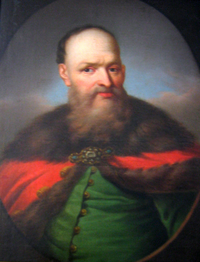 | |||||||
 coat of arms of одódзя | |||||||
| |||||||
| Predecessor | Stanislav Lyantskoronsky | ||||||
| Successor | Stanislav Jan Yablonovsky | ||||||
| |||||||
| Predecessor | Ivan Vygovsky | ||||||
| Successor | Michael Jerzy Stanislavsky | ||||||
| |||||||
| Predecessor | Jerzy Sebastian Lubomirsky | ||||||
| Successor | Jan Sobieski | ||||||
| Birth | 1599 | ||||||
| Death | February 16, 1665 Sokolovka | ||||||
| Kind | |||||||
| Father | Krishtof Charnetsky | ||||||
| Mother | Kristina Rheshovskaya | ||||||
| Spouse | Sofia Kobezhitskaya | ||||||
| Children | Alexandra Catherine Charnetskaya (wife of Jan Clementius Branicki) Constance of John Charnetskaya (wife of Vaclav Leschinsky) | ||||||
| Rank | |||||||
| Battles | |||||||


Biography
Stefan Czarnecki was born in 1599 in a poor noble family in the family estate of Czarnec near the town of Włoszczów in southern Poland. One of the ten sons of the headman of Khentsinsky and Zhivetsk Krzysztof Czarniecki and Kristina Rzeszowska.
He was trained in military affairs in the cavalry corps. Having become an officer at the age of 18, he took part in the Battle of Khotyn in 1621 , in which the Ottomans were defeated and after which the Polish-Turkish war ended . Later, Charnetskii served under the leadership of the hetman Stanislav Konetspolsky and participated in campaigns against the Crimean Tatars in 1624 , in particular in the battle of Martynov . He also gained military experience in the war with the Swedes and in the Smolensk war . In 1637, he won the Battle of Kumeykov , crushing Pavlyuk’s rebellion in Ukraine . In 1644, he, along with Stanislav Konetspolsky, fought in the battle of Akhmatov in which the Commonwealth inflicted a heavy defeat on the Crimean Tatar army under the command of the Perekop Murza Tugai Bey .
May 16, 1648 Czarnecki was among the many Polish nobles who were captured by Bogdan Khmelnitsky after the battle of Yellow Waters . He was sent in chains to the Crimea , from where he was bought for big money in 1649 . After that, he again took an active part in the battles against the Cossacks during the Khmelnitsky uprising , including in the victory battle for the Poles of Berestetskaya (1651) and in the devastating battle near Batog (1652). In the latter, he barely escaped death, hiding in a haystack and observing the reprisals of the Cossacks over several thousand Poles. As a result of this, he was always of the opinion that no compromises with the enemies of the Commonwealth were possible.
After the troops of the Swedish king Charles X invaded Poland, Charnetskiy initially commanded the defense of Krakow , but was forced to surrender the city due to lack of food. Upon the surrender of the city, the Poles were able to get the troops to leave without being captured. Czarniecki arrived in Glogowek and commanded in 1656 with the mayor Jerzy Lubomirski . On February 1, the Charnetskii division crossed the Vistula, then from the march took Sandomierz and advanced to Pulawy , but was defeated. Charnetskiy remained loyal to the king even when most of the army, the Sejm, and the hetmans joined the Swedes. He organized a guerrilla war, which proved to be a suitable and effective means against the powerful firepower and high mobility of the Swedes. Czarniecki inflicted several serious defeats on the Swedes, in particular under Yaroslav and Kozenice in 1656, but he himself was defeated by a small Swedish detachment near Chojnice . Nevertheless, the popular uprising against the Swedes organized under his leadership ended in success. Thanks to Czarnecki, King Jan II Casimir was able to return from exile and once again become the head of state.
After the Swedes left Poland and entered into an alliance with Denmark , Charnetskiy commanded an army sent to Jutland to expel the Swedes. After the signing of the Olivian peace , in which all Polish-Swedish contradictions were resolved, Charnetskiy was transferred to the eastern border of the Commonwealth, where there was a war with Russia . In 1660 he was appointed governor of the Russian (Polish position) and commanded Polish troops in the battles of Polonka [1] and on the Basse River .
At the beginning of 1661, the Polish Sejm publicly noted the merits of Charnetskiy, and King Jan II Casimir endowed him with titles and wealth.
Charnetskiy participated in the winter campaign, which was unsuccessful for the Polish side, to the Left-Bank Ukraine of 1663-1664, including the unsuccessful siege of Glukhov . After a large right-bank rebellion broke out in the rear of the Poles, he separated from part of the army from Jan II Casimir and went to suppress it. In 1664, Charnetskiy burned and sacked the Subotov farm, which had previously belonged to Bogdan Khmelnitsky. Charnetsky destroyed the tombs of Bogdan and Timosh Khmelnitsky in the Ilyinsky church , and ordered them to be thrown into the market square [2] .
Charnetsky died from a gunshot wound received during the siege of Stavische , in which, after taking, he ordered the death of all the inhabitants, regardless of gender and age. Six weeks before his death, he was bestowed the title of full crown hetman. He was buried in the family estate of Charents in the church he built.
In Fiction
- Lyudmila Ulitskaya ’s story “Queen of Spades” refers to the family of modern descendants of Czarniecki, the “fierce Polish voivode”.
- The heroic deeds of Stefan Czarnecki during the years of the struggle between the Commonwealth and the Swedish aggression are depicted in the novel “Flood” by G. Senkevich (1886) and in the film of the same name by Jerzy Hoffman (1974).
Notes
- ↑ Pamiętniki Samuela i Bogusława Kazimierza Maskiewiczów. - Wrocław, 1961.
- ↑ "Chernigov Chronicle", ed. Belozersky, p. 30.
Literature
- Charnetsky, Stefan // Brockhaus and Efron Encyclopedic Dictionary : 86 volumes (82 volumes and 4 additional). - SPb. , 1890-1907.
- Charnetsky, Stefan // Jewish Encyclopedia of Brockhaus and Efron . - SPb. , 1908-1913.
- Adam Kersten, Stefan Czarniecki 1599-1665 , I ed. Warszawa 1963, II ed. Wydawnictwo Uniwersytetu Marii Curie-Skłodowskiej, Lublin 2005, ISBN 83-227-2545-0
- Joachim Erlich , “Latopisiec albo kroniczka różnych spraw i dziejów dawnych i teraźniejszych czasów, z wieku i życia mego na tym padole” 1620-1673