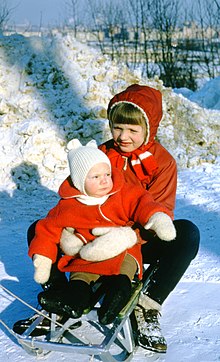

A child ( many children ) - in the main sense, a person during childhood . The age limits of childhood vary in different cultures , life cycle theories and legal systems . In the general case, a child is called a person from birth to the end of the puberty period. Girl - a female child; the boy is a male child. The section of medicine dedicated to children's health is called pediatrics .
Content
Etymology
The Russian word "child" comes from other Russian. Robѧ , continuing Praslav. * orbę ( patern . * orbęte ), related to other ind. árbhaḥ “little boy”, dr. Greek ὀρφανός "orphan", lat. orbus "orphaned", arm. orb "orphan", Gothic. arbja "heir". The vowel "e" in the first syllable is explained instead of the expected "o" by assimilation with the vowel of the second syllable [1] [2] .
Historical Information
The doctrine of the child, as is commonly believed, originates in the 4th century BC by the book of the father of medicine of Hippocrates "On the nature of the child." In the future (I — II centuries), Celsus , Galen and Soran write about the upbringing of children and their care. In the next 15 centuries, what was stated earlier by Galen and Soran was practically repeated. However, the high infant mortality rate , the emergence of charitable organizations , as well as the creation in some countries of Europe of educational homes ( shelters ) for foundlings and street children contributed to arousing interest in the characteristics of the children's body in the XV-XVII centuries - a large number of works were published on the upbringing and care of children [ 3] .
In Russia, Peter I issues a decree “On the Construction of Hospitals in Moscow for the Placement of Illegally Born Babies and on the Granting of Cash Salaries to them and Their Nurses”. Later , MV Lomonosov expresses the idea of creating folk almshouses for illegitimate children and issuing instructions for the treatment of childhood diseases in his letter “On the Reproduction and Preservation of the Russian People”. However, the first educational homes were opened in Russia (1763 - in Moscow, 1771 in St. Petersburg ) only thanks to the efforts of I. I. Betsky, who personally drafted the projects for these houses and developed instructions on raising and caring for children [3] .
Growing Periods
A child is a constantly growing and developing organism, at each age stage possessing certain morphological, physiological and psychological features [3] . The following periods of development of the psyche of the child are distinguished:
- the period of the newborn (the first four weeks of life - 28 days);
- infancy (from the 29th day of life to 1 year) [4] ;
- nursery or pre-school period (from 1 year to 3 years) [5] ;
- preschool period (from 3 to 7 years) [5] ;
- primary school age (from 7 to 12 years) [5] ;
- adolescence (from 13-14 to 17-18 years) [5] .
Infant
Infant is a child under the age of one year. Distinguish between the neonatal period (the first 4 weeks after birth) and infancy (from 4 weeks to 1 year). The development of the infant has a decisive influence on its further mental and physical development . His body is unstable to external influences, susceptible to disease, so he needs the most thorough care. Breast age is characterized by particularly intensive growth and development. At the age of one to three months, the growth of the child increases monthly by 3 cm; in 4–6 months - by 2.5 cm, in 7–9 months –– by 1.5–2 cm, in 10–12 months –– by 1 cm. During the first year of life, a child’s height increases by an average of 1.5 times reaching 75 cm, body weight increases on average 3 times, reaching 10 kg [4] .
Anatomical and physiological features
Infants have tender, easily vulnerable skin , underdeveloped excretory ducts of the sweat glands. Sweating in the first year of life doubles, but often has an inadequate character (may increase with cooling). Apocrine sweat glands do not function. Hair growth at this age is slowed down, during the first year of life, their thickness increases on average from 0.06 mm to 0.08 mm. At this age, both the mass of subcutaneous tissue and the number of fat cells increase rapidly. Infants have more than adults, the ratio of the mass of subcutaneous tissue to body weight. At birth, the fat content in the subcutaneous tissue is 35.5%, over the year it increases to 56% [4] .
The bone tissue of infants contains less minerals than adults. Thicker than in adults, the periosteum is involved in the formation of new bone tissue. Ossification points gradually appear, calcium salts accumulate in the skeleton , and the bones harden. During the first year of life, the calcium content in bones becomes 3.5 times higher on average (from 28 to 100 g). Physiological curves of the spine appear. The sutures between the bones of the skull that are in a newborn baby are tightened by 3-4 months, the small fontanel closes by the 4th-8th week; large fontanel - towards the end of the first year of life. The shape of the chest is barrel-shaped, has a horizontal arrangement of ribs . The first milk teeth appear in 6-8 months, at the age of one year there should be 8 teeth [4] .
The muscular system is poorly developed, the ratio of muscle mass to body weight is noticeably less than that of an adult. Muscles , especially flexors, in newborns have an increased tone , which normalizes in the hands by 2–2.5 months, in the legs by 3-4 months, and the usually bent limb condition disappears [4] .
Already formed bronchi have a narrow lumen, their muscle and elastic fibers are poorly developed. Underdevelopment has elastic lung tissue. During the first year of life, the number of alveoli increases, respectively, the respiratory surface of the lungs increases by 4 times in the first year of life, and the minute volume of respiration - from 635 to 2200 cm3. Respiratory rate gradually becomes less frequent. In normal infants, approximately 3 heartbeats occur in one breath. By the age of 8 months, the heart increases its mass by 2 times, mainly due to the thickening of the myocardium . The pulse gradually becomes less frequent: at the age of one year, its frequency does not exceed 120 beats per minute [4] .
Junior schoolchild personality development
It makes sense to look at the development of the personality of a younger schoolboy in the light of the formation of his internal position, the result of which is his arbitrary behavior - the strategic goal of all mental development as a whole at this age.
In primary school age, the leading factor in the formation of voluntary behavior is educational activity, partly work in the family. The latter is associated with responsibilities in the family, when the activity itself begins to have a pronounced arbitrary character.
- For the development of voluntary behavior, it is important that the child’s ability not only be guided by the goals that the adult sets before him, but also the ability to independently set these goals and organize and control their own behavior and mental activity in accordance with them. It is necessary to remember the powerful motivational significance of the goal to overcome difficulties. The goal then fulfills its constructive function when it is formed before the start of activity and if it is associated with a not very large amount of work ahead. Otherwise, the child refuses activity.
- The next point is associated with the growing importance of relations between students. It is during this period that collective ties arise, public opinion, mutual appreciation, exactingness and other phenomena of public life are formed. A pronounced desire to communicate with friends is observed on the threshold of 4-5 grades. Moreover, this need increases sharply in those children in whom it was previously barely noticeable. After all, every child wants to find his place, wants to be accepted and recognized by his comrades. At this age, there is a strong fluidity of relationships between children, which is based on the desire of the child to find for himself the closest comrade and friend.
- Arbitrariness of behavior determines the formation and development in students of grades 4-5 of a sense of adulthood.
Distinguish:
- social and moral adulthood, which manifests itself in relations with adults, in the participation of the child in caring for the family, its well-being, and systematic assistance to parents. This usually happens in a family where difficulties are experienced, where the child takes on the performance of adult duties;
- intellectual adulthood, expressed in the desire of the child to know something and to be able to truly, which stimulates his cognitive activity;
- the child’s alignment with the qualities of a “real man” and “real woman” as a result of direct imitation and the development of adult qualities such as strength, courage, courage, endurance, faithfulness in friendship, caring for others, etc.
An indicator of the emergence of a sense of maturity can be considered:
- the emergence of the desires and requirements of the “adult” attitude towards oneself from others,
- the desire for independence and the desire to protect some areas of his life from adult intervention
- the presence of their own lines of behavior, their own views and the desire to defend them.
Psychologists believe [ what? ] that the emergence of a sense of adulthood is an important psychological neoplasm of this period and by its appearance it is possible to judge the beginning of a new stage in the child’s personal development.
Adolescence
The age period in which puberty of the child occurs and the body is rebuilt to a higher level of development is adulthood .
Teenager - a boy or girl in transition from childhood to adolescence . Modern science determines adolescence depending on the country (region of residence) and cultural and national characteristics, as well as gender (from 12-14 to 15-17 years). In 2011, there are more than a billion teenagers in the world [6] .
Gallery
1 year
2 years
3 years
4 years
5 years
6 years
7 years
8 years
9 years
10 years
11 years
12 years
13 years old
14 years old
Mental Development Periods
Human intelligence goes through several main stages in its development [7] . From birth to 2 years, the period of sensory-motor intelligence continues; from 2 to 11 years - the period of preparation and organization of specific operations, in which the sub-period of preoperative representations (from 2 to 7 years) and the sub-period of specific operations (from 7 to 11 years) are distinguished; from 11 years to about 15, the period of formal operations lasts.
The main stages of development
Sensory-motor Intelligence Period (0–2 years)
From birth to two years, the organization of perceptual and motor interactions with the outside world gradually develops. This development goes from limitation by innate reflexes to the associated organization of sensory-motor actions in relation to the immediate environment. At this stage, only direct manipulations with things are possible, but not actions with symbols , representations in the internal plane.
The period of preparation and organization of specific operations (2-11 years)
Sub-period of preoperative representations (2-7 years)
Here, a transition is made from sensor-motor functions to internal - symbolic, that is, to actions with representations , and not with external objects. The symbolic function is “the ability to distinguish a designation from a designation and, therefore, the ability to use the first in order to recall the second or point to it” [7] . In infancy, a child, although it can perceive a sensory signal as a sign of an event that follows it, is not able to reproduce in the internal plane the sign of an event that is not perceived as actual, which is not a specific part of this event.
Sub-period of specific operations (7-11 years)
Even at the stage of preoperative representations, the child acquires the ability to perform some actions with representations . But only during the period of specific operations do these actions begin to unite, coordinate with each other, forming systems of integrated actions (in contrast to associative connectives). Such actions are called operations . Operations - “actions internalized and organized into the structures of the whole”; the operation is called “any act of presentation, which is an integral part of an organized network of related acts” [8] . Every committed (updated) operation is an element of a holistic system of possible (potential) operations in this situation.
Formal Operations Period (11-15 years)
The main ability that appears at the stage of formal operations is the ability to deal with the possible , with the hypothetical, and perceive external reality as a special case of what could possibly be. The reality and the child’s own convictions no longer necessarily determine the course of reasoning. The child now looks at the task not only from the point of view of what is directly given in it, but first of all he asks himself about all the possible relationships in which they can consist, in which elements of the directly given can be included.
Parenting
Education is the process of the formation of a human personality. In the process of education, the child prepares for personal, social, industrial and cultural life. Education plays a major role in the moral, mental and physical development of the child. The main types of education are family, or home, and public. Community-based education includes schools, preschool and after-school institutions, children's and youth organizations. In the process of upbringing, the child has an organized joint impact of family activities, socially-organized upbringing systems and the entire lifestyle of society, the level of development of science and technology, literature, art, and the media. Parenting is closely connected with training, which is the most important educational tool. Education provides continuity between older and younger generations, the transfer of accumulated experience in teaching knowledge, maintaining and developing health, worldview, etc. [9] .
Education occurs using the following fixed assets [10] :
- an example, primarily given by the educator to the pupil;
- an order , including a requirement and a ban;
- conviction ;
- learning;
- training ;
The science of education - pedagogy - identifies and explores all the factors that act in the process of education [10] .
The main areas of parenting are:
- a constant, but possibly not obsessive, direction of the child’s activities, first only in the process of games, later - with participation in household chores and labor activities;
- assistance in broadening one's horizons, explaining the essence of phenomena that a child needs to know about and that are interesting to him;
- the formation of the necessary moral qualities;
- the promotion of physical education and sports ;
Pedagogical science recommends a gradual systematic increase in requirements for children, depending on age [11] .
In ancient times, parenting did not have the nature of a specific activity. The life experience of the older generations was verbally transmitted from generation to generation in the course of labor activity, as well as during various ceremonies and games. Education provided primarily their physical development, developed their labor abilities [9] .
Особенности физиологии
У новорождённых и детей раннего возраста растущие потребности в кислороде и отводе углекислого газа и мочевины пропорционально гораздо больше, чем у взрослых. Дыхание ребёнка очень отличается от взрослого, слизистая оболочка лёгких тонкая и ранимая, но более гибкая, часто с обильными выделениями слизи, лучшей мукоцилиарной деятельностью; более эффективен кашель и чихание , но они менее контролируемы, чем у взрослых.
Частота дыхания (по отношению к весу тела ) у ребёнка от 6 месяцев до 4 лет в три раза больше, чем у взрослого, а для ребёнка от 5 до 11 лет — в два раза. Это означает, что организм ребёнка лучше снабжается кислородом, чем организм взрослого, но также более уязвим, когда вдыхает загрязнённый воздух; а именно: в то время как организм взрослого поглощает токсичные газы или аэрозольные взвеси из расчёта 1 мг на 1 кг массы тела в сутки, то ребёнок в возрасте от 6 месяцев до 4 лет поглощает в три раза больше, и при этом его детоксикационный потенциал зачастую ниже, чем у взрослых.
Здоровье
Следит за течением процессов роста и развития детей, а также состоянием здоровья и связанными с этим проблемами самостоятельная область медицины — педиатрия . В отличие от других медицинских специальностей, занимающихся в основном изучением отдельных органов и систем либо течения биологических процессов, педиатрия изучает любые отклонения, возникающие в процессе роста, развития и возможные нарушения состояния здоровья ребёнка ибо течение патологических процессов у детей существенно отличается от таковых у взрослых, а реакция организма на заболевания меняется по мере роста ребёнка. В числе прочего, в обязанности педиатра входит обеспечение для всех детей организованного коллектива ( ясли , дом ребёнка, детский комбинат , школа , интернат , стационар) благоприятных условий достижения ими природного потенциала развития. Таким образом, педиатры находятся в авангарде служб социальной заботы о детях, выступая в роли хранителей физического, умственного и эмоционального развития детей [12] .
Состояние здоровья детей в различных популяциях земного шара и вызванные этим проблемы зачастую обусловлены многими, нередко взаимосвязанными, факторами, среди которых [12] :
- распространение ( эпидемиология ) возбудителей инфекционных заболеваний и их носителей (лиц со стёртыми формами заболеваний);
- географическое положение, климатические условия, экология ;
- сельскохозяйственные ресурсы и обычаи;
- социально-культурный уровень общества, образование , экономическое развитие;
- частота носительства генов некоторых наследственных болезней .
В настоящее время особое внимание придаётся социальным и поведенческим аспектам помощи детям: начиная от пересмотра привычных методов воспитания ребёнка и заканчивая внедрением важных программ, направленных на профилактику жестокого обращения с детьми раннего и более старшего возраста, а также неудовлетворительного ухода за ребёнком [12] .
Профилактическое направление в педиатрии в первую очередь включает мероприятия, направленные на предупреждение заболеваний и возможного развития инвалидизации подрастающего поколения [13] :
- первичная профилактика (попытки предупредить развитие заболевания до его начала): иммунизация населения, хлорирование (обеззараживание) или фторирование воды (профилактика кариеса зубов), пастеризация , дератизация , профилактика травматизма и так далее;
- вторичная профилактика (выявление, распознавание и ограничение предвестников заболеваний, а также определение и лечение заболеваний на ранних стадиях, например нарушения осанки у подростков);
- третичная профилактика (мероприятия, направленные на предотвращение прогрессирования ограничения функций, обусловленного выявленным заболеванием, например физиотерапевтические методы лечения у пациентов с хроническими неврологическими нарушениями, направленные на предотвращение развития контрактур ).
Влияние возраста родителей на здоровье ребёнка
Возраст обоих родителей может влиять на здоровье ребёнка. В организме как мужчин, так и женщин с возрастом накапливаются изменения, негативно влияющие на здоровье потомства. Принято считать, что у женщины возрастом больше приблизительно 35 лет физиологические изменения могут сказываться на течении беременности и здоровье будущего ребенка [14] [15] . У мужчин с возрастом накапливаются мутации в половых клетках — примерно по две в год [16] . В 2019 году в обзорном исследовании показано, что при возрасте отца 45 лет и больше зачатый ребёнок подвергается повышенному риску врождённых заболеваний, в среднем такие новорожденные имеют более низкую оценку по шкале Апгар , кроме того, беременность женщины протекает тяжелее для неё [14] [15] .
С другой стороны, есть данные о том, что у детей пожилых отцов увеличена длина теломер на концах ДНК , что потенциально увеличивает продолжительность жизни и здоровье организма. Причём увеличенная длина теломер наблюдается также во втором и третьем поколении, у детей, которые родились уже у молодых отцов [17] [18] .
Юридический статус
Статус «ребёнка» равно как и «взрослого» варьируется в разных культурах и юридических системах. В настоящее время Конвенция о правах ребёнка определяет ребёнка как человеческое существо до достижения восемнадцатилетнего возраста [19] .
Возраст совершеннолетия
- В большинстве стран совершеннолетие наступает с 18 лет.
- Минимальный возраст совершеннолетия установлен на Фарерских островах — 14 лет.
- На Кубе совершеннолетие наступает с 16 лет
- В России совершеннолетие наступает в 18 лет
См. также — Совершеннолетие
Права ребёнка
В соответствии с международным и российским законодательством ребёнок от рождения имеет неотъемлемые права , которые гарантируются ему государством: ребёнок, как и любое человеческое существо, имеет неотъемлемое право на жизнь, на уважение его взглядов и права свободного выражения этих взглядов по всем затрагивающим его вопросам, иметь и выражать своё мнение, право получать и передавать информацию в различных формах, право на защиту от дискриминации, право на образование, на отдых и досуг и т. д.
Традиционно полагают [ who? ] , что человек остаётся ребёнком до 13-16 лет, но, в зависимости от контекста, можно использовать другие определения, например, легальный возраст, когда можно покупать спиртные напитки, получить паспорт, голосовать на выборах или « возраст согласия ». Другой способ определения, перестал ли человек быть ребёнком, — по достижении половой зрелости.
До наступления совершеннолетия человек не обладает всей полнотой юридических прав , ответственность за него несёт родитель , или иной законный представитель (например опекун ).
В большинстве стран существуют законы, по которым несовершеннолетним запрещена продажа алкогольной и табачной продукции .
Также существуют законы о защите детей от вредоносной информации (запрещена например демонстрация насилия , порнографии, пропаганда употребления наркотиков , и суицида ). В России с 1 сентября 2012 года действует федеральный закон , устанавливающий правила для всех источников массовой информации .
See also
- Physical development
- Всемирный день ребёнка
- Международный день детского телевидения и радиовещания
- Международный день детской книги
- Психология родительства
- Дети-солдаты
- Дети — жертвы пороков взрослых
Notes
- ↑ Фасмер М. Этимологический словарь русского языка . — Прогресс. — М. , 1964–1973. — Т. 3. — С. 453.
- ↑ Etymological dictionary of Slavic languages. — М. : Наука, 2005. — Т. 32. — С. 114—115.
- ↑ 1 2 3 А. В. Мазурин , И. М. Воронцов . Пропедевтика детских болезней. — 1-е изд. — М. : Медицина , 1986. — С. 6—19. — 432 с. - 100,000 copies.
- ↑ 1 2 3 4 5 6 Грудной ребёнок. Медицинская энциклопедия
- ↑ 1 2 3 4 Маклаков А. Г. Общая психология: учебное пособие для вузов и слушателей курсов психологических дисциплин. — С. 98-103.
- ↑ Информационный центр ООН в Москве — Пресс-бюллетень Архивировано 20 сентября 2012 года.
- ↑ 1 2 Флейвелл Джон Х. Генетическая психология Жана Пиаже. М., 1967. С. 202.
- ↑ Флейвелл Джон Х. Генетическая психология Жана Пиаже. М., 1967. С. 222.
- ↑ 1 2 Воспитание // Большая советская энциклопедия : [в 30 т.] / гл. ed. A.M. Prokhorov . - 3rd ed. - M .: Soviet Encyclopedia, 1969-1978.
- ↑ 1 2 ВОСПИТАНИЕ - это... Что такое ВОСПИТАНИЕ? (рус.) , Словари и энциклопедии на Академике . Date of treatment July 21, 2018.
- ↑ Семейное воспитание // Большая советская энциклопедия : [в 30 т.] / гл. ed. A.M. Prokhorov . - 3rd ed. - M .: Soviet Encyclopedia, 1969-1978.
- ↑ 1 2 3 Педиария (руководство) / Под ред. Р. Е. Бергмана, В. К. Вогана. — Пер. from English под ред. Воронцова И. М — 2-е изд. перераб. and add. — М. : « Медицина », 1991. — Т. 1 (Общие вопросы). — С. 15—26. — 704 с. — 20 000 экз. — ISBN 5-225-00537-3 0-03 011442-X.
- ↑ Педиария (руководство) / Под ред. Р. Е. Бергмана, В. К. Вогана. — Пер. from English под ред. Воронцова И. М — 2-е изд. перераб. and add. — М. : « Медицина », 1991. — Т. 1 (Общие вопросы). — С. 442—479. — 704 с. — 20 000 экз. — ISBN 5-225-00537-3 0-03 011442-X.
- ↑ 1 2 Sergey Vasiliev. Scientists have proven that the "clock is ticking" not only in women . A large-scale review of medical research has demonstrated the negative impact of the father's age on the health of his offspring . Naked Science (May 13, 2019) . Circulation date May 14, 2019.
- ↑ 1 2 Phillipsa, N. Maternal, infant and childhood risks associated with advanced paternal age: The need for comprehensive counseling for men: [ eng. ] / N. Phillipsa, L. Taylorb, G. Bachmanna // Maturitas: J .. - 2019. - Vol. 125 (July). - P. 81–84. - DOI : 10.1016 / j.maturitas.2019.03.03.020 . - PMID 31133222 .
- ↑ M. Frank-Kamenetsky. The most important molecule . - Alpina Publisher, 2016-11-28. - S. 301 .-- 345 p. - ISBN 9785961445220 .
- ↑ Polina Loseva. The late conceived grandfathers handed over their telomeres to their Filipino grandchildren . Scientists have traced the effect of "late children - long telomeres" in at least two generations . Attic (May 30, 2019) . Circulation date May 31, 2019.
- ↑ Eisenberg, Dan TA Older paternal ages and grandpaternal ages at conception predict longer telomeres in human descendants: [ eng. ] / Dan TA Eisenberg, Nanette R. Lee, Peter H. Rej ... [et al. ] // The Royal Society. - 2019. - 29 May. - DOI : 10.1098 / rspb.2019.0800 . - PMID 31138065 .
- ↑ Convention on the Rights of the Child // Official Records of the General Assembly: Forty-fourth Session: Adopted by General Assembly resolution 44/25 of November 20, 1989: [ arch. February 16, 2011 ]. - New York: UN, 1989. - S. 230–239.
Literature
- Philippe Aries Child and family life under the Old Order. // Discovery of childhood . - Ekaterinburg, 1999.
- Bozhovich L. I. Personality and its formation in childhood. - M. , 1968.
- Yu. B. Hippenreiter. Chat with a child. How? - M .: AST, Astrel ,, 2007 .-- 240 p. - 30,000 copies. - ISBN 978-5-271-15458-4 .
- Maklakov A.G. General Psychology: a textbook for universities and students of psychological courses . - Publishing House "Peter", 2012. - 593 p. - ISBN 9785459015799 .