Common Oriole [1] ( lat. Oriolus oriolus ) is a small bright bird, the only representative of the family of Orioles , common in the temperate climate of the northern hemisphere. Breeds in Europe and Asia east to the Yenisei . Noisy and mobile, usually held in the crown of trees, mainly deciduous. Uncommunicative, found alone or in pairs. It feeds on caterpillars and other insects, as well as berries. Migrates over long distances, winters in the tropics of Asia and Africa south of the Sahara . The usual look.
| Common Oriole | |||||||||||||||||||||||||||||||||||
 | |||||||||||||||||||||||||||||||||||
| Scientific classification | |||||||||||||||||||||||||||||||||||
|---|---|---|---|---|---|---|---|---|---|---|---|---|---|---|---|---|---|---|---|---|---|---|---|---|---|---|---|---|---|---|---|---|---|---|---|
| |||||||||||||||||||||||||||||||||||
| International scientific name | |||||||||||||||||||||||||||||||||||
Oriolus oriolus ( Linnaeus , 1758 ) | |||||||||||||||||||||||||||||||||||
| Subspecies | |||||||||||||||||||||||||||||||||||
| |||||||||||||||||||||||||||||||||||
| Area | |||||||||||||||||||||||||||||||||||
 Nesting range Migrations | |||||||||||||||||||||||||||||||||||
| Security status | |||||||||||||||||||||||||||||||||||

According to the International Union for Conservation of Nature , a fairly numerous species. Despite the fact that the general bird population has declined in recent years, its dynamics currently does not allow us to consider this species as vulnerable. In the international Red Book, the Oriole has the status of a minimum risk taxon (LC category) [2] .
Description
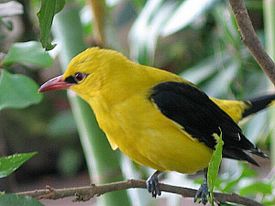
The size is slightly larger than an ordinary starling : length 24-25 cm, wingspan about 45 cm, weight 50–90 g [3] [4] . The body is somewhat elongated. In color, pronounced sexual dimorphism : males and females are noticeably different from each other. The plumage of the male is golden yellow with black wings and a black tail. On the edge of the tail, as well as on the wings, small yellow spots are visible. From the beak to the eye there is a black stripe called the “bridle” - depending on the subspecies, it can go behind the eyes or not (see picture). The female has a greenish-yellow top and a whitish bottom with dark longitudinal streaks. The wings are greenish-gray. The beak of both sexes is brown or reddish brown, quite long and strong. The iris is red. Young birds are more like a female, but stand out with a duller, mottled and darker plumage from below. A very mobile bird, quickly and silently jumps from branch to branch in the dense foliage of trees. The flight is fast and undulating, like woodpeckers or blackbirds . The average flight speed is 40–47 km / h, although males in pursuit of each other can reach 70 km / h [5] . Rarely flies to an open place, although males sometimes pose while sitting on a branch during the mating season.
Vocalization includes several dissimilar variations. Sometimes it emits a sharp and completely non-musical cry, reminiscent of the meowing of a frightened cat . From far away you can hear a low melodic whistling of a bird, reminiscent of the sounds of a flute and consisting of 3-4 syllables: “fiu-liu-li”. At a distance, one can hardly make out another scream typical of the Orioles: a series of jerky creaky sounds of “gigigigigi”, like falcons [3] [4] [6] [7] .
Subspecies
Depending on the coloring of the head and tail feathers, as well as the ratio of the length of the feathers, 2 subspecies of the common Oriole are distinguished [8] :
- O. o. oriolus Linnaeus, 1758. The second fly feather is larger than the fifth. There is no black spot behind the eye. The outer pair of tail feathers in the main half is black. In the 2nd – 4th outside pairs of steering feathers, black coloring occupies half or more than half of the main part of the feather [9] . It nests in Europe, Western Siberia and the northern half of Kazakhstan from the Atlantic coast east to the Yenisei , in Asia from Turkey , the Caucasus Mountains, central Iran to the Ferghana Valley , Lake Zaysan , Altai , Western Sayan , Dzhungarsky Alatau . Migrates to East and South Africa, northwest India [10] [11] .
- O. o. kundoo Sykes, 1832. The second fly feather is less than or equal to the fifth. There is a small black spot behind the eye. The outer pair of tail feathers is usually entirely yellow, only sometimes black is developed at the base. The 2nd – 4th outside pairs of steering feathers have a black color at the bases [9] . Breeds in the south of Kazakhstan, in Central Asia from the Amu Darya and Syr Darya basins to the west to the valleys of the Chu and Ili , Tien Shan and Altai rivers, to the south to the Pamirs , eastern and central Afghanistan , the mountainous regions of Balochistan and Kashmir , the western and central Himalayas, the Indian Mysore State [11] .
Distribution
Range
Widespread view. It covers almost the whole of Europe, penetrating north to 63 ° C. w. in Sweden and Finland , and 61 ° C. w. in the European part of Russia [12] . On the British Isles, it almost does not nest, occasionally meeting only on the Isles of Scilly and the south coast of England [13] . Also irregularly nests in the Azores and Madeira Island [14] . The nesting range in Asia occupies the entire western part up to the Yenisei valley, the Minusinsk depression , the Western Sayan and the Dzungarian Alatau , as well as the lower Ganges in India and Bangladesh . Migratory birds are everywhere, with the exception of the Indian population, which makes only insignificant migrations during the non-nesting period [3] .
Habitats
He spends most of his life high in the crown of trees - despite the bright plumage, this bird is often difficult to see from the ground. Prefers light high-stemmed forests, mainly deciduous - birch, willow or poplar groves. In arid regions, it often settles in tugai thickets of river valleys. Less common in grassy pine forests. Finally, sometimes he chooses deserted islands with separate trees, where he feeds in sand dunes or heather thickets [5] .
Avoids continuous shaded forest and taiga, while willingly settles next to a person in gardens and parks, forest plantations along roads [3] [15] [16] . In the Tien Shan nests up to 2000–2200 m above sea level [17] . On flights it is found much higher - up to 2700 m in Talas Alatau [9] , 2300 m in Rwanda and 4300 in Tanzania [18] . From November to February it stays mostly on the plains: up to 850–900 m above sea level in Angola and up to 50 m in Kenya [18] .
Nutrition
The basis of the diet is animal feed. In the breeding season, it feeds mainly on woody insects, mainly caterpillars, including hairy ones. It eats butterflies (including bears ), dragonflies , earwigs , mosquito-centipedes , bedbugs (from Pentatomidae insects to Acanthosoma kilos ), tree beetles ( ground beetles , Cantharidae softworms , Elateridae nutcrackers, Cerachaeidaeida lamellaris, Cerachaeidaeidae chameleidae , , weevils Curculionidae), some Orthoptera ( Lamella tailed Leptophyes , conoheads Conocephalus ). Catches some spiders .
Nests of small birds such as the gray flycatcher ( Muscicapa striata ) and redstart ( Phoenicurus phoenicurus ) are sometimes ravaged [19] .
During fruit ripening and in places of migration, it partially switches to fruits - cherries , grapes , currants , bird cherry , figs , pears , mulberries , etc. [20] . It feeds mainly in the early morning, to a lesser extent in the afternoon after 15 hours [21] .
Reproduction
Like other members of the family, the common Oriole is monogamous . In the case of migration, nesting places arrive quite late, when the first greens already appear on the trees: in central Russia in the second half of May. The first to arrive are males, females a bit later. Reproduction occurs once a year, full clutches are found in East Germany in late May - early June, in Spain in late May, in Belgium , Switzerland and Sweden in early June, in Morocco in mid-June [22] . During the mating season, the male behaves in a pointed manner - he jumps from branch to branch, flies around the female, pursues her, makes “dives” in the air, actively chirps and whistles, spreads his tail and flaps his wings. He also protects his territory - fierce fights are often between competing males. The attracted female responds with a whistle and twirls her tail.
The nest is a shallow hanging basket with wide oval edges, usually woven from strips of bast, dry stems of grass and birch bark. The diameter of the nest is 12–16 cm, the height of the nest is 6–9 cm, the diameter of the tray is 8.5–11 cm, and the depth of the tray is 4–5 cm [23] . Inside, the nest is laid out with leaves, down, cobwebs or even scraps of soft debris left after a person. In general, if necessary, when building a nest, birds can use any material suitable for this - for example, in one well-known case during the First World War, the Orioles took bandages from a nearby dressing station [5] . When arranging the nest, a clear distribution of responsibilities is noticeable - the male collects the material, and the female puts it in place.
As a rule, the nest is located high above the ground, in the fork of thin horizontal branches far from the trunk, and in the absence of a suitable place between the two branches. It attaches well so that a strong gust of wind could not destroy it, and is masked in the foliage by pieces of moss and stalks of grass. A well-known Russian ornithologist and publicist S. A. Buturlin drew attention to an interesting feature of the location of the nest - a fresh nest is always tilted to the trunk, but subsequently, under the weight of the chicks, its angle gradually moves in the opposite direction [24] . In the clutch, as a rule, there are 4 (less often 3-5) white eggs with a pink or cream tint and rare reddish-brown specks. Egg size (28–33) x (21–23) mm [23] , weight about 0.37–0.48 g [25] . Hatching lasts 13-15 days, mainly the female sits. The male feeds the female and occasionally replaces her for a short time [25] . The chicks that were born are blind and covered with long yellowish fluff. Both parents feed them first with caterpillars , and later in addition with harder berries. Observations showed that the number of approaches of parents with prey to the nest averaged 9-15 times per hour, which ultimately resulted in 211 feedings per day [26] . Chicks begin to fly in 15-17 days — in the south of Russia, the first fledglings appear already in the second half of June, and by mid-July and throughout the range [25] . Dispersion occurs in early August, and at the end of this month, migratory birds begin to migrate to winter apartments.
Enemies
Reports of an attack by feathered predators on an ivologist are episodic, despite the fact that the bright plumage invariably attracts attention to them. It is known that they are hunted by the sparrow hawk , various falcons ( peregrine falcon , Falco vespertinus , red falcon, Eleanor Falco eleonorae , ashen Falco concolor , Mediterranean Falco biarmicus falcons, common kestrel Falco tinnunculus ), dwarf eagle ( Hierausetus ), penny eagle ( Hierausetus ) milvus ) and red ( Milvus migrans ) kites and some other birds of prey [26] .
Etymology
The origin of the scientific name Oriolus has two versions. According to one of them, the name comes from the Latin word “ aureolus ” (“golden”), which later in Old French was transformed into the word “oriol”. It is believed that in this way the bright yellow color of the bird, atypical for Europe , was emphasized. The second version - the name imitates the Oriole's melodic song - a phenomenon in linguistics called onomatopoeia [27] .
The Russian name for the Oriole, according to linguists, has Slavic roots and is the same root with the words “volog” and “moisture”. It is believed that in ancient times the bird was presented as a harbinger of rain [28] [29] . The name is consonant with the Polish word wilga ("Oriole"), Latvian vālodze and Lithuanian volunge ("nuthatch").
In astronomy
In honor of the Oriole , the asteroid (701) Oriola , discovered in 1910, is named.
Notes
- ↑ Boehme R. L. , Flint V. E. The Bilingual Dictionary of Animal Names. Birds. Latin, Russian, English, German, French / Ed. ed. Acad. V. E. Sokolova . - M .: Rus. lang., "RUSSO", 1994. - S. 461. - 2030 copies. - ISBN 5-200-00643-0 .
- ↑ Oriolus oriolus . International Union for Conservation of Nature . Date of treatment November 7, 2015. Archived on November 7, 2015.
- ↑ 1 2 3 4 Koblik, 2001 , p. 271.
- ↑ 1 2 Ryabitsov, 2001 , p. 391.
- ↑ 1 2 3 Walther & Jones, 2008 , p. 722.
- ↑ Mullarney et al., 1998 , p. 340.
- ↑ Morozov, 1987 , p. 72.
- ↑ Stepanyan, 2003 , p. 385-386.
- ↑ 1 2 3 Kovshar, 1974 , p. 6.
- ↑ Mayr & Greenway, 1962 , p. 127.
- ↑ 1 2 Famili Oriolidae . James C. Greenway. Date of treatment September 19, 2008. Archived March 18, 2012.
- ↑ Stepanyan, 2003 , p. 385.
- ↑ Sharrock, 1974 , p. 28.
- ↑ Dementiev, Gladkov, 1953 , p. 144.
- ↑ Milovidov, Nekhoroshev, 2002 , p. 97.
- ↑ Dementiev, Gladkov, 1953 , p. 146.
- ↑ Bucket, 1974 , p. 9.
- ↑ 1 2 Mason & Allsop, 2009 , p. 229.
- ↑ Walter Hovorka. Zur Autökologie des Pirols Oriolus O. Oriolus (L., 1758) unter Berücksichtigung populationsökologischer aspekte). (German) . Dissertation zur Erlangung des Doktorgrades . Formal- und Naturwissenschaftlichen Fakultät der Universität Wien. Date of treatment September 20, 2008. Archived March 18, 2012.
- ↑ Dementiev, Gladkov, 1953 , p. 148.
- ↑ Ralf Wassmann aus Wolfenbüttel. Ökologische und ethologische Untersuchungen am Pirol (Oriolus oriolus L. 1758). (German) . Dissertation zur Erlangung des Doktorgrades . Mathematisch-Naturwissenschaftlichen Fakultäten der Georg-August-Universität zu Göttingen. Date of treatment September 20, 2008. Archived August 22, 2011.
- ↑ Cramp & Simmons, 1993 , p. 228.
- ↑ 1 2 Mikheev, 1975 , p. 163.
- ↑ Buturlin S.A. Birds // Fauna of the USSR . - Moscow - Leningrad: Detizdat, 1940.
- ↑ 1 2 3 Dementiev, Gladkov, 1953 , p. 147.
- ↑ 1 2 Walther & Jones, 2008 , p. 723.
- ↑ Jobling, 1992 , p. 169.
- ↑ Max Fasmer . Etymological dictionary of the Russian language . - 1986.- 2960 s. - ISBN 5170168330 .
- ↑ Semenov A.V. Etymological Dictionary of the Russian Language. Russian language from A to Z. - Unves, 2003 .-- 704 p. - ISBN 978-5-88682-149-9 .
Literature
- Dementiev, G.P .; Gladkov, N.A. Birds of the Soviet Union. - Soviet science, 1953. - V. 5. - 803 p.
- Koblik E. A. Variety of birds (based on the materials of the exposition of the Zoological Museum of Moscow State University. - Publishing House of Moscow State University, 2001. - T. Part 4 (Detachment Vorobinobraznye - continued). - 384 pp. - ISBN 5-211-04072-4 .
- Kovshar, A.F. (Ed. Ed.). Birds of Kazakhstan. - Alma-Ata: Nauka, 1974.- T.V. - 479 p.
- Milovidov, S.P .; Nekhoroshev, O. G. Directory-identifier of birds of the Tomsk region. - Publishing house of Tomsk University, 2002. - ISBN 5-7511-1417-5 .
- Mikheev, A.V. Biology of birds. Field identifier of bird nests. - M .: Education, 1975 .-- 171 p.
- Morozov, Vladimir. Entertaining bioacoustics. - M .: Knowledge, 1987 .-- 208 p.
- Ryabitsev V.K. Birds of the Urals, Cisurals and Western Siberia: A guide-determinant. - Ekaterinburg: Publishing House of the Ural University, 2001. - 608 p. - ISBN 5-7525-0825-8 .
- Stepanyan L. S. Synopsis of the ornithological fauna of Russia and adjacent territories. - M .: Academic book, 2003 .-- 727 p.
- Cramp, S .; Simmons, KEL 1-5 // Handbook of Birds of Europe, the Middle-East and North Africa. - Oxford University Press, 1993. - T. VII: Flycatchers to Shrikes. - 610 p. - ISBN 978-0198575108 .
- Jobling, James A. A Dictionary of Scientific Bird Names. - United States: Oxford University Press, 1992. - ISBN 0198546343 .
- Mason, Paul; Allsop, Jake. The Golden Oriole. - Poyser, 2009 .-- 280 p. - ISBN 978-0713676839 .
- Mayr, Ernst; Greenway, James C. (eds). Check-list of birds of the world: a continuation of the work of James L. Peters. - Cambridge: Harvard University Press, 1962 .-- T. XV.
- Mullarney, Killian; Svensson, Lars; Zetterstrom, Dan; Grant, Peter. Collins Bird Guide: The Most Complete Field Guide to the Birds of Britain and Europe. - Harpercollins Pub Ltd, 1998. - 400 p. - ISBN 0-00-219728-6 .
- Sharrock, JTR Scarce Migrant Birds in Britain and Ireland. - T & AD Poyser Ltd, 1974. - 192 p. - ISBN 978-0856610080 .
- Walther BA; Jones, PJ Family Oriolidae (Old World orioles) / Del Hoyo J., Elliott A., Christie D. - Handbook of the birds of the world. - Lynx Edicions, 2008 .-- T. Vol. 13: Penduline-tits to Shrikes. - 860 p. - ISBN 978-8496553453 .
Links
- Vertebrates of Russia: European Oriole
- Video clips of an ordinary Oriole
- Common Oriole on ecosystema.ru
- Eurasian Golden Oriole - BirdLife Species Factsheet
- Oriolus oriolus (English) . The IUCN Red List of Threatened Species .