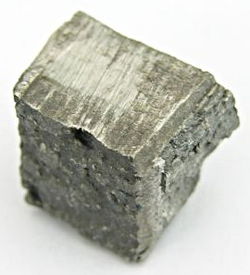
Dysprosium ( other Greek δυσπρόσιτος - hard to reach [3] ) - a chemical element with atomic number 66; rare earth metal with a glitter of silver. It is not found in nature in its pure form, but it is part of some minerals, for example, xenotime .
| Dysprosium | ||||
|---|---|---|---|---|
| ← Terbium | Holmium → | ||||
| ||||
| The appearance of a simple substance | ||||
| Soft glossy silver metal | ||||
 | ||||
| Atom properties | ||||
| Name, symbol, number | Dysprosium / Dysprosium (Dy), 66 | |||
| Atomic mass ( molar mass ) | 162,500 (1) [1] a. E. m. ( g / mol ) | |||
| Electronic configuration | [Xe] 4f 10 6s 2 | |||
| Atom radius | 180 pm | |||
| Chemical properties | ||||
| Covalent radius | 159 pm | |||
| Ion radius | (+ 3e) 90.8 pm | |||
| Electrode potential | Dy ← Dy 3+ -2.29V Dy ← Dy 2+ -2.2V | |||
| Oxidation state | 3 | |||
| Ionization energy (first electron) | 567.0 (5.88) kJ / mol ( eV ) | |||
| Thermodynamic properties of a simple substance | ||||
| Density (at N. at. ) | 8.55 g / cm³ | |||
| Melting temperature | 1685 K | |||
| Boiling temperature | 2835 K | |||
| Beats heat of vaporization | 291 kJ / mol | |||
| Molar heat capacity | 28.16 [2] J / (K · mol) | |||
| Molar volume | 19.0 cm³ / mol | |||
| The crystal lattice of a simple substance | ||||
| Lattice structure | hexagonal | |||
| Lattice options | a = 3,593 c = 5,654 Å | |||
| C / a ratio | 1,574 | |||
| Other characteristics | ||||
| Thermal conductivity | (300 K) 10.7 W / (mK) | |||
| CAS Number | ||||


| 66 | Dysprosium |
Dy 162,500 | |
| 4f 10 6s 2 | |
History
P.E. Lecock de Bois Bododran discovered dysprosium in 1886 by spectroscopic analysis of holmium, or holmium earth, and then isolated oxide. In 1906, J. Urbain received dysprosium in its purest form.
Being in nature
Clark dysprosium in the earth's crust (according to Taylor) is 5 g / t, the content of oceans in the water is 2.9⋅10 −6 [4] . Together with other rare earth elements it is part of the minerals gadolinite, xenotime, monazite, apatite, bastenzite and others.
Deposits
Dysprosium is mined in deposits of lanthanides , the most significant of which are in China , USA , Vietnam , Afghanistan , Russia ( Kola Peninsula ), Kyrgyzstan , Australia , Brazil , India [5] . There are significant reserves in the deep-sea deposit of rare-earth minerals off the Pacific island of Minamitori in the exclusive economic zone of Japan [6] .
Getting
Dysprosium is obtained by reducing DyCl 3 or DyF 3 with calcium, sodium, or lithium.
Physico-chemical properties
Dysprosium is a silver gray metal . Below 1384 ° C, α-Dy with a hexagonal lattice is stable, а = 0.35603 nm, с = 0.56465 nm, and above 1384 ° C, β-Dy with a cubic lattice.
It oxidizes slowly in air, quickly above 100 ° C. When heated, metallic dysprosium reacts with halogens, nitrogen, and hydrogen. It interacts with mineral acids (except for HF), forming salts of Dy (III), does not interact with alkali solutions.
Prices
Prices for metal dysprosium in ingots with a purity of 99–99.9% in 2008 amounted to 180–250 dollars [7] per 1 kg.
In 2014, 10 grams of dysprosium with a purity of 99.9% could be bought for 114 euros .
Application
- Metallurgy Dysprosium serves as an alloying component of zinc alloys. Adding dysprosium to zirconium dramatically improves its manufacturability (but increases the thermal neutron capture cross section). So, dysprosium-doped zirconium is easily amenable to pressure treatment (bar pressing).
- Laser materials . Dysprosium ions are used in medical lasers (wavelength - 2.36 microns ).
- Catalysts . It is used as an effective catalyst.
- Nuclear power Dysprosium is used in nuclear technology (boride, borate, oxide, hafnate, titanate) as an actively neutron-capture material (coatings, enamels, paints, control rods), capture cross section of a natural mixture of isotopes of about 930 bar , and the most active capture in a natural mixture of isotopes neutrons are dysprosium-161 (585 barn) and dysprosium-164 (2700 barn). For example, dysprosium titanate is used in the control rods of VVER-1000 reactors [8] , however, only as an addition, the main part of the rod is filled with boron carbide . The absorption efficiency of dysprosium titanate is lower than that of boron, but dysprosium absorbs neutrons with emission of gamma rays only , without emitting alpha particles, therefore this substance does not swell [9] .
- Giant magnetostrictive effect . The dysprosium-iron alloy, in polycrystalline and especially in single-crystal form, is used as a powerful magnetostrictive material.
- Thermoelectric materials . Thermo-EMF of dysprosium monotelluride is about 15-20 μV / K.
- Electronics Dysprosium orthoferrite has limited application in electronics.
- Magnetic materials . Dysprosium oxide is used in the manufacture of heavy duty magnets.
- Light sources . Dysprosium is used for the production of lighting metal halide lamps with a spectrum close to the sun. Dy 2 O 3 is used as a component of red phosphors.
Biological role
Does not bear a biological role. Dysprosium metal dust irritates the lungs.
Notes
- ↑ Michael E. Wieser, Norman Holden, Tyler B. Coplen, John K. Böhlke, Michael Berglund, Willi A. Brand, Paul De Bièvre, Manfred Gröning, Robert D. Loss, Juris Meija, Takafumi Hirata, Thomas Prohaska, Ronny Schoenberg , Glenda O'Connor, Thomas Walczyk, Shige Yoneda, Xiang ‑ Kun Zhu. Atomic weights of the elements 2011 (IUPAC Technical Report ) // Pure and Applied Chemistry . - 2013 .-- Vol. 85 , no. 5 . - P. 1047-1078 . - DOI : 10.1351 / PAC-REP-13-03-02 .
- ↑ Chemical Encyclopedia: in 5 vols. / Editorial: Knunyants I.L. (Ch. Ed.). - Moscow: Soviet Encyclopedia, 1990. - T. 2. - S. 82. - 671 p. - 100,000 copies.
- ↑ Dysprosium // Brockhaus and Efron Encyclopedic Dictionary : in 86 volumes (82 volumes and 4 additional). - SPb. , 1890-1907.
- ↑ JP Riley and Skirrow G. Chemical Oceanography V. I, 1965
- ↑ What is MINERAL RESOURCES: RARE METAL ORE - Collier Encyclopedia - Dictionaries - Slovoediya
- ↑ The tremendous potential of deepsea mud as a source of rare-earth elements
- ↑ Dysprosium prices Archival copy of December 29, 2009 on the Wayback Machine
- ↑ Risovany VD , Varlashova EE , Suslov DN Dysprosium titanate as an absorber material for control rods (Russian) // Journal of Nuclear Materials. - 2000 .-- September ( vol. 281 , no. 1 ). - P. 84-89 . - DOI : 10.1016 / S0022-3115 (00) 00129-X .
- ↑ Andrushechko S.A. and other nuclear power plants with a VVER-1000 type reactor. From the physical foundations of operation to the evolution of the project. - M .: Logos, 2010 .-- S. 197 .-- 604 p. - 1000 copies. - ISBN 978-5-98704-496-4 .