Radium is an element of the main subgroup of the second group, the seventh period of the periodic system of chemical elements of DI Mendeleev , with atomic number 88. It is designated by the symbol Ra ( lat. Radium ). A simple substance is radium - a shiny silver-white metal that quickly fades in the air. Refers to alkaline earth metals , has a high chemical activity. Radioactive; the most stable nuclide is 226 Ra (half-life of about 1600 years ).
| Radium | ||||
|---|---|---|---|---|
| ← France | Actinium → | ||||
| ||||
| The appearance of a simple substance | ||||
| Silver white metal | ||||
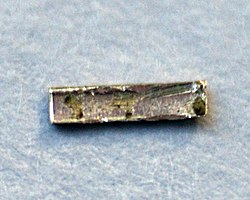 | ||||
| Atom properties | ||||
| Name, symbol, number | Radium / Radium (Ra), 88 | |||
| Atomic mass ( molar mass ) | 226.0254 a. E. m. ( g / mol ) | |||
| Electronic configuration | [Rn] 7s 2 | |||
| Chemical properties | ||||
| Ion radius | (+ 2e) 143 pm | |||
| Electronegativity | 0.9 (Pauling scale) | |||
| Electrode potential | Ra ← Ra 2+ −2.916 V | |||
| Oxidation state | 2 | |||
| Ionization energy (first electron) | 1st 509.3 (5.2785) kJ / mol (eV) 2nd 979.0 (10.147) kJ / mol ( eV ) | |||
| Thermodynamic properties of a simple substance | ||||
| Density (at N. at. ) | (at rt) 5.5 g / cm³ | |||
| Melting temperature | 1233 K | |||
| Boiling temperature | 2010 K | |||
| Beats heat of fusion | 8.5 kJ / mol | |||
| Beats heat of vaporization | 113 kJ / mol | |||
| Molar heat capacity | 29.3 [1] J / (K · mol) | |||
| Molar volume | 45.0 cm³ / mol | |||
| The crystal lattice of a simple substance | ||||
| Lattice structure | cubic body-centered | |||
| Lattice options | 5,148 [2] | |||
| Other characteristics | ||||
| Thermal conductivity | (300 K) (18.6) W / (mK) | |||
| CAS Number | ||||


| 88 | Radium |
Ra (226) | |
| 7s 2 | |
History
French scientists Pierre and Marie Curie found that the waste remaining after the separation of uranium from uranium ore ( uranium tar mined in the city of Joachimstal , Czech Republic ) is more radioactive than pure uranium. After several years of intensive work, two highly radioactive elements: polonium and radium were isolated from this waste. The first report on the discovery of radium (in the form of a mixture with barium ) Curie made December 26, 1898 at the French Academy of Sciences . In 1910, Marie Curie and Andre Debierne isolated pure radium by electrolysis of radium chloride at a mercury cathode and subsequent distillation in hydrogen . The isolated element was, as is now known, the radium-226 isotope, the decay product of uranium-238 . For the discovery of radium and polonium, the Curie spouses received the Nobel Prize. Radium is formed through many intermediate stages during the radioactive decay of the uranium-238 isotope and is therefore found in small quantities in uranium ore.
In Russia, radium was first obtained in the experiments of the famous Soviet radiochemist V. G. Khlopin . In 1918, the Radium Department was organized on the basis of the State X-ray Institute , which in 1922 received the status of a separate scientific institute. One of the tasks of the Radium Institute was the study of radioactive elements , primarily radium. The director of the new institute was V.I. Vernadsky , his deputy was V.G. Khlopin , the physics department of the institute was headed by L.V. Mysovsky [3] .
Many radionuclides that occur during the radioactive decay of radium, before their chemical identification was carried out, received the names of the types radium A, radium B, radium C, etc. Although it is now known that they are isotopes of other chemical elements, their historical traditional names are sometimes used:
| Isotope | |
| Radium emanation | 222 rn |
| Radium A | 218 Po |
| Radium B | 214 Pb |
| Radium C | 214 Bi |
| Radium C 1 | 214 Po |
| Radium C 2 | 210 Tl |
| Radium D | 210 Pb |
| Radium E | 210 Bi |
| Radium F | 210 Po |
Named after the Curie spouses, the extra-systemic unit of activity of the radioactive source “curie” (Ki), equal to 3.7⋅10 10 decays per second, or 37 GBq , was previously based on the activity of 1 gram of radium-226. But since, as a result of more accurate measurements, it was found that the activity of 1 g of radium-226 is approximately 1.3% less than 1 Ci , this unit is currently defined as 37 billion decays per second (for sure).
Name Origin
The name "radium" is associated with the emission of atomic nuclei Ra ( lat. Radius - ray).
Being in nature
Radium is quite rare. Since the time of its discovery - more than a century - all over the world, only 1.5 kg of pure radium have been extracted. One ton of uranium tar , from which the Curie couple received radium, contains only about 0.1 g of radium-226 . All natural radium is radiogenic - occurs during the decay of uranium-238 , uranium-235 or thorium-232 ; of the four found in nature, the most common and long-lived isotope (half-life of 1602) is radium-226, which is part of the radioactive series of uranium-238. In equilibrium, the ratio of the content of uranium-238 and radium-226 in the ore is equal to the ratio of their half-lives: (4,468⋅10 9 years) / (1602 years) = 2,789⋅10 6 . Thus, for every three million uranium atoms in nature, there is only one atom of radium; the clarke number of radium (content in the earth's crust) is ~ 1 μg / t .
All natural isotopes of radium are summarized in the table:
| Isotope | Historical name | Family | Half life | Decay type | Subsidiary isotope (historical name) |
|---|---|---|---|---|---|
| Radium-223 | sea anemone X (AcX) | uranium-235 series | 11,435 days | α | radon-219 ( actinon , An) |
| Radium-224 | thorium X (ThX) | thorium-232 series | 3.66 days | α | radon-220 ( thoron , Tn) |
| Radium-226 | radium (Ra) | uranium-238 series | 1602 years | α | radon-222 ( radon , Rn) |
| Radium-228 | mesotorium I (MsTh 1 ) | thorium-232 series | 5.75 years | β | actinium-228 ( mesotorium II, MsTh 2 ) |
The geochemistry of radium is largely determined by the features of migration and concentration of uranium, as well as the chemical properties of radium itself - an active alkaline-earth metal. Among the processes that contribute to the concentration of radium, it should be noted first of all on the formation at small depths of geochemical barriers in which radium is concentrated. Such barriers can be, for example, sulfate barriers in the oxidation zone. Hydrogen chloride-containing radium-containing water rising from below becomes sulfate in the oxidation zone, radium sulfate co-precipitates with BaSO 4 and CaSO 4 , where it becomes an practically insoluble constant source of radon. Due to the high migration ability of uranium and its ability to concentrate, many types of uranium ore formations are formed in hydrothermal, coal, bitumen, carbonaceous shales, sandstones, peat bogs, phosphorites, brown iron ore, clays with fish bone residues (lithofacies). When burning coal, ash and slag are enriched with 226 Ra. Also, the content of radium is increased in phosphate rocks.
As a result of the decay of uranium and thorium and leaching from the host rocks, radionuclides are constantly formed in oil. In a static state, oil is in natural traps, there is no exchange of radiation between oil and its supporting waters (except for the water – oil contact zone), and as a result there is an excess of radium in the oil. During field development, produced and injected water intensively enters oil reservoirs, the water – oil interface increases sharply, and as a result, radium goes into the stream of filtered water. With a high content of sulfate ions, radium and barium dissolved in water precipitate in the form of a Ba (Ra) SO 4 radio barite, which precipitates on the surface of pipes, fittings, and tanks. Typical volumetric activity of the water-oil mixture entering the surface of 226 Ra and 228 Ra may be of the order of 10 Bq / l (corresponds to liquid radioactive waste).
The bulk of radium is in a dispersed state in the rocks. Radium is a chemical analogue of alkaline and alkaline-earth rock-forming elements that make up feldspars , which make up half the mass of the earth's crust. Potassium feldspars are the main rock-forming minerals of acidic igneous rocks - granites , syenites , granodiorites , etc. It is known that granites have a natural radioactivity slightly higher than the background due to the uranium contained in them. Although the clark of uranium does not exceed 3 g / t , its content in granites is already 25 g / t . But if the much more common chemical analogue of radium barium is a part of rather rare potassium barium feldspars ( hyalophanes ), and “pure” barium feldspar, the Celzian mineral BaAl 2 Si 2 O 8 is very rare, then the accumulation of radium with the formation of radium feldspars and minerals generally do not occur due to the short half-life of radium. Radium decays into radon, carried away in pores and microcracks and washed out with groundwater. In nature, young radium minerals are sometimes found that do not contain uranium, for example, radio barite and radiocalcite , during crystallization of which from solutions enriched with radium (in the immediate vicinity of readily soluble secondary uranium minerals), radium co-crystallizes with barium and calcium due to isomorphism .
Getting
Getting pure radium at the beginning of the 20th century was worth a lot of work. Marie Curie worked 12 years to get a grain of pure radium. To get only 1 g of pure radium, several wagons of uranium ore, 100 wagons of coal, 100 tanks of water and 5 wagons of different chemicals were needed. Therefore, at the beginning of the 20th century there was no more expensive metal in the world. For 1 g of radium, it was necessary to pay more than 200 kg of gold.
Usually radium is mined from uranium ores. In ores old enough to establish secular radioactive equilibrium in the series of uranium-238, 333 milligrams of radium-226 are accounted for a ton of uranium.
There is also a method for the extraction of radium from radioactive natural waters, which leach radium from uranium-containing minerals. The radium content in them can reach up to 7.5 × 10 −9 g / g . So, on the site of the current village of Vodny, the Ukhta district of the Komi Republic from 1931 to 1956, there was the only enterprise in the world where radium was extracted from the underground mineralized waters of the Ukhta deposit, the so-called “Water craft” [4] .
From an analysis of the documents preserved in the archives of the successor of this plant (Progress Ukhta Electroceramic Plant OJSC), it was estimated that approximately 271 grams of radium were released before the closure at Vodnoy Vyshl. In 1954, the world stock of mined radium was estimated at 2.5 kg . Thus, by the beginning of the 1950s, approximately every tenth gram of radium was obtained in the “Water Fishery” [4] .
Physical and chemical properties
Under normal conditions, radium is a brilliant white metal; it darkens in air (probably due to the formation of radium nitride ). Reacts with water. It behaves like barium and strontium , but is more chemically active. The usual oxidation state is +2. Radium hydroxide Ra (OH) 2 is a strong, corrosive base.
Due to the strong radioactivity, all compounds of radium shine with a bluish light ( radio chemiluminescence ), which is clearly visible in the dark [5] , and radiolysis occurs in aqueous solutions of its salts.
Application
At present, radium is sometimes used in compact neutron sources; for this, small amounts of it are fused with beryllium . Under the influence of alpha radiation ( helium-4 nuclei) neutrons are knocked out of beryllium:
In medicine, radium is used as a source of radon for the preparation of radon baths (although at present their usefulness is disputed). In addition, radium is used for short-term exposure in the treatment of malignant diseases of the skin, nasal mucosa, and urogenital tract.
However, there are currently many more suitable radionuclides for these purposes with the desired properties, which are obtained in accelerators or in nuclear reactors, for example, 60 Co ( T 1/2 = 5.3 years ), 137 Cs ( T 1/2 = 30 , 2 years ), 182 Ta ( T 1/2 = 115 days ), 192 Ir ( T 1/2 = 74 days ), 198 Au ( T 1/2 = 2.7 days ), etc.
Until the 1970s, radium was often used for the manufacture of luminous paints with a constant glow (for marking the dials of aircraft and marine instruments, special watches and other instruments), but now it is usually replaced by less dangerous isotopes: tritium ( T 1/2 = 12.3 years ) or 147 Pm ( T 1/2 = 2.6 years ). Sometimes watches with radium light composition were also produced in civilian performance, including wrist watches. Also, radium light mass in everyday life can be found in some old Christmas tree decorations, toggle switches with backlight of the tip of the lever, on the scales of some old radios and more. A characteristic sign of Soviet-made permanent light composition is mustard yellow paint, although sometimes the color is different (white, greenish, dark orange, etc.). The danger of such devices is that they did not contain warning labels; they can only be detected with dosimeters. Also, the phosphor degrades over the years and the paint by our time often ceases to glow, which, of course, does not make it less dangerous, since radium does not disappear. Another dangerous feature of radium phosphor is that over time the paint degrades and can begin to crumble, and the speck of paint that gets into the body with food or when inhaled can cause great harm due to alpha radiation.
Biological role
Radium is extremely radiotoxic. In the body, it behaves like calcium - about 80% of the radium received in the body accumulates in the bone tissue. High concentrations of radium cause osteoporosis , spontaneous bone fractures and malignant tumors of bones and hematopoietic tissue . Radon is also a danger - a gaseous radioactive decay product of radium.
The premature death of Marie Curie was due to chronic radiation poisoning, since at that time the risk of exposure was not yet recognized.
At the beginning of the 20th century, radium was even considered useful and was included in many products and household items: bread, chocolate, drinking water, toothpaste, face powders and creams, paint on the dials of watches, means for increasing tone and potency [6] [7 ] [7 ] ] .
Isotopes
There are 35 known isotopes of radium in the range of mass numbers from 201 to 235 [8] . The isotopes 223 Ra , 224 Ra , 226 Ra , 228 Ra are found in nature, being members of the radioactive series of uranium-238, uranium-235 and thorium-232. The remaining isotopes can be obtained artificially. Most of the known radium isotopes undergo alpha decay into radon isotopes with a mass number that is 4 less than that of the mother nucleus. Neutron-deficient isotopes of radium also have an additional beta decay channel with positron emission or capture of an orbital electron ; in this case, a France isotope is formed with the same mass number as that of the maternal nucleus. In neutron-rich radium isotopes (mass number range from 227 to 235), only beta-minus decay was detected; it occurs with the formation of actinium nuclei with the same mass number as the mother nucleus. Some isotopes of radium ( 221 Ra, 222 Ra, 223 Ra, 224 Ra, 226 Ra) near the beta stability line exhibit, in addition to alpha decay, cluster activity with the emission of a carbon-14 nucleus and the formation of a lead nucleus with a mass number that is 14 less than that of the mother nucleus (for example, 222 Ra → 208 Pb + 14 C), although the probability of this process is only 10 −8 ... 10 −10 % relative to alpha decay. Radioactive properties of some isotopes of radium [8] :
| Mass number | Half life | Decay type |
|---|---|---|
| 213 | 2.73 (5) minutes | α (80 ± 3%) |
| 219 | 10 (3) ms | α |
| 220 | 17.9 (14) ms | α |
| 221 | 28 (2) s | α [9] |
| 222 | 33.6 (4) s | α [10] |
| 223 (AcX) | 11.4377 (22) days | α [11] |
| 224 (ThX) | 3.6319 (23) days | α [12] |
| 225 | 14.9 (2) days | β - |
| 226 | 1,600 (7) years | α [13] |
| 227 | 42.2 (5) minutes | β - |
| 228 (MsTh 1 ) | 5.75 (3) years | β - |
| 230 | 93 (2) min. | β - |
- Radium Products
Reproductions of radium products from the early 20th century on display at the Museum of Marie Curie , Paris .
The inscription on the jar: "TO-RADIUM powder based on radium and thorium according to the formula of Alfred Curie ..."
Notes
- ↑ Editorial board.: Zefirov N.S. (Ch. Ed.). Chemical Encyclopedia: in 5 volumes. - Moscow: Big Russian Encyclopedia, 1995. - V. 4. - P. 153-154. - 639 p. - 20,000 copies. - ISBN 5-85270-092-4.
- ↑ WebElements Periodic Table of the Elements | Radium | crystal structures
- ↑ Meshcheryakov M. G. , Perfilov N. A. In memory of Lev Vladimirovich Mysovsky (on his seventy-fifth birthday) // Issue of Physics – Uspekhi: Collection of Physics-Uspekhi. - M. , 1963. - Issue. November
- ↑ 1 2 Kichigin A.I. , Taskaev A.I. “Water industry”: the history of radium production in the Komi Republic (1931-1956) // Issues in the history of natural science and technology. - 2004. - No. 4 . - S. 3-30 .
- ↑ Radium // Great Soviet Encyclopedia : [in 30 vol.] / Ch. ed. A.M. Prokhorov . - 3rd ed. - M .: Soviet Encyclopedia, 1969-1978.
- ↑ ANR | Radium Face Cream, 1918
- ↑ 10 Radioactive Products That People Actually Used (link not available) . Date of treatment April 17, 2011. Archived April 4, 2011.
- ↑ 1 2 Audi G. , Kondev FG , Wang M. , Huang WJ , Naimi S. The Nubase2016 evaluation of nuclear properties (Eng.) // Chinese Physics C. - 2017 .-- Vol. 41 , iss. 3 . - P. 030001-1-030001-138 . - DOI : 10.1088 / 1674-1137 / 41/3/030001 . - .
- ↑ A very rare cluster decay of radium-221 with the release of carbon-14 nucleus (branching coefficient (1.2 ± 0.9) · 10 −10 %) was also found.
- ↑ A very rare cluster decay of radium-222 with the release of carbon-14 nucleus (branching coefficient (3.0 ± 1.0) · 10 −8 %) was also found.
- ↑ Обнаружен также очень редкий кластерный распад радия-223 с вылетом ядра углерода-14 (коэффициент ветвления (8,9±0,4)·10 −8 %).
- ↑ Обнаружен также очень редкий кластерный распад радия-224 с вылетом ядра углерода-14 (коэффициент ветвления (4,0±1,2)·10 −9 %).
- ↑ Обнаружен также очень редкий кластерный распад радия-226 с вылетом ядра углерода-14 (коэффициент ветвления (2,6±0,6)·10 −9 %).
Literature
- Погодин С. А. , Либман Э. П. Как добыли советский радий / Под ред. Corr. АН СССР В. М. Вдовенко . — М. : Атомиздат, 1971. — 232 с. — (Научно-популярная библиотека Атомиздата). - 25,000 copies. (region)
- Погодин С. А. , Либман Э. П. Как добыли советский радий / Под ред. Corr. АН СССР В. М. Вдовенко . - 2nd ed., Rev. and add. — М. : Атомиздат, 1977. — 248 с.