Thallium is an element of the 13th group of the periodic table of chemical elements (according to the outdated classification, it is an element of the main subgroup of the III group), sixth period, atomic number 81. It is indicated by the symbol Tl ( lat. Thallium ). It belongs to the group of heavy metals . The simple substance is thallium - a soft, extremely toxic metal of silver-white color with a grayish-bluish tint.
| Thallium | ||||
|---|---|---|---|---|
| ← Mercury | Lead → | ||||
| ||||
| The appearance of a simple substance | ||||
| Soft silver-white metal with a bluish tint | ||||
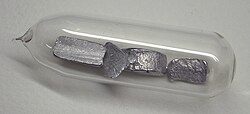 Thallium in ampoule | ||||
| Atom properties | ||||
| Name, symbol, number | Thallium (Thl), 81 | |||
| Atomic mass ( molar mass ) | [204.382; 204.385] [comm 1] [1] a. E. m. ( g / mol ) | |||
| Electronic configuration | [Xe] 4f 14 5d 10 6s 2 6p 1 | |||
| Atom radius | 171 pm | |||
| Chemical properties | ||||
| Covalent radius | 148 pm | |||
| Ion radius | (+ 3e) 95 (+ 1e) 147 pm | |||
| Electronegativity | 1.62 (Pauling scale) | |||
| Electrode potential | Tl ← Tl + −0.338 V Tl ← Tl 3+ 0.71 V | |||
| Oxidation state | 3, 1 | |||
| Ionization energy (first electron) | 588.9 (6.10) kJ / mol ( eV ) | |||
| Thermodynamic properties of a simple substance | ||||
| Density (at N. at. ) | 11.849 [2] g / cm³ | |||
| Melting temperature | 577 K (304 ° C, 579 ° F) [2] | |||
| Boiling temperature | 1746 K (1473 ° C, 2683 ° F) [2] | |||
| Beats heat of fusion | 4.31 kJ / mol | |||
| Beats heat of vaporization | 162.4 kJ / mol | |||
| Molar heat capacity | 26.3 [3] J / (K · mol) | |||
| Molar volume | 17.2 cm³ / mol | |||
| The crystal lattice of a simple substance | ||||
| Lattice structure | hexagonal | |||
| Lattice options | a = 3,456 c = 5,525 [4] | |||
| C / a ratio | 1,599 | |||
| Debye temperature | 96.00 K | |||
| Other characteristics | ||||
| Thermal conductivity | (300 K) 38.9 [3] W / (m · K) | |||
| CAS Number | ||||


| 81 | Thallium |
Tl | |
| 4f 14 5d 10 6s 2 6p 1 | |
Content
History
Thallium was discovered by the spectral method in 1861 by the English scientist William Crookes in the sludge of the lead chambers of a sulfuric acid plant near the city of Abberode , located in the Harz massif.
Thallium metal was independently obtained by William Crookes and the French chemist Claude-Auguste Lamy in 1862 [5] .
Name Origin
The element was named after the characteristic green lines of its spectrum and the green color of the flame. From other Greek θαλλός is a young, green branch [6] .
Being in nature
Thallium is a scattered element. It is found in tricks and pyrites of zinc , copper and iron , in potassium salts and mica. Thallium is a heavy metal. Only seven thallium minerals are known ( cruxite (Cu, Tl, Ag) 2 Se, lorandite TlAsS 2 , vrbaite Tl 4 Hg 3 Sb 2 As 8 S 20 , gutchinsonite (Pb, Tl) S • Ag 2 S • 5As 2 S 5 , Avicennitol Tl 2 O 3 ), all of them are extremely rare. The main mass of thallium is associated with sulfides, and primarily with iron disulfides. In pyrite, it is installed in 25% of the analyzed samples. Its content in iron disulfides is often 0.1-0.2%, and sometimes reaches 0.5%. In galena, the thallium content ranges from 0.003 to 0.1% and rarely more. High concentrations of thallium in disulfides and galena are characteristic of low-temperature lead-zinc deposits in limestone. A thallium content of up to 0.5% is noted in some sulfosalts. A small amount of thallium is found in many other sulfides, for example, in sphalerites and chalcopyrites of some copper pyrite deposits, the content varies from 25 to 50 g / t . Thallium has the greatest geochemical similarity with K , Rb , Cs , as well as with Pb , Ag , Cu , Bi . Thallium easily migrates in the biosphere. From natural waters, it is sorbed by coals, clays, manganese hydroxides, and accumulates during the evaporation of water (for example, in Lake Sivash up to 5–10 −8 g / l). Contained in potassium minerals ( mica , feldspars ), sulfide ores: galena , sphalerite , marcasite (up to 0.5%), cinnabar . As an impurity, it is present in natural oxides of manganese and iron [7] .
The average content of thallium (by weight):
- in the earth's crust 4.5⋅10 −5 %;
- in ultrabasic rocks 10 −6 %;
- in the main rocks 2⋅10 −5 %;
- in sea water 10 −9 %.
Isotopes
Natural thallium consists of two stable isotopes: 205 Tl ( isotopic abundance of 70.48% by the number of atoms) and 203 Tl (29.52%). In negligible amounts in nature there are also radioactive isotopes of thallium, which are intermediate members of the decay series :
- 206 Tl ( T 1/2 = 4.19 min.) And 210 Tl (1.30 min.) - a series of uranium-238 ;
- 207 Tl (4.78 min.) - a series of uranium-235 ;
- 208 Tl (3.1 min.) - series of thorium-232 .
All other known isotopes of thallium with mass numbers from 176 to 217 are obtained artificially.
Getting
Technically pure thallium is cleaned of other elements contained in blast furnace dust (Ni, Zn, Cd, In, Ge, Pb, As, Se, Te) by dissolving in warm dilute acid, followed by precipitation of insoluble lead sulfate and adding HCl to precipitate thallium chloride (TlCl). Further purification is achieved by electrolysis of thallium sulfate in dilute sulfuric acid using a wire of platinum , followed by melting the released thallium in a hydrogen atmosphere at 350-400 ° C.
Properties
Thallium is a shiny silver soft metal with a bluish tint. It quickly fades in air, covered with a black film of thallium oxide Tl 2 O [3] . It dissolves in water in the presence of oxygen with the formation of TlOH , in the absence of oxygen it does not react, therefore, thallium is stored under a layer of boiled distilled water (or paraffin, and also varnished) [3] .
Physical Properties
Exists in three modifications. The low-temperature modification of Tl II is a crystal of hexagonal syngony , space group P 6 3 / mmc , cell parameters a = 0.34566 nm , c = 0.55248 nm , Z = 2 , magnesium type lattice. Above 234 ° C, there is a high-temperature modification Tl I of cubic syngony (body-centered lattice), space group Im 3 m , cell parameters a = 0.3882 nm , Z = 2 , lattice of the α-Fe type ; the transition enthalpy between modifications I and II is 0.36 kJ / mol . At 3.67 GPa and 25 ° C, Tl III modification of cubic syngony (face-centered lattice), space group Fm 3 m , cell parameters a = 0.4778 nm , Z = 4 . The melting point is 577 K (304 ° C), boils at 1746 K (1473 ° C) [2] . Thallium belongs to the group of heavy metals ; its density is 11.855 g / cm 3 [2] .
The cross section for thermal neutron capture by an atom is 3.4 ± 0.5 barn. The configuration of external electrons is 6s 2 6p. Ionization energies (in eV ): Tl 0 → Tl + → Tl 2+ → Tl 3+ → Tl 4+ are respectively 6.1080; 20,4284; 29.8; 50.0 [3] .
Thallium is diamagnetic , the mass magnetic susceptibility of polycrystalline hexagonal thallium is χ = −0.249 · 10 −9 m 3 / kg under normal conditions, −0.258 · 10 −9 m 3 / kg at T = 14.2 K. For cubic polycrystalline thallium at T > 235 K, the mass magnetic susceptibility is −0.158 · 10 −9 m 3 / kg . Single-crystal hexagonal thallium exhibits anisotropy, χ || = −0.420 · 10 −9 m 3 / kg , χ ⊥ = −0.164 · 10 −9 m 3 / kg . For liquid thallium, χ = −0.131 · 10 −9 m 3 / kg at the melting temperature [8] .
At a temperature of 2.39 K, thallium transforms into a superconducting state .
The thallium spectrum in the visible range has a bright line with a wavelength of 525.046 nm (green), due to which this element got its name.
The Mohs hardness is 1.3, and according to Brinell it is 20 MPa [3] .
Chemical Properties
Reacts with non-metals: with halogens and oxygen at room temperature, with sulfur, selenium, tellurium, phosphorus - when heated. It fuses with arsenic without the formation of a compound. It does not react with hydrogen, nitrogen, carbon, silicon, boron, and also with ammonia and dry carbon dioxide.
Easily soluble in nitric acid, worse in sulfuric acid. Hydrochloric acid acts weakly on thallium due to passivation with a film of thallium monochloride .
It does not react with alkalis, with ethanol in the presence of dissolved oxygen forms thallium ethylate .
In compounds, it exhibits oxidation states of +1 and +3. The most stable salts are Tl (I), which resemble salts of potassium, silver and lead. Under the action of bromine water , potassium permanganate , potassium bromate, potassium disulfate, Tl (I) is oxidized to Tl (III), whose salts are thermally unstable, easily hydrolyzed and reduced. In solutions, Tl (III) is reduced to Tl (I) under the action of sulfur dioxide , hydrogen sulfide , sodium thiosulfate and a number of metals, including zinc , iron and copper . Compounds are known in which thallium is present immediately in two oxidation states, for example, thallium (I) hexachlorotallate (III) Tl 3 [TlCl 6 ].
Application
- Thallium amalgam has a low melting point ( t pl = −61 ° C; only the eutectic in the sodium-potassium-cesium system with t pl = −78 ° C is more easily melted). It is used for filling low-temperature thermometers and as a coolant .
- Nuclide 201 Tl is used in medicine for cardiology research.
- Thallium is introduced as an activator into the crystals of sodium iodide , which is used as a scintillator for detecting ionizing radiation.
- In infrared optics, thallium (I) bromide and iodide are used as lens materials. In addition, during the Great Patriotic War, thallium oxysulfide (thallophide) was used as a sensitive element of night-vision devices [9] .
- Thallium (I) iodide is added to metal halide lamps.
- The Klerichi solution , consisting of thallium formate (HCOOTl) and thallium malonate (CH 2 (COOTl) 2 ), is used in mineralogy to determine the properties of minerals.
- Thallium (I) sulfate and thallium (I) carbonate were previously used as a means of controlling rodents in hard-to-reach places.
- Trivalent thallium is the main component of some relatively strong oxidizing agents in organic synthesis:
- Thallium (III) trifluoroacetate or thallium tris (trifluoroacetate), TTFA (Tl (Otfac) 3 ); [ten]
- Thallium Trinitrate , TTN (Tl (NO 3 ) 3 );
- Thallium triacetate , TTA (Tl (CH 3 COO) 3 ).
Physiological Impact
Both thallium itself and its compounds are highly toxic and carcinogenic (especially soluble in water - chloride , nitrate , acetate , etc.). Thallium compounds are classified as cumulative poisons - accumulating pathological symptoms in chronic poisoning [11] .
Thallium compounds affect the peripheral nervous system , gastrointestinal tract and kidneys .
Monovalent thallium ions Tl + replace potassium ions in biochemical processes due to the similarity of their chemical properties. Thallium is concentrated in the hair, bones, kidneys and muscles.
A characteristic symptom of poisoning with thallium compounds is partial hair loss, with a significant dose - total alopecia . At a high dose, alopecia is uncharacteristic, as a person dies from poisoning before the onset of hair loss.
The maximum permissible concentration in water for thallium is 0.0001 mg / l, for bromide , iodide , carbonate (in terms of thallium) in the air of the working zone ( maximum permissible concentration ) is 0.01 mg / m 3 , in atmospheric air 0.004 mg / m 3 .
The lethal dose of thallium for adults in compounds is 600 mg .
When poisoning with thallium or its compounds, Prussian blue is used as an antidote .
First aid for thallium poisoning - gastric lavage with a solution of 0.3% sodium thiosulfate (Na 2 S 2 O 3 ) with shaken powder of activated carbon .
Criminal poisoning with thallium compounds is described in a number of action-packed works of detective literature [12] [13] and films [14] .
Known cases of thallium poisoning
- 1950s - Thallium madness in Australia .
- 1987 - the case of Tamara Ivanyutina .
- 2017–2018 - mass poisoning in Taganrog at the Taganrog Aviation Scientific and Technical Complex named after G. Beriev [15] [16] .
Notes
- ↑ Michael E. Wieser, Norman Holden, Tyler B. Coplen, John K. Böhlke, Michael Berglund, Willi A. Brand, Paul De Bièvre, Manfred Gröning, Robert D. Loss, Juris Meija, Takafumi Hirata, Thomas Prohaska, Ronny Schoenberg , Glenda O'Connor, Thomas Walczyk, Shige Yoneda, Xiang ‑ Kun Zhu. Atomic weights of the elements 2011 (IUPAC Technical Report ) // Pure and Applied Chemistry . - 2013 .-- Vol. 85 , no. 5 . - P. 1047-1078 . - DOI : 10.1351 / PAC-REP-13-03-02 .
- ↑ 1 2 3 4 5 Thallium: physical properties . WebElements. Date of treatment August 20, 2013.
- ↑ 1 2 3 4 5 6 Fedorov P.I. Thallium // Chemical Encyclopedia: 5 tons / N. Zefirov (Ch. Ed.) . - M .: Big Russian Encyclopedia , 1995. - T. 4: Polymer — Trypsin. - S. 490-492. - 639 p. - 40,000 copies. - ISBN 5-85270-039-8 .
- ↑ Thallium: crystal structure . WebElements. Date of treatment August 20, 2013.
- ↑ * Crookes, William (March 30, 1861) "On the existence of a new element, probably of the sulphur group," Chemical News , vol. 3, pp. 193–194 ; reprinted in: Crookes, William. Xlvi. On the existence of a new element, probably of the sulphur group (Eng.) // Philosophical Magazine : journal. - 1861 .-- April ( vol. 21 , no. 140 ). - P. 301-305 . - DOI : 10.1080 / 14786446108643058 . ;
- Crookes, William (May 18, 1861) "Further remarks on the supposed new metalloid," Chemical News , vol. 3, p. 303 .
- Crookes, William (June 19, 1862) "Preliminary researches on thallium," Proceedings of the Royal Society of London , vol. 12, pages 150-159.
- Lamy, A. (May 16, 1862) "De l'existencè d'un nouveau métal, le thallium," Comptes Rendus , vol. 54, pages 1255-1262 .
- ↑ Weeks, Mary Elvira . The discovery of the elements. Xiii. Supplementary note on the discovery of thallium (Eng.) // Journal of Chemical Education : journal. - 1932. - Vol. 9 , no. 12 . - P. 2078 . - DOI : 10.1021 / ed009p2078 . - .
- ↑ Wolfson F.I., Druzhinin A.V. The most important types of ore deposits, Moscow: Nedra, 1975, 392 p.
- ↑ Physical quantities: Reference book / Ed. I.S. Grigoriev, E.Z. Meilikhova. - M .: Energoatomizdat, 1991 .-- S. 602. - 1232 p. - 50,000 copies. - ISBN 5-283-04013-5 .
- ↑ Thallium
- ↑ Sullivan, PD Menger, EM Reddoch, AH Paskovich, DH Oxidation of anthracene by thallium (III) trifluoroacetate. Electron spin resonance and structure of the product cation radicals. (English) // Journal of Physical Chemistry . - 1978. - Vol. 82 , no. 10 . - P. 1158-1160 . - DOI : 10.1021 / j100499a015 .
- ↑ Tarasenko N.V., Rubtsov V.F., Malinin A.V., Sedov V.V. Thallium // Big Medical Encyclopedia : in 30 tons / hl. ed. B.V. Petrovsky . - 3 ed. - Moscow: Soviet Encyclopedia , 1985. - T. 24. Vascular suture - Teniosis . - 544 p. - 150,800 copies.
- ↑ Dr John Emsley . The trouble with thallium (Eng.) // New Scientist . - 1978. - 10 August. - P. 394.
- ↑ Villa "White Horse"
- ↑ Crime. RU. Criminal Russia The elusive smack of death (December 11, 2016). Date of treatment February 18, 2018.
- ↑ Korolev, Nikita Thallium brought to the Taganrog aviation enterprise . Kommersant (March 1, 2018). Archived March 1, 2018.
- ↑ Comment of PJSC "TANTK named after G.M. Beriev" regarding poisoned employees. . TANTK them. G. Berieva (March 2, 2018). Archived March 6, 2018.
- Comments
- ↑ The range of atomic mass values is indicated in connection with the heterogeneous distribution of isotopes in nature.