Dinaburg Castle ( Dinaburg , German: Dünaburg , Latvian. Dinaburgas pils ; in medieval Russian documents also Nevgin ) - a castle in Latvia that existed in 1275-1577. In the damaged form it remained until the Northern War ( 1700 - 1721 ), during which it was even more destroyed; the walls were dismantled in 1811 - 1829 .
| Castle | |
| Dinaburg Castle | |
|---|---|
| Schloss dünaburg | |
 Castle layout | |
| A country |  Latvia Latvia |
| Location | |
| Founder | Ernst von Ratsenburg |
| Established | 1275 year |
| Status |  Monument of Culture , No. 680 Monument of Culture , No. 680 |
| condition | destroyed; underground part partially preserved |
| Site | History of the Dinaburg Fortress |
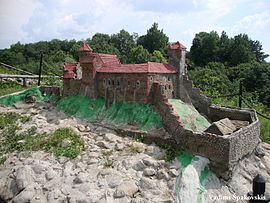
The remains of the castle are located in the protected area of the Daugavas Loki Natural Park; here in 1996 a mock castle was installed.
The date of construction of the castle - 1275 is considered the founding date of the city of Daugavpils .
Content
History
Reconstruction of 1893.
In the middle of the XIII century, the German swordsmen decided to create strongholds in order to keep the Latgalian local population in obedience and confront the Russian princes. A place for one of such points was chosen on the bank of the Daugava (Dvina), where the ancient settlement Nevgin (modern Nauene , 19 km upstream of the Daugava from Daugavpils ) was located. The ancient settlement Nevgin was part of the Principality of Gersik .
Here trade routes passed from Pskov and Novgorod to Vilno , and from Polotsk to Riga and the Baltic .
| Only the army that was there This mountain went around As the master stood in place, The Knight Brothers said: "This important mountain It bodes well for us. We’ll put a lock on it And save ourselves from troubles ”Reimchronik |
In 1275, on the site of the wooden castle of Novén, the master of the Livonian Order Ernst von Ratzeburg built the castle, which was originally wooden. The citadel rose 24 m and was protected by the Daugava riverbed, two deep ravines and ditches with a drawbridge. The castle was equipped with significant military and food supplies. It became the residence of the Komtur (commander), in whose hands power was concentrated over the whole territory that modern Latgale now occupies. The castle commentary covered Rezekne , Ludza , Liksno and Ilukst districts . A settlement was formed near the castle, which in the XIII-XIV centuries was a significant place of trade.
The castle was an important stronghold in the struggle of the Order with Lithuania and the Russian principalities. The successful location at the crossroads of trade routes ensured the rapid growth of the merchant village . Due to frequent military clashes, the castle did not turn into a large shopping center.
The Grand Duke of Lithuania, Troyden , besieged the castle around 1277 . The assault lasted continuously for a month. The Lithuanians built four huge mobile towers for the assault. The efforts of the attackers, including the Russians, were unsuccessful: they had to destroy the siege weapons and retreat beyond the Daugava .
In response to this, in the winter of 1278, the master went on a campaign inland, but was defeated.
In 1313 , 1396 , 1403 and 1418, Russians and Lithuanians seized the castle, destroyed it, but the masters with enviable persistence restored Dinaburg:
- In 1313, the castle was restored by the master of the Livonian Order Gerhard von York (Yoke);
- In 1396, the castle was destroyed by the Lithuanians, and the Order once again restored it;
- In 1403, the Grand Duke of Lithuania Vytautas , having entered the war with the Order, broke into Latgale , walked through it with fire and a sword. The castle was again destroyed and rebuilt by the crusaders ;
- In 1418, Vytautas burned it again.
The Russian army of Ivan III in 1481 captured Dinaburg and forced Master Walter von Plettenberg to sign an agreement with the Moscow principality on tribute. However, the contract was violated.
The Knightly Order began to set Poland and Sweden on a war with Russia , which sought to establish economic ties with Western Europe and reach the Baltic Sea for this.
For this reason, and under the pretext of non-payment by the Order of Tribute for the Yuryev ( Tartu ) land, which paid the quitrent to the Kiev princes, in 1558 Ivan IV the Terrible began military operations against Livonia .
| He was persistent in his attempts against Livonia - his conscious goal was to give Russia access to the Baltic Sea.Karl Marx |
According to legend, Ivan the Terrible sent the enemy a whip with the inscription:
| I can not and do not want to endure the insult committed against me and my people. God sends you punishment in me in order to lead you to obedience! |
In 1559, the Dinaburg castle was captured by the Russian-Tatar detachment, and for some time Ivan the Terrible had a residence in it. Then the Russian troops left the castle.
After another siege in November 1561, the weakening Order of the Knights pleaded vassal of the Polish crown and transferred Dinaburg to Sigismund Augustus . Five years later, Sigismund Augustus ordered to appoint it as the main city of the Infland (Latgale) province, to throw away the old coat of arms of the castle (a shield divided by a dash in two, in the top - the image of the Mother of God with a baby in her arms, in the bottom - a knight on her knees hugging the castle wall) and assign a new one: on a red field, a white vulture holds a naked sword in his right paw, and the king’s initials on the chest of this half-bird are half initials.
Soon in Dinaburg the administrative department of all Latgale, the residence of the Catholic bishop, was located. The importance of the city has increased.
In 1577, Ivan the Terrible, after two weeks of siege, again captured Dinaburg. The Russian troops used huge cannons, throwing cores weighing 20 pounds (320 kg), made by the disciples of Andrei Chokhov , who cast the Tsar Cannon.
Ivan the Terrible ordered to destroy Dinaburg to the base and proceed with the construction of a new fortress, since the old fortress interfered with troops during campaigns in Riga. The king’s order on the destruction of Dinaburg was executed, so much so that so far it has not been possible to discover its original foundation.
Gradually, the castle was losing its military significance and began to collapse. In 1577, after a siege, the settlement was moved 19 km downstream of the Dvina River and a trench (military fortification) was laid down at the mouth of the Shunitsa river at the behest of the Tsar. Next to the trench later built the city of Stefan Batory . In 1582, Stefan Bathory decided not to rebuild the castle, but to build a new fortress 19 kilometers downstream of the Daugava (on the site of the modern Daugavpils ). In 1671 they wanted to repair the castle, but during the Northern War (1700-1721) the castle was completely destroyed. It is known that local peasants dismantled stones and bricks and sold them to the contractor, who delivered the material for the construction of the fortress; the remains of the walls, in spite of the imperial decree (dated December 31, 1826 ) to protect all the remains of antiquity, were sold by the Vitebsk Chamber of State Property for 300 rubles. The main walls of the castle were demolished in 1811 - 1829 .
Architecture
Initially, the castle, modeled on the defensive structures of the time, was built of field stones and had blind walls with loopholes. The entrance to the castle was from the east, via a drawbridge. The gates were typical of order castles, with their lateral buildings forming the east wing. It is believed that this wing was the oldest part of the castle. The castle was irregular in plan, taking into account the terrain. At that time, the castle was considered large: 120 steps in length and 40 in width. Around him was a forburg , fenced with a protective wall, the thickness of which exceeded two and a half meters.
During the excavations of 1888, under the leadership of V. Neumann, small order coins were found - shillings, with the designation of the minting site - Revel of the late XV - early XVI century , stone cores, clay vessels, fragments of glass and tiles. In front of the western side of the castle was a front yard or trench, which was created at the time of the appearance of firearms. Chanets lay 17 m below the main castle’s bridge and served as the front line for the defense of the citadel. The front yard was surrounded by a wall with a thickness of 2.5 m. After 1979, in connection with the construction of the Daugavpils Hydroelectric Power Station , excavations began at the site of the ruins. If a hydroelectric power station was built, the castle hill would turn into an island that rises about 7-8 meters above the water. In 1982, on the castle hill (Old Castle), archaeological excavations were carried out under the leadership of the Academy of Sciences of the LSSR , materials were published in the city newspaper "Red Banner" . Currently, you can explore the excavated western part.
Dinaburg Trail
After the castle site became a tourist destination, a hiking trail several hundred meters long was laid to the ruins. It starts near the parking lot, then goes down 20 meters down, where 2 streams merge. Above this place is a wooden bridge. Further, the path goes along the slope and rises to the castle hill. The descent from the castle mountain to the Daugava is equipped with a wooden staircase. At this place used to be the front yard of the castle. Below is the continuation of the trail to the "Knights Square", where a place for a fire is equipped.
The trail ends with an ascent to the parking lot, crossing the place where the ancient medieval cemetery was located, destroyed in the late 1980s, in connection with the construction of the Daugavpils hydroelectric station .
Present
In 1990, Castle Hill came under the protection of the Daugavas Loki Nature Park. Guided tours were made to the mountain, wooden pedestrian bridges were built, and stairs were made.
In 1996, a castle model was installed on the site of the former castle. The author and performer of the layout is Igor Petrovich Manzhos.
In 1999, some fragments of the castle walls were excavated.
In 2003, barriers to the walls of the castle and the layout were built.
In July-August 2008, the front yard was excavated.
In 2009, the restoration of the layout.
Excavation years
- 1888 - directed by V. Neumann
- 1890
incomplete information
- 1982
- 1986-1989
- 1999
- 2000
- 2008 - directed by A. Vilzane [2]
Interesting Facts
- Old-timers say that before 1941 one could go down to the castle's dungeon. But during the war this area was heavily bombed, and to date, the entrance to the remains of the dungeons (if they still exist) has not been found.
- During the excavations of 2008, an arrowhead, bones, jewelry, metal forging slag, and ceramics were found.
- Castle Hill is located in the proposed flood zone of the Daugavpils Hydroelectric Power Station .
See also
- Kommstvo Dinaburg
Literature
- Jakub Z. I. Daugavpils in the past. Publications of the local historian. - Daugavpils: AKA, 1998. 304 S. ISBN 9984-582-08-6
Notes
Links
- Bit Book, 1475-1605, Volume II. Part III. M. Academy of Sciences of the USSR. (Institute of History). The science. 1982
- History of the Dinaburg Fortress
- Excursion into the history of the city of Daugavpils
- 2000 archaeological site
- Archaeological site of Dinaburg Castle (2008) (unavailable link from 05/25/2013 [2276 days])
- Earth keeps secrets