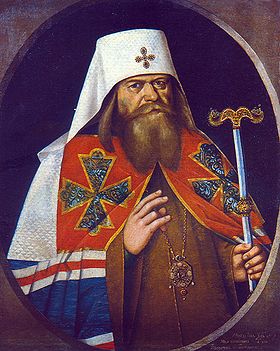
Patriarch Adrian (in the world Andrey ; October 2 (12), 1637 , or 1627 [2] , Moscow - October 16 (27), 1700 , Moscow ) - the last Patriarch in the First Patriarchal period, from August 24, 1690 years, Patriarch of Moscow and All Russia .
| Patriarch Adrian | ||
|---|---|---|
 | ||
| ||
| August 24 (September 3) 1690 - October 2 (October 13) 1700 | ||
| Intronization | August 24 (September 3) 1690 | |
| Church | Russian Orthodox Church | |
| Predecessor | Patriarch Joachim | |
| Successor | Metropolitan Stefan ( patriarchal locum tenens ) until 1721; Patriarch Tikhon (1917) | |
| ||
| March 21 (March 31) 1686 - August 24 (September 3) 1690 | ||
| Predecessor | Joasaph | |
| Successor | Marcell | |
| Birth name | Andrew | |
| Birth | October 2 (12), 1627 Moscow | |
| Death | October 16 (27), 1700 (73 years old) Moscow | |
| Buried | Assumption Cathedral [1] | |
Full title: His Holiness Cyrus Adrian, Archbishop of Moscow and All Russia and all the Nordic Countries, Patriarch [3] .
Content
Biography
Born in Moscow on October 2 (October 12), 1627 (according to some sources - 1639). Already a monk, his piety and virtues were known to Patriarch Joachim , who in 1678 appointed him archimandrite of the Chudov Monastery . Managing the monastery, Archimandrite Adrian “made a great deal of the dispensation” of this monastery. Under his supervision, a cathedral church was built in the name of St. Alexis with the Annunciation side chapel, as well as a church in the name of St. Apostle Andrew the First-Called.
The position of the miracle archimandrite in the hierarchy of that time was so prominent, and Adrian’s personal qualities were so outstanding that in 1686, Patriarch Joachim made him Metropolitan of Kazan and Sviyazhsky . On the activities of Metropolitan Hadrian in the Kazan diocese, information has practically not been preserved. It is only known that he made contributions to the beautification of the Annunciation Cathedral and wrote the book “On the Ancient Tradition of Saints, the Apostle and Saints, the Father, Which Befits Every Orthodox Christian to the Sign of the Cross ... Finger Fellows and What a Picture of Himself”.
In the last days of the life of Patriarch Joachim, Metropolitan Adrian was his right hand, and after his death he ruled the Moscow diocese , although he was still titled Metropolitan of Kazan and Sviyazhsky.
On August 24, 1690, Metropolitan Adrian was elevated to the Patriarchal throne. During his intronization, Patriarch Adrian called upon the Orthodox to keep the canons untouched, to observe peace, to protect the Church from heresies . In the "District Epistle" and "Exhortation" to the flock, consisting of 24 points, Patriarch Adrian taught each of the classes spiritually useful instructions. He did not like shaving, smoking, the abolition of Russian national clothes, and other similar household innovations of Peter I. Useful and really important undertakings of the tsar, aimed at the good dispensation of the Fatherland (the construction of the fleet, military and socio-economic transformations), Patriarch Adrian understood and supported.
Patriarch Adrian sought to influence his flock exclusively in a moral way, completely abandoning any external pressure. This approach was promoted by his monastic mood of the soul, his appeal to the inner man, the desire to awaken his conscience.
The diocesan administration under Patriarch Adrian continued to maintain the appearance and character established by Patriarch Joachim. To streamline church life, Patriarch Adrian issued the “Instructions to the Elders of the Popes” with a more accurate distribution of cases according to orders, as well as “The Hierarchical Preaching to Newly-Priered Priests”. The services of Saints Donatus, Hypatius, Daniel of Moscow and Daniil Pereyaslavsky , several teachings , letters to various people, including two to Peter I, and several letters, including one with praise to the future Hierarch Dimitri , Metropolitan of Rostov (then still Abbot), to whom the Patriarch especially favored the compilation of the Fourth-Minei .
Spirituality and standing in the faith of the fathers, upholding the traditional way of life found expression both in the Patriarchal Epistles and in his spiritual testament published upon the death of the Patriarch, drawn up three and a half years before his death. The patriarch, parting with the flock, bequeathed to protect the "Orthodox-Catholic faith", "to honor the Holy and Apostolic Church, protect it from all heresies and seduced libels."
In 1698, Patriarch Adrian blessed to be counted among the saints Euphrosyne of Suzdal , whose relics were discovered in the 16th century, and to commemorate her on September 25 (October 8).
On October 15, 1700, Patriarch Adrian died in the countryside Perervinsky monastery on the 74th year of his life [4] .
Patriarchate
Adrian and the reforms of Peter I
The ten-year activity of Hadrian, which included the patriarchal period, is of interest in that Hadrian, who was old-fashioned and reluctant to respond to the reforms of Peter I , had to recognize the justice of many of the tsar’s indications of disorder in church administration and came up with some amendments that made the beginning of reforms in the church area . So, on December 26, 1697, he instructed the archimandrite of the Vladimir Nativity Monastery, Joseph, to instruct the elders of the priests and dean rangers to seek to correct much that needed to be corrected and did not escape the sight of Peter I. It is here that we see concerns about observing church deanery everywhere, supplying all churches with serviceable printed books and Missal, all church facilities, on the observation that there are no priests without written letters to wandering and black priests from parish priests treb not bounces and to lay people illegally the robes are not worn, the court went only as if old age and so on. d. (1st Complete Collection of Laws , number 1611). Similarly, his other order (1698), so as not to allow anywhere to establish new monasteries without the sovereign decree (No. 1629). Despite the fact that Adrian sometimes allowed himself to sharply object to the tsar, he himself appeared, however, with a proposal to the House of Imposition to process the articles “on the holy court”.
Relations with the tsar escalated after his refusal in 1698 to mow the wife of Peter I, Evdokia Lopukhin . During the Streletsky revolt in 1698-1699 he stood up for the executed, but his request was rejected by Peter I. On the other hand, during the same period, Peter I discussed the level of Russian education with the patriarch and insisted on the need for broad and thorough education in Russia. The patriarch fully supported the king, and these reforms led to the creation of the Academy of Sciences in 1724 [5] .
The opposition of Patriarch Adrian to the anti-clerical policy of Peter I caused sharp reviews by his contemporaries (known are the denunciations of the holy fool Ivan Nagoy and Metropolitan Ignatius of Siberia and Tobolsk) and criticism from later historians (for example, Anton Kartashev ).
Peter I, citing state affairs, did not come to the funeral service of the patriarch, which was an unprecedented event in Russian history. According to Kartashev, “Peter tactfully waited for this end and tactfully lingered on the traditional form of locality of the patriarchal throne ” [6] , which lasted more than twenty years.
Buried in the Assumption Cathedral of the Moscow Kremlin .
Theological controversy
Under the Patriarch Adrian there were two cathedrals: one (1697) regarding the deacon Mikheev, who proposed new dogmas regarding baptism and other rites, the other about (1698) the deacon Peter, who claimed that the pope was a true shepherd.
Shortly before his patriarchate, the struggle of two teachings on the Eucharist — the Likhud brothers and Sylvester Medvedev — was allowed. The former, representing the traditional “Greek” party, taught that bread and wine became the body and blood of Jesus Christ after the secretary uttered the words “By applying your Holy Spirit”; while Medvedev and others from the "Latin" party argued that mysterious transubstantiation occurs during anamnesis . The patriarch, apparently sharing the teachings of the Likhud brothers, referred this dispute to the resolution of the eastern patriarchs, and their teaching was recognized as correct. Nevertheless, the brothers remained removed in the Kostroma Ipatiev Monastery , and their teaching, set forth in the book “The Shield of Faith,” remained unprinted.
Proceedings
Patriarch Adrian wrote several sermons and theological interpretations, some of which were printed; the most important of them are: “A Note on the Hierarchical Courts” submitted to the House of Departments (for example, in the article of Kalachev, on the significance of the helmsmen in the system of other Russian law, 1849) and a “Letter of Beard” (for example, by Esipov, “Raskolniki Cases” , 2 vols., And according to his short edition, reprinted in the 1st vol. Of the Critical-Biographical Dictionary of Vengerov, 1889).
- "The shield of faith."
- "Spiritual Testament."
- Two letters: “To the Middle Boyar Alexei Semenovich Shein” under Azov, 1696.
- Services: Saints Donatus, Hypatia, Daniel of Moscow and Daniel Pereyaslavsky. miracle worker.
- "Instruction to the priests elders."
- "Hierarchical teaching to new priests."
- “On the Tradition of St. Apostle and St. Father: some fingers on the meaning of the cross svagasta. "
- "Extract of the rights and rulers of the Greek-Russian church."
- 7 documents addressed to Peter I. The Wanderer, 1905, vol. I, part I, p. 732.
Notes
- ↑ Grand Duke Nikolai Mikhailovich . Moscow necropolis. - St. Petersburg: Printing house M.M. Stasyulevich, 1907.- T. I. - S. 10.
- ↑ I. L. Andreev, L. A. Belyaev, T. V. Gimon, S. V. Dumin, K. Yu. Erusalimsky, Y. I. Zverev, A. I. Kuksin, N. B. Leonova, E N. Marosinova, D. A. Mindich, L. E. Morozova, D. O. Osipov, E. V. Pchelov, E. N. Svyatitskaya, L. M. Starikova, I. Yu. Strikalov, S. N Tatsenko, V. V. Trepavlov, S. Yu. Shokarev, Yu. V. Shokarev, M.K. Yurasov. The history of Russia until the XIX century. - M .: Bustard-plus , 2008 .-- S. 47.- 856 s. - ISBN 978-5-9555-1225-9 .
- ↑ Peter and Paul Cathedral ... why not Borisoglebsky - Essay on the history of the city of Petrovsk
- ↑ Adrian, Patriarch of Moscow and All Russia . Patriarchy.ru. Date of treatment March 12, 2018.
- ↑ P.N.Senko. Introduction // Russian church leaders - members of the Academy of Sciences: historical biogr. Researches: at 3 p. for issue. D. E. Baburin, E. A. Balakisheeva. - SPb. : Lance, 1995 .-- S. 11. - 288 p. - 1000 copies. - ISBN 5-86379-021-0 .
- ↑ Kartashev A.V. Essays on the history of the Russian Church. In 2 vols. - M .: Terra, 1997 .-- T. 2 .-- S. 263.
Literature
- Adrian, All-Russian Patriarch // Encyclopedic Dictionary of Brockhaus and Efron : 86 volumes (82 volumes and 4 additional). - SPb. , 1890-1907.
- Adrian, Russian patriarch // Great Soviet Encyclopedia : in 66 volumes (65 volumes and 1 additional) / Ch. ed. O. Yu. Schmidt . - M .: Soviet Encyclopedia , 1926-1947.
- Bumblevsky L. Historical background of the establishment of the Holy Synod of the Russian Orthodox Church .
- Belyakova E.V. Adrian // Orthodox Encyclopedia . - M .: Church Scientific Center "Orthodox Encyclopedia" , 2000. - T. I. - S. 312-313. - 752 s. - 40,000 copies. - ISBN 5-89572-006-4 .
- Bogdanov A.P. The Hierarchical Court of the Patriarch Adrian // Religions of the world: history and modernity. - M., 2004 .-- S. 123-137.
- Pavlov A.N. Diploma of Peter I to Patriarch Adrian on the capture of Azov // Bulletin of Church History . - 2006. - No. 2. - S. 240–242.
- Skvortsov G. A. Patriarch Adrian, his life and works in connection with the state of the Russian Church in the last 10 years of the 17th century. - Kazan, 1913.
Links
- Adrian Article in the Orthodox Encyclopedia ( 2000 )
- Adrian on the site Russian Orthodoxy
- Andrey Petrovich Bogdanov. Patriarch Adrian
- ADRIAN, Patriarch of Moscow and All Russia (Andrey)
- The Presidency of Patriarch Hadrian (1690-1700) in the Orthodox Encyclopedia .
| Predecessor: Patriarch Joachim | Patriarchs of Moscow 1690 - 1700 | Successor: Stefan Yavorsky ( patriarchal locum tenens ), Tikhon (Patriarch of Moscow) |