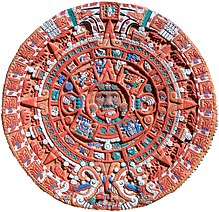
The Aztec calendar is a time measurement system used by the peoples of Mesoamerica . For the first time this system appeared among the Olmecs about 3,500 years ago and later spread among the cultures and peoples of central Mexico, including the Mayans , Zapotecs and Aztecs , who believed that time embodies the divine presence and also predetermines a happy, unhappy or neutral fate.
| The calendar | |||
|---|---|---|---|
| Other calendars | |||
| Armelijah Indian · Inca · Iranian · Irish · Islamic · Celtic · Kyrgyz · Chinese · Comte · Coptic · Malay · Maya · Masonic · Mingo · Nepali · Novoyulia sky · Proleptichesky: Julian , Gregorian · Roman · Rumiysky · Balanced · Soviet · Stable · Tamil · Thai: moon , sunny · Tibetan · Trohsezonny · Tuva · Turkmenistan · French · Khakassia · Canaanite · Harappan · Juche · Breakfast · Sumer · Ethiopian · Julian · Javanese · Japanese |
The calendar consisted of two parallel cycles: civilian 365-day shiupoualli ( ast. Xiuhpohualli , which means “count of years”, corresponds to the haab of Maya) and ritual 260-day tonalpoualli ( ast. Tonalpohualli , which means “count of days" or “count of destinies "Corresponds to the tzolkin in Maya). Shioupoualli and tonalpoualli coincided every 52 years, forming the so-called "century", called the "New Fire". The Aztecs believed that at the end of each such 52-year cycle, the world was in danger of being destroyed, so the start of a new one was marked by special celebrations. One hundred "centuries", in turn, constituted the 5,200-year-old era, called the "Sun". In accordance with this system, we are currently living in the fifth era of the Four Earthquakes , the “sun” of which is the god Tonatiu .
The Aztecs believed that both calendars were of divine origin: the first was associated with Quetzalcoatl , and the second with Oshomoko and Sipactonal , the deities of astrology and calendars.
The calendar year began with the first appearance of the Pleiades above the eastern horizon just before the rising of the Sun (see Heliatic Sunrise ).
Content
Civil Calendar
At the heart of the civil or agricultural calendar lay the solar year. In accordance with this calendar, the Aztecs determined the dates and duration of rites and ceremonies associated with agricultural cycles. The calendar consisted of 18 months for 20 days. Five days were one week. In order to correspond to the astronomical year, nemontemi were added to it - five empty days, an additional week of fasting and abstinence.
The problem of leap years was solved by doubling one day every four years. It was not possible to establish an exact correlation with the Gregorian calendar , but many authors agree that the beginning of the Aztec year was in the first days of February.
The shiupoualli year was given a name, or was numbered in its own way, receiving one of 52 combinations consisting of a number from 1 to 13 and four characters of talpowalli (see below): calli (house), dottli (rabbit), akatl (reed), texpatl (flint). For example, Hernan Cortes met with Montezuma II on day 8 Wind per year 1 Reed (or November 8, 1519).
| No | Name of the month | Patron Deity and Rituals | |
|---|---|---|---|
| one | Atlcahualo (cessation of water) | Tlaloc , Chalchiuhtlicue | Sacrifice of children to aquatic deities |
| 2 | Tlakashepeualitstli (flaying people) | Shepe Totek | Warrior sacrifice; the dance of the priest with skin torn from the victims |
| 3 | Tososontli (small vigil) | Coatlicue , Tlaloc | Burial of the skin of the victims, the sacrifice of children |
| four | Waitosostli (great vigil) | Centeotl , Chicamecocoatl | Blessing new corn; girl sacrifice |
| five | Toshkatl (drought) | Tezkatlipoka , Huitzilopochtli | Sacrifice of the personifications of the gods |
| 6 | Etsalkualistli (dish of corn and beans) | Tlaloc | Ritual suffocation of water gods personifications; ritual ablutions and dances |
| 7 | Tequiluitontli (small feast of the gentlemen) | Shuishtochiuatl , Shochipilli | The sacrifice of the personifications of the gods; salt makers ceremony |
| eight | Weitekuutl (Gentlemen's Great Feast) | Xilonen | Feast of the young corn goddess; to know gives out gifts and mobile food |
| 9 | Tlashochimako (birth of flowers) | Huitzilopochtli | All images of the gods are decorated with flower garlands. A feast with corn tortillas and turkey. |
| ten | Shokotluetsi (falling fruits) Weymikkaiuytl (big feast of the dead) | Shiuteutkutli | Ritual contest; sacrifices to the fire gods (burning of sacrifices) |
| eleven | Ophanistli (sweeping the road) | Tlasolotelot | Sweeping houses and roads; battle imitation |
| 12 | Teoteleko (return of the gods) | Tezkatlipoka | Welcome ceremonies in honor of the return of the gods to earth; ritual intoxication, fire sacrifices |
| 13 | Tepeiuitl (feast of the hills) | Tlaloc | Ceremonies dedicated to the gods of the mountain rains; human sacrifice and ritual cannibalism |
| 14 | Kecholli (precious feather) | Mixcoatl-Kamashtli | Fasting and subsequent ritual hunting; sacrifice of prey and ritual feast |
| 15 | Panktsalistli (raising the flag) | Huitzilopochtli | Houses and fruit trees are decorated with paper flags; procession; mass sacrifices |
| sixteen | Atemostli (the descent of waters) | Tlaloc | Feast in honor of the water gods; Sacrifice of children and slaves |
| 17 | Titlle (stretching) | Ilamatekutli | Magical rituals to induce rain; beating women with sacks of straw to make them cry |
| 18 | Iscally (resurrection) | Shiuteutkutli | The construction of figures of gods from amaranth dough; feast with tamales and plants |
| Nemontemi (empty days) | Five days of fasting and abstinence without rituals | ||
Holy Calendar
In addition to the civil calendar, the Aztecs used the sacred tonalpoualli calendar. This sacred calendar was recorded in the "book of days" tonalaml , which was a code on leather or paper made from bark, on the basis of which the priest of tonalpouke calculated horoscopes and predicted favorable and unfavorable days. Each day was assigned a combination of from 1 to 13 and one of twenty sign days, so each day of the year had its own unique designation. In total, there are 260 such combinations, which resulted in a 260-day holy year. The year consisted of 20 weeks for 13 days, and when a new day arrived, a unit and a new sign were added to the date. So, the first week began on day 1 of the Crocodile and ended on day 13 Reed. After this, the numbers were repeated, and the signs continued to go in order: the second week began at 1 Jaguar and ended at 13 Skull, and so on. Only after a full 260 days (13 × 20) had passed, did both cycles of numbers and signs match, repeating the combination of 1 Crocodile again.
It was believed that each sign is ruled by a god or goddess, and all of them were also connected to the cardinal points (counterclockwise, starting from the east, from where the sun rises). A group of thirteen days is called tresena ( trecena , from Spanish trece - thirteen). Each such group had its patron among the deities .
Day names (counterclockwise):
- Sipaktli - Crocodile / Cayman
- Eekatl - Wind
- Callie - House
- Quetzpallin - Lizard
- Coatl - Snake
- Mikistli - Skull / Death
- Mazatl - Deer
- Maille - Rabbit
- Atl - Water
- Itskintli - Dog
- Osomatli - Monkey
- Malinalli - Grass / Plant
- Acatl - Reed
- Ocelotl - Jaguar / Ocelot
- Quautli - Eagle
- Koskakuutli - Vulture
- Ollin - Motion / Earthquake
- Thekpatl - Flint / Flint Knife
- Chiawitl - Rain
- Shochitl - Flower
Literature
- Prester Juan; Antonio Perez; Fry Pedro de los Rios (Gloss) . Mexican manuscript 385 Codex Teleriano-Remensis (with additions from Codex Rios) / Ed. and trans. S.A. Kuprienko, V.N. Talakh. - K .: Vidavets Kupriinko SA, 2013. - 317 p. - ISBN 978-617-7085-06-4 .
- Tales of the Suns. Myths and historical legends of Nahua / Ed. and trans. S.A. Kuprienko, V.N. Talakh .. - K .: Vidavets Kupriinko SA, 2014. - 377 p. - ISBN 978-617-7085-11-8 .
- Talah V.N. , Kuprienko S.A. America is original. Sources on the history of the Maya, Nahua (Asteks) and the Incas / Ed. V.N. Talakh, S.A. Kuprienko. - K .: Vidavets Kupriinko SA, 2013. - 370 p. - ISBN 978-617-7085-00-2 .
- Caso, Alfonso, Los Calendarios Prehispánicos. México: Universidad Nacional Autónoma de México, 1967
- Piña Garza, Eduardo, Aritmética del tonalpohualli y del xiuhpohualli . Estudios de cultura Náhuatl, ISSN 0071-1675, No. 30, 1999, p. 257-266.
- León-Portilla, Miguel, Mitos de los orígenes en Mesoamérica (inaccessible link from 05/09/2013 [2151 day] - history , copy ) . Arqueología Mexicana, No. 56, p. 20-27.
Links
- Calendar // Encyclopedic dictionary of Brockhaus and Efron : in 86 tons (82 tons and 4 extra). - SPb. , 1890-1907.
- Aztec calendar
- Table of the modern calendar and the Aztec calendar (pdf)
See also
- Mayan calendar
- Inca calendar