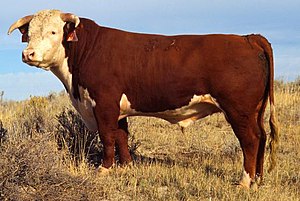
Buried bovine livestock are livestock of the bovine subfamily ( Bovinae ).
The main purpose of cattle is the production of meat and milk , getting hides and sometimes wool , as well as pulling force . At the beginning of the 2010s, there are about 1.3–1.4 billion cattle in the world [1] [2] [3] .
Classification
Craniological classification
Craniological classification - classification according to the shape and parameters of the skull. On this basis, the following types of cattle are distinguished:
- Primitive (narrow-minded). A wild ancestor of this type is considered the Asian tour.
- Broad-browed It has a strongly developed frontal bones, a wide and long skull. An Asian tour is also considered a wild ancestor of this type.
- Short The main difference of this type is short and straight horns. European tour is considered to be the wild ancestor of the type
- Short-headed . The front part of the skull of this type is shortened, the distance between the orbits is wide. This type is also considered a descendant of a European tour.
- Straight . The head of cattle of this type is narrow, with a short forehead and a concave occipital crest. The horns are directed upwards, curved in the shape of a crescent. An ancestor of this type is considered the African tour.
- Komoly ( humble ). The main feature of this type is the absence of horns. The origin of this type of cattle has not yet been clarified.
Classification by age and sex
- Oxen - males older than three years old, castrated at an early age.
- Cows are calves.
- The bulls are undaturated males older than three years.
- Gobies are young males older than three months, but not older than three years.
- Bull calves are neutered males at the age of more than three months, but not older than three years.
- Milk calves are animals of both sexes aged from 14 days to three months, fed mainly with milk.
- Chicks are non-living females.
- First - timers - first-timed females.
- Heifers - productively inseminated heifers.
Impact on global warming
Breeding cattle has a significant impact on global warming due to the production in the intestines of animals about 10% of anthropogenic greenhouse gases [4] : carbon dioxide (CO 2 ), methane (CH 4 ), nitrogen oxide (I) (N 2 O) and some others. To reduce emissions, various methods are offered (for example, feed additives, gas-accumulating bags, etc.), used so far only in experiments, as well as reduction of livestock while reducing their meat consumption (which is promoted by various organizations) [5] .
The development of cattle breeding in Russia
In the states of the Eastern Slavs, animal husbandry developed more rapidly than in Western Europe, since the Slavs for a long time came into close contact with the Eastern peoples, their urban population, army and cavalry grew faster. In Kievan Rus (9th – early 12th centuries), well-developed cattle were used for field work. He gave meat and milk for the personal needs of the peasant farms and the princely court. In winter, animals were kept in primitive rooms or dugouts. They were given hay, straw, grain (oats, barley). Plots for mowing grass for hay were assigned to individual owners. According to the law of Prince Yaroslav, mowing on foreign plots was punished with a fine of 12 hryvnias.
In the period of the Moscow principality , which was dependent on the Turkic-Mongols , the development of animal husbandry mainly consisted in increasing the number of pigs, as the Turkic peoples professed Islam and did not take tribute from the number of pigs. The increase in cattle livestock significantly intensified and took an important place in agriculture and the economy after the final cessation of the payment of tribute to Russia in 1700 (read the Treaty of Constantinople Peace Treaty (1700) ). At the end of the 16th century, Fletcher noticed that the Slavs kept very few cattle, except pigs, which the Tatars did not touch or hijack, because they share the same religion with the Turks and do not eat pork meat. "The horse became the basis of peasant farming. Large cattle were mostly used for the production of meat, milk and dairy products, raw materials for the handicraft industry (leather, candle, butter-making, cheese-making) But until the XVII century cattle in Russia was used mainly for meat production Loka and draft power. His improvement has not been given attention. He was focused mainly on the farms of serfs, where content and feeding of animals were primitive, tribal work was carried out.
Beginning of activities to improve the breeding and productive qualities of cattle was laid during the reign of Alexei Mikhailovich (mid XVII century), who issued decrees on the acquisition abroad, for the palace estates of breeding animals and inviting specialists in the organization and management of livestock breeding . At the same time, measures were taken to improve and increase the productivity of Kholmogory cattle in the north of Russia in order to provide the population with salted meat and dairy products, as well as selling these products abroad. In the era of the reign of Peter I, the industry of cattle began to develop both in quantitative and qualitative terms. More attention has been paid to improving the productive and breeding qualities of local cattle. For this purpose, improved feeding and animal welfare conditions, especially in the winter period, imported production bulls from other countries. There has been a specialization of regions of the country in the production of livestock products. The development of industry and the rapid growth of the urban population contributed to a significant increase in the demand for livestock products. Therefore, in the regions adjacent to large cities, dairy cattle breeding began to develop, and beef meat - to move to more remote steppe regions and supply cities with meat. This process continued throughout the seventeenth and nineteenth centuries.
The increase in the production of milk and dairy products for the urban population has stimulated work to increase the productivity of cows and improve their breeding qualities. This required improvement of the conditions for feeding and keeping animals, introducing grass planting, and organizing breeding work. On the basis of this, a highly productive Yaroslavl breed of dairy cattle was created in the Yaroslavl province , and a Kholmogory breed in the Arkhangelsk region. In these provinces in the XIX century, the production of cheese and butter, the cultivation of pedigree cattle for sale, were widely developed. During this period, 2-3 thousand cows were exported annually to suburban households of Moscow and St. Petersburg from the Yaroslavl Province.
Somewhat different way in the late XIX - early XX centuries. developed dairy cattle in Siberia . With remoteness from the markets for whole milk and perishable dairy products, Siberian cattle breeding began to expand on the basis of butter factories that process milk into “Russian” (baked) butter, which is highly valued in the world market. The improvement of local livestock was mainly carried out "in itself" in order to increase milk production and milk fat. In the XIX century. in many regions of the country, tribal work began to develop rapidly. At the same time, much attention was paid to the selection and selection of animals, the choice of producers, and the breeding of pedigree young animals, especially bulls. All this increased the milk production of local cows. For example, already in the 60s. In the 19th century, a herd of local Russian cows of the Butyrsky Farm, located near Moscow, yielded an annual yield of more than 2500 liters from each cow. There were such herds in the Arkhangelsk, Yaroslavl and other provinces. In the 70s. XIX century in the European part of Russia, there were 138 of the most famous private breeding farms of cattle, of which in the Moscow province - 12, Petersburg - 10, Tula - 8, Yaroslavl - 5, Poltava - 5, Nizhny Novgorod - 3. An important indicator of the development of cattle breeding is the dynamics of the number of animals. So, in 1846, the number of cattle in 50 provinces of the European part of Russia was 22.7 million goal; in 1888 - 24.6; in 1900 - 32.9; in 1905, 33.8; in 1911 - 31.4 million heads.
The development of Russian cattle breeding and its qualitative improvement at the end of the nineteenth century. cooperative associations promoted, and above all, control partnerships or unions. The first control partnership in Russia was organized in 1905 under the Northern Agricultural Society in St. Petersburg Province. At first, the control associations were mainly engaged in the organization of proper feeding and culling of low-productive animals. Tribal business in them was delivered a little later. The first annual reports of control associations showed a rather high productivity of Russian cattle, which aroused interest in breeding work and stud books. The first pedigree book was published in Russia in 1885 by the society of Baltic cattle breeders, in 1903 in the Kursk province, then in Yaroslavl, Tula, Arkhangelsk, Kharkov and others. An impetus to the development of breeding work with peasant cattle was given by the All-Russian Exhibition of Livestock, organized by the Northern Society of Agriculture in St. Petersburg in 1910, and the Congress of livestock breeders (during the exhibition) on issues of mass improvement of livestock. At this exhibition for the first time in Russia, animals of Russian breeds and offspring and data on their productivity were presented. Before the beginning of the First World War, within the borders of the former Russia, there were about 500 control associations, which ceased their activities during the First World War and the Civil War.
After the October Revolution in 1917, landowner farms, in which there were many breeding animals of different breeds, were eliminated. In order to preserve this valuable livestock, ensure the rapid development of livestock breeding and increase livestock production, the Council of People's Commissars in 1918 adopted a decree "On breeding livestock", in accordance with which all breeding animals were recognized as national property and listed in breeding books . This document assumed the organization of breeding plants and breeding grounds for breeding animals, providing them with coarse and concentrated feed. In 1920, a decree was passed “On breeding animal husbandry in labor collectives”, giving a number of benefits to cooperative labor collectives engaged in breeding and raising breeding animals, but the implementation of the planned work slowed down due to the Civil War and drought in 1921, which caused livestock breeding great damage. from 58.4 million in 1916 to 45.8 million goals.
The recovery period, which began in 1922, was marked by a rapid increase in the number of cattle, which in 1928 increased by 21 million and reached 66.8 million heads. At the same time, the productivity of animals increased - the milk yield per cow was 1042 kg. Gross milk production reached 24.8 million, beef (in the slaughter mass) - 1.5 million tons.
During the collectivization of agriculture, animal husbandry again fell into disrepair. The production of milk and beef has fallen sharply. In the prewar years, after the completion of collectivization, large farms experienced a big leap in the development of livestock breeding, newly created breeding factories, state breeding centers, large breeding farms , artificial insemination of animals began to be widely introduced. From other countries more than 50 thousand heads of cattle of various breeds were imported. In 1940, there were 450 breeding factories and state-owned farms, 13,200 collective farm farms, and 104 state-owned breeding centers in the country. Milk production increased to 37 million tons, which significantly exceeded the level of 1913 and 1928, the productivity of cows increased to 1,185 kg per year, and in the best farms it reached 5,000 and even 6,000 kg. Beef production in the slaughter mass was 1 million tons. Cattle became the main livestock industry.
During the Great Patriotic War, animal husbandry suffered enormous damage: 17 million goals were lost. cattle. However, with great efforts, part of the breeding stock of the Nazi-occupied territories of the country was evacuated to the eastern regions. Despite the difficulties of wartime, systematic tribal work continued.
In the post-war period (in 1948), the cattle population quickly recovered and began to increase. In 1950 it amounted to 58 million goals; At the same time, the productivity of the cows increased. In 1950, it was 1370 kg; Milk production in these years amounted to 108 million tons, respectively; the output of marketable beef at a slaughter mass of 8 million tons. Consequently, the cattle population increased more intensively in the 1950s and 1960s, and in the 1980s. it has not changed significantly. The productivity of cows increased more intensively in the 1960s and especially in the 1980s. Milk production growth rates were higher in the 1950s, lower in the 1970s. The increase in beef production was more significant in the 1960s and 1980s. As a result of long breeding work to improve the local livestock, started in the 1930s, high-yield animals of the same type were created in different regions of the country, and on their basis were several new valuable cattle breeds that were approved in the post-war years: black and white motley with three offspring (Central Russian, Ural and Siberian), Kostroma, Kurgan, Caucasian brown, Kazakh white-headed. In connection with the transition to a market economy, the discrepancy in prices for livestock products and agricultural equipment, energy, fertilizers, building materials and other industrial products in the 1990s. the economic condition of agricultural enterprises has deteriorated sharply, the number of cattle, the productivity of cows, the production of milk and beef have decreased.
As of January 1, 2004, in the Russian Federation, the cattle population in the farms of all agricultural producers amounted to 25 million heads. Calculations show that in order to fully satisfy the country's population in animal products, it is necessary to produce 48 million tons of milk, 11 million tons of meat by 2010. In dairy cattle breeding, absolute priority should be given to increasing the productivity of animals, and not to increasing their numbers. Despite the fact that the number of cows in the country has more than doubled, we have 85 cows per thousand people, while in England, the USA and other developed countries - 35-40 heads.
Strength
According to the All-Russian Agricultural Census of 2006, as of July 1, 2006, the number of cattle in Russia was 23,514.2 thousand heads. Of them:
- 11,225.5 thousand heads in agricultural organizations
- 979.5 thousand heads in peasant farms and individual entrepreneurs
- 11 309.2 thousand heads in non-profit associations of citizens
The share of cattle beef breeds in Russia accounts for 1.5% of the total cattle population. 98% beef was obtained from dairy cows.
By the end of 2016, the total number of cattle in Russia decreased to 18,753 thousand heads. Of these is:
- 8356 thousand heads in agricultural organizations
- increased to 2380 thousand heads in peasant (farmer) farms and individual entrepreneurs
- 8017 thousand heads in households.
Artificial insemination of cattle
Based on the patterns of sexual intercourse, cervical artificial insemination is used on cattle, i.e. The semen is injected directly into the cervical canal. For its implementation, at different times, three methods were proposed which differ in the technique of execution: visocervical, manocervical and rectocervical. The first two to date have been generally superseded by the rectocervical method [6] .
Major breeds of cattle
- Hereford
- Aberdeen-Angus
- Dutch
- Kholmogorskaya
- Red steppe
- Ayrshire
- Yaroslavskaya
- Simmental
- Sychevskaya
- Schwycka
- Kostroma
- Kalmyk
Notes
- ↑ Breeds of Cattle at CATTLE TODAY (Eng.) "The World Cattle Breed is about 1.3 billion head, with about 30 percent in Asia, 20 percent in South America,"
- ↑ Counting chickens (English) . The Economist (July 27, 2011). - "Cattle are not at all the next most populous breed of farm animals at 1.4 billion." The appeal date is June 26, 2019.
- With "With estimated standing population of 1.43 billion cattle, 1.87 billion sheep and goats, 0.98 billion pigs, and 19.60 billion chicken" Timothy P. Robinson et al. Mapping the Global Distribution of Livestock (English) // PLoS ONE. - No. 9 (5) . - P. e96084 . - DOI : 10.1371 / journal.pone.0096084 .
- ↑ Henning Steinfeld, Pierre Gerber, TD Wassenaar, Vincent Castel, Cees de Haan. Livestock's Long Shadow: Environmental Issues and Options . - Food & Agriculture Org., 2006.
- ↑ “ Save the Planet ” film // National Geographic Channel, 2016.
- ↑ N.I.Polyantsev, A.I.Afanasyev. Obstetrics, gynecology and animal biotechnology. - SPb. : Lan, 2012. - 400 p.
Literature
- Cattle / Elk NF // Baptism of the Lord - Lastochkovye. - M .: The Great Russian Encyclopedia, 2010. - P. 130. - (The Great Russian Encyclopedia : [in 35 tons.] / Ch. Ed. Yu. S. Osipov ; 2004–2017, V. 16). - ISBN 978-5-85270-347-7 .
- Cattle // Konda - Kun. - M .: Soviet Encyclopedia, 1973. - (The Great Soviet Encyclopedia : [in 30 t.] / Ch. Ed. AM Prokhorov ; 1969-1978, v. 13).
- Sovetov, A. Cattle large horned // Encyclopedic dictionary of Brockhaus and Efron : in 86 tons (82 tons and 4 extra). - SPb. , 1900. - T. XXX. - p. 260-265.
- Kostomakhin N. M. Cattle Breeds: A textbook for university students enrolled in the specialty "Zootechny". - M .: KolosS Publishing House, 2011. - 119 p. - ISBN 978-5-9532-0749-2 .
Links
- Cattle classification
- Cattle // Encyclopedia " Krugosvet ".