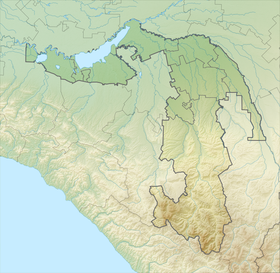
The Big Azish Cave [1] is located at the border of the Krasnodar Territory ( Absheron District ) and the Republic of Adygea ( Maykop District ), between the rivers Belaya and Kurdzhips. The entrance to the cave is located on a plateau massif, 500 m from the asphalt road Maykop - Lago-Naki. Together with the Small Azish cave, it forms the Azish cave system. Between these two caves is only 50 meters. Category of difficulty 2A.
| Big Azish cave | |
|---|---|
 | |
| Specifications | |
| Length | 690 m |
| Volume | 11 900 m³ |
| Opening year | 1911 |
| Enclosing rocks | limestone |
| Visit | |
| Difficulty category | 2A |
| Visible to visitors | 220 m |
| Lighting | electric |
| Location | |
| A country |
|
| The subject of the Russian Federation | Adygea |
| Mountain system | Azish tau |


Content
General information
The cave has been known since 1911 , but only in 1987 was equipped as a sightseeing object. The Big Azish cave has a length of more than 640 m. Of these, 220 m of the cave are equipped for sightseeing. The cave consists of voluminous tiered galleries and large halls. It surpasses many of the underground complexes in beauty and grandeur. The cave is equipped with walkways, stairs and fences, convenient and safe for inspection. There is electric lighting.
The cave is located among the beech-fir forest in the southern part of the Azish-Tau ridge. The cave is developed in the Upper Jurassic dolomitic limestones, which have a weak fall of about 5 degrees to the north-west. The entrance to the cavity is a vertical well. This hole is formed as a result of the collapse of the roof of the upper hall. The entrance hall is the upper floor of the cavity. Two more levels stand out clearly. At the bottom of the lowest passage, a stream flows, at the end of the gallery falling from a waterfall ledge and disappearing into narrow crevices several meters later.
In 1987, an attempt was made to go further and further along the stream, below the waterfall, but it ended unsuccessfully. The entire cave consists of several large halls and a gallery of the lower floor, through which an underground river flows. The Big Azish Cave is rich in streak formations. These are columns, large (several meters) stalactites and stalagmites . Stalactites often line up in chains that extend exactly beneath cracks crossing the ceiling. In one of the halls there are even two rows of columns parallel to each other, which form something like a corridor or passage. Beautiful ribbed sagging over the ledge leading from the upper hall down.
An interesting cave formation is calcite slabs, apparently formed in an ancient underground river or lake. After the water left, some of them remained lying horizontally, and some collapsed. On inclined, collapsed slabs, stalagmites with a height of up to 50 cm and more managed to grow.
The Big Azish Cave was declared a natural monument in 1973 .
See also
- Small Azish cave
- PCB cave
Literature
- List of classified caves. - Moscow: Central Council for Tourism and Excursions, 1989.
- Cadastre of caves of the USSR . - VINITI, 1986.
Notes
- ↑ Great Azish cave // Great Russian Encyclopedia . Electronic version (2016); Date of appeal: 07/27/2017.