Vladimir Ivanovich Rebikov ( May 19 (31), 1866 , Krasnoyarsk - August 4, 1920 , Yalta ) - Russian composer , pianist, music writer.
| Vladimir Ivanovich Rebikov | |
|---|---|
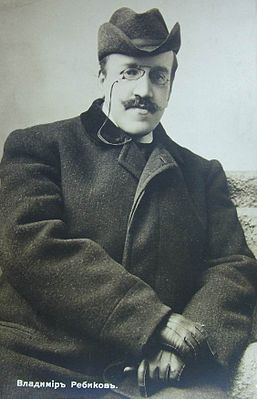 Vladimir Rebikov. Post card (open letter, 1910) | |
| basic information | |
| Date of Birth | May 19 (May 31 ) 1866 |
| Place of Birth | Krasnoyarsk Russian empire |
| Date of death | August 4, 1920 (54 years old) |
| A place of death | |
| Buried | |
| A country |  Russian empire Russian empire |
| Professions | composer , music teacher |
| Years of activity | Yalta |
| Instruments | |
| Genres | |
Content
- 1 Biography
- 1.1 Family
- 2 Creativity
- 2.1 Opera
- 2.2 Ballets
- 2.3 Piano loops
- 2.4 Piano loops for children
- 2.5 Vocal works
- 2.6 Orchestral works
- 2.7 Sacred music
- 2.8 Books
- 2.9 Articles
- 2.10 Translations
- 3 Bibliography
- 4 notes
- 5 Links
Biography
Came from a noble family. Rebikov's father is a mining engineer. In Moscow, the family lived on Prechistenka Street since 1868. She received her first music lessons from her mother.
From 1878 he studied at the Commercial School on Ostozhenka Street, from 1880 - at the real school of K.P. Voskresensky, where he continued his musical studies. In 1885 he tried to enter the Moscow Conservatory, but presenting to the examination committee (headed by S. I. Taneev ) his “modernist dissonant essays”, he was rejected and entered the Moscow University for a philological department. He studied music privately with N. S. Klenovsky . In 1891 he went abroad to receive a musical education in Berlin with K. Meyerberger and G. Muller.
In 1893 he created in Moscow a cycle of romances to the words of Semyon Nadson , which received the support and approval of P.I. Tchaikovsky . In 1893-1896 he lives in Odessa, where he creates his first opera “The Forest Is Noisy” (according to the story by V. G. Korolenko ); later the opera gained recognition and was staged in Moscow at the Aquarium Theater.
Rebikov attended literary and artistic evenings in the house of Valery Bryusov . From 1893 he taught in Moscow , Kiev and Odessa . Having settled in Chisinau in 1897 , he achieved the opening of a branch of the Russian Musical Society there and organized a music school. In the late 1890s he visited Vienna and Munich , where he became acquainted with the latest trends in European art.
In 1898-1901 he was the initiator and participated in the organization of the first in the history of Russian music official creative association - “Society of Russian Composers”. Since 1901 he performed with concerts in Russia and abroad. On Russian and foreign stages, Rebikov’s best work, the opera The Christmas Tree, is successfully staged, newspapers and magazines write and discuss about Rebikov, but his fame gradually faded. To his latest opera Noble Nest (based on the novel by I. S. Turgenev ), V. I. Nemirovich-Danchenko was interested.
Rebikov responded to the revolutionary events of 1905 with the literary poem Alpha and Omega, the musical and psychological painting Nightmare. Since 1906 abroad. Since 1909 again in Moscow; published a series of articles on the problems of musical art.
Rebikov loved Crimea very much. In his youth, he often spent the summer in Feodosia , where his parents had a small cottage. Since 1910 he lived in Yalta , where he was a noticeable eccentric figure (for example, he could be seen on the streets of the city, walking with two umbrellas - white from the sun and black from the rain). In 1913, to the 25th anniversary of Rebikov’s creative activity, Rebikov’s opera The Yolka was staged on the stage of G. G. Solodovnikov’s Moscow theater with the help of artists from the Opera S. I. Zimin .
He died in Yalta on August 4, 1920, was buried at Autkinsky cemetery. Later, his remains were transferred to the Polikurovsky memorial , where there is a memorial plaque dedicated to him.
Family
- Wife - Lidia Vasilievna Rebikova
- Daughter (reception) - Alexandra Rebikova (born 1896 ), theater and silent film actress
Creativity
Rebikov’s creative views resonate with contemporary directions in the movement of symbolism and musical impressionism. Often, as the subjects for his works, the composer chose popular at that time literary and pictorial works. A number of Rebikov's piano works, in particular, “Sketches-Moods,” were written under the influence of Arnold Böcklin 's painting. A long friendship connected the composer with the poet Valery Bryusov , to the verses of which he wrote several cycles of romances.
In his work, Rebikov adhered to the concept of "musical psychography" formulated by him. His style was significantly different from the established norms of composition, and his experiments in the field of musical language often met with misunderstanding on the part of his contemporaries. However, P. Tchaikovsky very kindly responded to Rebikov’s creative debut, who found in the music of the young composer “considerable talent ... poetry, beautiful harmonies and very remarkable musical ingenuity”. In turn, Rebikov dedicated to Tchaikovsky his piano cycle “Memoirs of Autumn”.
Rebikov was one of the pioneers of solid-wood music in Russia, often used in his compositions the harmonies of the quart structure and other unusual tricks for that time. In search of new musical forms and possibilities for synthesizing various types of art, the composer created several works in the genres of rhythm-recitation, “melomimics”, and “meloplasty”. So, for example, Rebikov’s “rhythmic recitation” is known to the poems of K. Balmont “Like a Flower” (1918). Contemporaries considered Rebikov “a musical decade, not reckoning with any musical laws and forms” (Big Brockhaus, 1903). Rebikov clearly formulated his aesthetic principles in the article-manifesto “Musical Records of Feelings” published in the Russian Musical Newspaper (No. 48) in 1913, where he urged us to abandon certainty in musical form and harmony, because “our feelings do not have pre-established forms and endings. ”
Rebikov’s handwriting was most pronounced in his works for musical theater. Rejecting the aesthetics of traditional opera , Rebikov actively used allegories and mystical symbols in his "musical-psychological dramas" such as The Noble Nest of 1916 (Thea, 1904 ; Alpha and Omega, 1911 ).
In the genre of melomimics, Rebikov created the cycle of the same name, in the preface to which he explains: “Melomimics are a stage genre in which facial expressions and music are combined in an inextricable ensemble. They differ from ballet, because dance does not play any role in them, and from pure pantomime, because music plays a role at least equal to facial expressions ” [2] . His "Vocal Melomimics" are known.
In the field of instrumental music, Rebikov limited himself to the simplest small forms, creating several dozen piano miniatures of a lyrical or genre-characteristic plan, combined in a series entitled “Around the World”, “Autumn Leaves”, “Through Slavic Countries”, “Bucolic Scenes” and several others . As part of these cycles, you can find attractive plays that are distinguished by grace, wit and imagery of music, but technically simple [2] .
He worked in the field of sacred music. Known for his "Vespers", according to the composer and conductor Alexander Dmitrievich Kastalsky, "outstanding for the courage of presentation."
Rebikov took an active part in the development of musical life in Chisinau , where he created not only a branch of the Russian Musical Society , but also a Music College. Over the years of work there, he wrote a large number of musical works for children - piano, song and choral collections “Children's World”, “Children's Rest”, “Days of Childhood”, “School Songs”, musical scenes “Fables in Faces” (by I. Krylov ), children's ballets Musical Snuffbox, Snow White, Prince Handsome, a large number of piano cycles.
Rebikov’s creative heritage includes not only musical works, but also a number of articles on musical aesthetics: “Musical recordings of feelings”, “Music after 50 years”, “Orpheus and Bacchantes”.
Opera
- “In a thunderstorm” (according to the novel “The Forest is Noisy” Korolenko, op. 5, 1893, set in 1894, City Trade Hall, Odessa)
- “Princess Mary” (according to the novel “Hero of Our Time” by Lermontov, not finished)
- “The Christmas Tree” (based on the fairy tale “An Girl with a Matches” by Andersen and the story “Boy with Christ on the Christmas Tree” by F. M. Dostoevsky , Op. 21, 1900, post. October 30, 1903, Entrepreneur ME Medvedev, “Aquarium”, Moscow; 1905, Kharkov; 1906, Prague) [3]
- “Tea” (to the text of the poem of the same name by A. Vorotnikov, op. 34, 1904)
- "Abyss" ( 1907 , according to the same story of Leonid Andreev )
- “Woman with a Dagger” ( 1910 , libretto by Rebikov, Op. 41, according to the same novel by A. Schnitzler, Arthur Schnitzler )
- "Alpha and Omega" (lib. Rebikova, Op. 42, 1911)
- "Narcissus" (libr. Rebikova, according to Ovid's "Metamorphoses" in the lane of T. L. Shchepkina-Kupernik, op. 45, 1912)
- “Arachne” (libr. Rebikova, according to Ovid's “Metamorphoses”, op. 49, 1915)
- “The Noble Nest” ( 1916 , Op. 55, based on the same novel by Ivan Turgenev , post. January 22, 1995, Chamber Music Theater , Moscow, director B. A. Pokrovsky , resumed March 6, 2009)
Ballets
- “Snow White” (based on the fairy tale “The Snow Queen” by Andersen)
- "What happened to the ballerina, the Chinese and the jumpers." One act ballet. Moscow, 1914. Statement by B. G. Romanov .
Piano Loops
- "Autumn Dreams"
- “Sketches of moods”
- “Melomimics” op.11 (1898)
- “Melomimics” op.17 (1903)
- “10 sonic poems op. 13"
- “Slavery and freedom”, a musical-psychological picture (1903)
- “Songs of the Heart”, a musical-psychological picture (1903)
- “Aspiration and achievement”, a musical-psychological picture
- "At dusk"
- "Nightmare", "Musical and psychological picture (for piano four hands)
- "At home"
- Autumn Leaves (1904)
- From the Diary, op. 33
- "Meloplasty" (1910)
- The Little Ballet Suite (1906)
- Idylls, op. 50 (1913)
- Five Dances, op. 51 (1914)
- “They are merry,” op. 54
- The Musical Snuffbox (1902)
- "From a forgotten notebook"
Piano Cycles for Kids
- "Around the world"
- "Silhouettes"
- "From the ancient world"
- "Pictures of the Past"
- “Album of Easy Pieces for the Young”
- "Christmas tree toys"
- "Sparks"
Vocal works
- Vocal Scenes, op. 1 (to the texts of Maykov, Koltsov, Nadson, Fet)
- Romances, op. 4 (to Nadson's texts), op. 16 and 18 (to the texts of Bryusov), op. 20 (to the texts of Confucius, Bryusov, Apukhtin)
- “Fables of Krylov in faces”
- Melomimics, op. 19 (for choir and piano for lyrics by Lermontov)
- “Melodeclamations,” op. 32 (to the texts of Apukhtin and Heine)
- “Rhythm Declaration”, op. 52 (to the texts of Apukhtin, Balmont, Petrarch, Rukavishnikov and other poets)
- “Melopoiesis” (a genre introduced by Rebikov) “Balcony in the Fall”, op. 53 (to the text of Zvyagintseva)
- Children's choir "Cool singing"
- Children's World Choir
- Choir "Days of childhood"
Orchestral works
- Orchestral Suite "In the East"
Sacred Music
- "Liturgy of St. John Chrysostomos "
- Vespers
- "10 choirs"
Books
- Melomimics. Odessa, 1899
Articles
- Orpheus and Bacchantes // RMG, 1910, No 1
- After 50 years // RMG, 1911, No 1-3, 6-7, 13-14, 17-19, 22-25
- Musical records of feelings // RMG, 1913, No 48.
- (together with V. G. Karatygin) For 7 days // RMG 1913, No 35
Translations
- Meyerberger K. "Wagner's Harmony", trans. with him. lang
- Gavart F. "Methodical course of orchestration" (M., 1898) per. with french (Rebikov translated and supplemented the text with Russian examples).
Bibliography
- Pavel Milyukov . "Essays on the history of Russian culture." Part 2. St. Petersburg 1897 Volume 2
- The magazine "Libra". 1904 Volume I, Number 7. Article about V. Rebikov.
- Chesikhin V. History of Russian opera (from 1674 to 1903) 2nd ed. and value add. ed. Publisher: I. Jurgenson, St. Petersburg 1905.
- Niva. N 41-1913. Illustrated journal of literature and modern life of St. Petersburg. Ed. A.F. Marx 1913. Photo portraits of composers: P. Schenk, V. Rebikov.
- Stremin M. , About Rebikova, “Art Life”, 1922, No. 2
- Sabaneev L. "History of Russian music." Ed. "Education Worker." Moscow, 1924, 87 pp. (A small note on Rebikov)
- Berberov R. , ( foreword ), in the publication: V. Rebikov, Pieces for Piano, Book 1, M., 1968.
- Tompakova O. Vladimir Ivanovich Rebikov: an essay on life and work. - M., 1989
Notes
- ↑ German National Library , Berlin State Library , Bavarian State Library , etc. Record # 118948652 // General regulatory control (GND) - 2012—2016.
- ↑ 1 2 Yu. V. Keldysh. V. I. Rebikov // Moscow “Music”. - 1997.
- ↑ Gosenpud A.A. Dostoevsky and music. - L .: Music, 1971. - S. 149-150. - 175 p.
Links
- Sheet music of V.Rebikov's works on the International Music Score Library Project website
- V. I. Rebikov on the Belcanto.ru Internet portal
- V. I. Rebikov on the Classical Forum Internet Portal
- V. I. Rebikov in the project "Crimeology"
- V. I. Rebikov in the encyclopedia "Moscow"
- V. I. Rebikov in the music archive “Notoboz”