Larisa Anatolievna Popugaeva ( , - , ) - Soviet geologist , candidate of geological and mineralogical sciences ( 1970 ), one of the pioneers of diamond deposits in the USSR .
| Larisa Popugaeva | |||
|---|---|---|---|
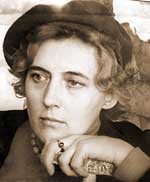 Larisa Anatolyevna Popugaeva, the beginning of the 1960s | |||
| Birth name | Larisa Anatolievna Grintsevich | ||
| Date of Birth | |||
| Place of Birth | |||
| Date of death | |||
| Place of death | |||
| A country | |||
| Scientific field | geology | ||
| Alma mater | |||
| Known as | Discoverer of a primary diamond deposit in the USSR | ||
| Awards and prizes |
 | ||


Content
Biography
Larisa Grintsevich was born on September 3, 1923 in Kaluga . Her father, Anatoly Grintsevich, is the secretary of the Prigorodny District Party Committee in Odessa , was shot in 1937 . Mother, Olga Grintsevich, is a Leningrad art critic.
In 1937, after the death of her father, Larisa returned to Leningrad with her mother and sister Irina, who was born in Odessa. In 1941 she graduated from high school and entered the Leningrad University .
Larisa Grintsevich met the Great Patriotic War in Moscow , where she, along with other graduates - excellent students of Leningrad schools, was sent by special ticket to the All-Union Agricultural Exhibition . At the beginning of the war, this group was left indefinitely in Moscow. Meanwhile, Larisa’s mother and sister left for evacuation to the Urals.
In September 1941, Larisa arrived in Molotov , where her mother and four-year-old sister were evacuated. She was enrolled in Molotov University (now Perm State University). She graduated from nursing courses, worked in a clinic. Then she graduated from machine gunner courses.
From April 1942 to July 1945 she was a volunteer in the Moscow Air Defense Division, a gun crew commander, and received the rank of junior sergeant. Here she joined the Komsomol (before she was not accepted as the daughter of an " enemy of the people "). In 1944 she joined the CPSU (b) .
In 1950 she graduated from the Department of Mineralogy of Leningrad University . Simultaneously with studies, she worked as a geologist foreman for three years on various expeditions of the North-West Geological Department.
Already in 1950, her work in the north of the Irkutsk region turned out to be related to diamonds. In the summer of 1951 she was on an expedition to the Subpolar Urals. In 1952, Larisa Grintsevich married LISI professor Viktor Popugaev.
In 1950, the Central Expedition of the Geological Administration began to study the sands from Yakutia to identify diamond mineral companions. The geologist Natalia Sarsadskikh conducted these works.
In June 1954 , Larisa Popugaeva discovered a kimberlite surface, which later became known as the “Zarnitsa pipe ”. The following year, another 10 pipes were opened in this area, including the richest in diamonds - Udachnaya. “Zarnitsa” has become a kind of testing ground for geologists to master the pyrope method of searching for kimberlite bodies. Now in those places there is the city of Udachny , quarries, towns, the airport, processing plants, roads.
The story of Zarnitsa itself turned out to be complicated. At first, it was recognized as not industrial, but re-exploration in the early 1980s refuted this conclusion, and the diamonds in it turned out to be excellent.
However, all the merits - the development of the pyrope method and the discovery of kimberlite pipes - were appropriated by the Amakinsk expedition . At the meeting, the chief engineer said that it was the Amakinsk expedition that found the kimberlite pipe . The leadership of the Amakinsk expedition tried to force Popugaev to go to work for them. At first she refused, but after a month and a half gave up and retroactively took shape on the Amakinsk expedition. When Popugaeva returned to Leningrad, Sarsadskikh accused her of dishonesty. [one]
In 1954-1955 Popugaeva worked in Leningrad. In 1955, with co-authorship with Natalia Sarsadskikh, she published an article in the journal Exploration and Protection of Subsurface Resources, which gave a strictly scientific justification for the fact that the breed was found to be kimberlite.
In 1956, Popugaeva quit the Amakinsk expedition. But in Leningrad, they did not take her at the place of her previous work. She entered graduate school at the Mining Institute .
In 1957, six geologists of the Amakinsk expedition received the Lenin Prize . Parrot on this list was not.
In commemoration of the 325th anniversary of the entry of Yakutia into Russia, she was awarded the Order of Lenin "for achievements in economic and cultural construction."
Her graduate school did not work out, and in 1959 Popugaeva transferred to the Central Research Laboratory of gem stones at the Lenin Executive Committee, where she was engaged in an inventory of all diamond deposits in the USSR .
In 1970 she was awarded an honorary diploma and the sign " Field Discoverer ". In November of the same year, she made a generalization report on her work at the Leningrad Mining Institute and became a candidate of science. The entire academic council - 25 people - voted in favor. In the early 1970s, Larisa Popugaeva prepared for publication the Atlas of Gems of the USSR, which remained, however, unpublished. She brought a live stream to the club of mineral lovers at the Palace of Culture. Leningrad City Council, was invited as an expert in jewelry and ornamental stone to the Hermitage and to customs.
Larisa Popugaeva died on September 19, 1977 from blockage and rupture of the aorta.
Memory
A diamond weighing 29.4 carats (about 12 mm across) is named after Larisa Popugaeva. On the "Zarnitsa" put a pillar with the text of her note. The streets in the diamond cities of Udachny and Aikhal bear her name. In Yakutia, in the city of Udachny, a monument was erected to Larisa Popugaeva.
Rewards
- Excellent gunner ( 1943 )
- medal "For the victory over Germany" ( 1945 )
- Order of Lenin ( 1957 )
- Pioneer of the Field sign ( 1970 )
See also
- The largest diamonds of Russian origin
Literature
- Yuzmukhametov, Rishat Nurgalievich. The finest hour and the tragedy of Larisa Popugaeva. - Yakutsk: Bichik, 2004 .-- 64 p. : phot.
- Sviridov George Ivanovich. At the edge of blue diamonds. M .: Politizdat. 1978. 352 p.
- Larisa Anatolyevna Popugaeva is the prototype of Larisa Aleksandrovna Sorokina, the first protector of the Zarnitsa kimberlite pipe in Nikolai Yakutsky ’s short story “ Seekers of Diamonds ”.
Video
- The Broadcasting Company “Petersburg” Broadcasting Company in 2007, in the series “Winners”, a documentary film “ Larisa Popugaeva ” was shot.
- The documentary of the TV channel “Russia K” under the heading “Deprived of Glory” - “ Larisa Popugaeva. The diamond face . "