Barber (through Polish. Cyrulik from lat. Chirurgus ) - historically a hairdresser and a bathhouse attendant who knows the basic techniques of surgery.
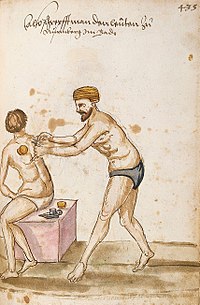
In every city in Europe to the XII-XIII centuries. there was a bath with a hairdresser with her [1] . Like all artisans of the Middle Ages, its workers were united in a workshop . Qualification of a bathhouse attendant was appropriated by a workshop to an apprentice only after several years (up to seven) of apprenticeship and after passing exams in the presence of elders of the bathhouse workshop , a representative of the city council and doctors of medicine [2] .

The workshop had rules regarding procedures and payments for bath services in the bath [3] . The bath attendants had the right, besides washing, to massage, cut, shave, straighten dislocations , apply dressings for fractures and wounds , and tear out diseased teeth [4] . Their main activity, in addition to cutting and shaving , consisted in bloodletting by incision of the saphenous veins, which until the XIX century. It was considered very useful: in the traditions of ancient and medieval medicine, many diseases were explained by stagnation of bad blood, which must be released from the body [5] .
Since they didn’t have an idea about the disinfection of instruments, such procedures in the baths probably contributed to the spread of contagious diseases .
The medieval barber-craftsman was different from a professional doctor who received a theoretical medical education in the works of Galen , Hippocrates , Aristotle at the university . In addition, some learned doctors were ordained, and the priests of the Fourth Lateran Council (1215) were forbidden to personally cut bodies and stain their hands with blood, which led to the further division in Europe of the professions of a physician and a barber surgeon [6] .
Some barbers have seriously improved their surgical skills, having great real practice in dealing with wounds, injuries and skin diseases, especially since the spread from the 15th century. firearms confronted them with the problems of treating gunshot wounds , which had no analogues in the past: techniques for dressing wounds, extracting bullets and fragments, etc. [7]
From the XVII — XVIII centuries. The separation of the specialties of a hairdresser and a surgeon began , when surgery finally became a part of real professional medicine [7] .
See also
- Siberian barber
- The hairdresser
- Lo-tzu is a Chinese deity who patronized barbers.
Notes
- ↑ Extinct Professions: Barber-Surgeon “MyHeritage Blog . blog.myheritage.com. Date of appeal May 15, 2017.
- ↑ Washing, drawing, lancing - the requisite skills for a barber-surgeon in early modern times , Die Welt der Habsburger . Date of appeal May 15, 2017.
- ↑ CRAFT REGISTERS AND TRADE OF THE CITY OF PARIS . The statutes of the shop attendants . Eastern literature . Date of treatment April 9, 2017.
- ↑ Sherrow Victoria. Encyclopedia of Hair: A Cultural History. - L. , 2006 .-- S. 52.
- ↑ Mortimer J. Surgeons // Medieval England: A Time Traveler's Guide.
- ↑ Mortimer J. Practitioners // Medieval England: A Time Traveler's Guide.
- ↑ 1 2 McCallum Jack. Barber-surgeon // Military Medicine: From Ancient Times to the 21st Century. - Santa-Barbara, 2008 .-- S. 37.
Links
- Wikimedia Commons has media related to The Barber
- Paramedics and paramedics // Brockhaus and Efron Encyclopedic Dictionary : in 86 volumes (82 volumes and 4 additional). - SPb. , 1890-1907.