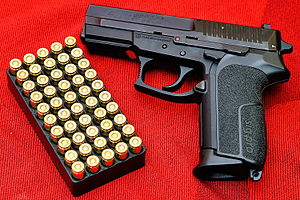
A self-loading pistol is a pistol that performs a recharge process using the energy of powder gases to feed the cartridge from the magazine to the chamber . For each shot the shooter must pull the trigger.
Abroad, self-loading pistols with the function of firing single fire are called semi-automatic ( eng. Semi-automatic pistol ).
Most self-loading pistols use interchangeable magazines that need to be inserted into the grip before opening fire.
Content
Automation work
To charge the gun, you need to insert the magazine in the handle, and then delay and release the bolt. This operation is called “distort the bolt”. After pressing the trigger, a shot is fired, thanks to the recoil of the barrel, the pistol automatically ejects an empty cartridge case, sending a new cartridge into the chamber. Thanks to this mode of operation, the recharge rate is increased, and it is also possible to use more cartridges than in a revolver .
Some modern self-loading pistols have dual action USM only; This means that it is enough to send one cartridge into the chamber, and each time the trigger is pulled, the trigger comes down and strikes the firing pin. Each pull on the trigger requires the muscular strength of the shooter. An example of a double action pistol is the Colt Double Eagle . USM double action is usually used in small pistols, pistols for self-defense and concealed carry, it is not suitable for target or hunting pistols. The exception is the Glock family pistols , in which the drummer is cocked when the bolt returns to the forward position. This reduces the trigger stroke. You can replace the trigger spring with a lighter spring and combine it with a light sear that will give a slight pull on the trigger, resulting in improved shooting accuracy (as on the G34 and G35 models).
USM double action, or self-cocking ( eng. Double Action, DA ) can be used in two ways: either the same as USM single action, or when you press the trigger, the trigger (drummer) first comes up, and then the descent. It significantly increases the efficiency of the weapon, but negatively affects the accuracy of shooting, since the descent force and the trigger stroke when firing by self-cocking is noticeably greater than during pre-arming.
In recent decades, the spread of USM, acting only self-platoon ( eng. Double Action Only, DAO ). It is believed that a weapon with such a mechanism does not need a safety device, since a shot can occur only when the trigger is fully squeezed out, and in many practical cases a decrease in firing accuracy can be neglected.
Another version of the USM solution is when the combat spring is only partially cocked before the shot, and when pressed the trigger is “pressed”. Such a solution is applied, for example, in Glock and Smith-Wesson Sigma pistols.
In the single trigger (single) action ( eng. Single Action, SA ), when the trigger is pulled, only the pre-cocked mechanism is released. USM single action can only be cocked by an external impact on its percussion element (trigger, less often a drummer) - be it a rolling bolt or finger arrow. A similar pistol is the famous Colt M1911 pistol . Also, the cartridge can be inserted directly into the chamber when the shutter is on safety.
Cocking Modes
Usually self-loading pistols are worn with a cocked hammer, a fully charged magazine, a cartridge in the chamber, and a safety catch on. For most self-loading pistols, this method is convenient mainly for right-handers, since the fuse box is located on the left side of the pistol and therefore it is easy to control the pistol only with the right hand.
Many self-loading single-action pistols have a so-called safety platoon . Pressing the trigger will not allow the weapon to fire as long as it is on the safety platoon, which also prevents the gun from being accidentally fired.
The main advantage of this mode was the absence of a click when the shutter is cocked. The second advantage was the prevention of an accidental shot when a weapon was dropped. The attitude to the safety platoon began to be revised in the 1970s, when the Colt , and then other manufacturers - in the new pistols, when the trigger was pulled, the drummer began to be removed from the platoon. In any case, self-loading pistols should not be worn with the fuse off.
There are various designs of self-loading pistols, including recharging the shop with removable clips and non-removable magazines. Usually such structures are not used now. The Mauser C96 pistol had a non-detachable magazine located at the front of the trigger that could only be charged from above with the shutter open using a detachable clip.
Terminology
The names of automatic , semi- automatic , semi-automatic weapons often cause confusion in different countries. For example, in Russia and Ukraine, the term “automatic pistol” technically refers to self-propelled pistols, that is, to pistols that can fire bursts when the trigger is pressed once, and in the USA it is used as a synonym for self-loading (semi-automatic) pistols. The term "pistol" is usually applied to short-barreled weapons as a whole - in order to distinguish self-loading pistols from revolvers.
Features of self-loading weapons
The vast majority of modern pistols have automatics . But automation can be of two types. If the automatics is built for firing a single fire, then the pistol is called self-loading , if it allows continuous fire, then it is self-firing . In self-loading pistols, only the process of reloading and firing mechanism is automated; descent is carried out manually. Almost all pistols, with rare exceptions, are self-loading. Therefore, in modern Russian terminology, self-loading pistols, as a rule, are called simply pistols, and “ self-firing ” pistols that are capable of firing bursts are called automatic pistols .
Abroad, another symbol is used for these varieties: self-loading weapons are called semi-automatic, and self-propelled weapons are fully automatic.
For pistols - short-barreled weapons, designed for the use of relatively weak cartridges - in most cases the simplest principle of operation of automatics is adopted - the use of recoil bolt with a fixed barrel. But among the military models still dominated by systems that operate on the principle of using recoil coupled with the barrel with a short course of the barrel.
There are automatic pistols with interlocking bolts, operating according to other principles, but they are relatively few.
In the designs of pistols, in addition to the various schemes of work of automation, a variety of parts and their configuration are used. Conversely, the shape of parts is affected by their location, such as the location of the return spring — above the barrel, under the barrel, around the barrel, or in the handle.
Cartridges in a pistol shop are more often located in a single row, but lately, especially in military models, a two-row arrangement of cartridges is becoming more common, allowing us to achieve a significant increase in the capacity of stores without increasing their length.
To load a pistol with a removable magazine, you need to insert a loaded magazine into it and send a cartridge into the chamber.
The trigger mechanisms of pistols are very diverse. The development of pistols shortly after their appearance was characterized by a wide distribution of systems with trigger or tucked mechanisms hidden inside, characterized by simplicity of the device, high reliability, good protection from clogging from the outside, and most importantly, compactness. However, these mechanisms have disadvantages, among which, first of all, it is necessary to include the impossibility of a smooth descent of a hidden trigger or a drummer.
Fuses on pistols with hidden impactors or hammers may be manual or automatic. For greater security, pistols are often supplied with both fuses. Manual fuses are usually turned on by turning a small lever that locks the trigger or trigger mechanism. Automatic fuses are parts protruding above the surface of the handles. They are constantly on and off only with the right coverage of the pistol grip with an arrow. Accidental pressing of the trigger, for example in a pocket, cannot lead to a shot, since the direction of movement of the trigger and the automatic safety device are usually opposite, and therefore it is unlikely that two random pressures, oppositely directed, occur simultaneously. On the pistols there may be other safety devices, for example, in the form of devices for a smooth descent of the trigger, for weakening the tension of the mainspring, for the impossibility of lowering the trigger when the store is taken out, etc.
Recently, pistols with a trigger mechanism and openly located trigger have become prevalent. These systems turned out to be more convenient. The safety of handling them is the same as the safety of handling revolvers - the position of the open trigger is clearly visible even with a quick inspection of the weapon. The main advantage of the percussion mechanisms with open triggers is that they allow smooth triggering of the trigger with a platoon without firing a shot. A pistol with a cartridge in the chamber and with a flattened trigger is no more dangerous than a loaded revolver. In this case, the combat spring is not in a tense state, which allows you to store a loaded pistol for as long as you like. If necessary, the trigger for the first shot can be easily cocked with one finger movement of the hand that holds the weapon. Smooth descent of an openly located trigger is equivalent to turning on the fuse in beskurkovyh systems, and cocking the trigger - to turn it off, so the trigger systems can be without special safety devices
A number of pistols trigger mechanisms allow only self-cocking firing. In such systems, the recoil energy is used only for extracting the spent cartridges and for filing the next rounds of ammunition; for each subsequent shot, however, a cocking mechanism is required using the muscular strength of the shooter. Such a device certainly has a negative impact on shooting accuracy, but it makes the trigger mechanism extremely simple, very reliable and provides constant readiness for shooting. These pistols usually do not have any fuses, and handling them is very much like handling self-cocking revolvers with hidden trigger.
Initially, automatic pistols were designed exclusively as self-loading weapons, so they all had somehow implemented devices that cut off the trigger from the sear during the shot and suspend the automatic operation of the percussion mechanism - the latter remained cocked, despite the fact that the trigger still pressed finger arrow. For each subsequent shot, it was necessary to stop pushing the trigger (at that time he grappled with the sear), and then a new pressure on him. However, over time, pistols appeared, from which you can shoot in bursts. These are mainly military samples of pistols with high-capacity stores and with attached butts to ensure greater stability when firing.
Since the pistols are designed for firing at minimum distances, the aiming devices on them are usually made the simplest, that is, constant. For most military-style pistols, the steepness of the trajectory turns out to be so insignificant within the limits of the distances available for actual firing that it is possible to use constant sights in them. Only the most powerful samples of military pistols are mobile, mounted for shooting at different distances. Permanent sights pistols consist of front sight and rear sight with a slot. On military-style pistols, usually one of these parts is fixed, while the other is a separate part attached to the pistol after zeroing. Sometimes bright paint or luminous compounds are applied to the sights for better vision at dusk and other adverse conditions.
Recently, laser designators have appeared, greatly facilitating aiming and increasing the accuracy of shooting. Aiming at a target of a weapon equipped with such a sight is carried out by aiming at the target of the outgoing emitted target designator of the beam, that is, by aligning the "bunny" - the luminous point - with the target. This is done much easier and faster than pointing a weapon with the help of the front sight and rear sight. No matter how compact the target designators are, they still increase the dimensions of the weapon, and partly because of this, their distribution is still small. On pocket pistols, both the front sight and the rear sight are often immobile. On the so-called vest pistols, very often, the sights can either be completely absent or they can be quite primitive, for example, representing a gap, running along the surface of the bolt.
In the most powerful examples of pistols, there was always a desire to expand the scope of their application by giving them such features that would bring these pistols closer to light carbines or to machine pistols. Currently, there are separate samples of pistols with elongated barrels, side butts and more advanced aiming devices designed for firing at different distances. In recent times, even such models of pistols have appeared, which by almost all signs refer to machine pistols and are not counted among them only because of the impossibility of firing by bursts and because of the absence of a butt. This type of weapon was called assault pistols.