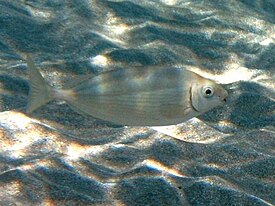
Gold-banded cigan , or stream cigar [1] ( lat. Siganus rivulatus ) - a species of fish from the family of cigan (Siganidae). Distributed in the western Indian Ocean from the Red Sea and the Gulf of Aden to southern Africa, including Madagascar . Through the Suez Canal, they entered the Mediterranean Sea, where they took root well. Often you can observe in schools of up to 100 or more fish. It feeds on bottom algae. The hard rays of the dorsal and anal fins are connected to the poisonous glands that are located at their base. Prickling of this fish is painful, which is why they pose a danger to careless bathers.
| Golden-cigan |
 |
| Scientific classification |
|---|
| No rank : | Bilateral symmetrical |
| Family: | Siganidae ( Siganidae Richardson , 1837 ) |
|
| International scientific name |
|---|
Siganus rivulatus
Forsskål & Niebuhr , 1775 |
| Security status |
|---|
Least ConcernedIUCN 3.1 Least Concern : 155025 |
|
The body is tall, oval in shape, squeezed from the sides, its height fits 2.7-3.4 times in the standard body length. The dorsal fin has 14 spiny and 10 soft rays. The first spine is small, directed forward, often covered with skin. In the anal fin there are 7 spiny and 9 soft rays. Unique are their ventral fins, in which 3 soft rays follow the first prickly ray, and then another hard ray. Caudal fin slightly emarginate. The maximum body length is 27 cm, usually up to 20 cm [2] . In the Mediterranean Sea, the length of golden-striped cigans reaches 40 cm [3] .