American mink , or eastern mink [1] ( lat. Neovison vison ) is a North American species from the marten family.
| American mink |
|
| Scientific classification |
|---|
| No rank : | Bilateral symmetrical |
|
| International scientific name |
|---|
Neovison vison Schreber , 1777 |
| Synonyms |
|---|
|
| Area |
|---|
|
| Security status |
|---|
Least ConcernedIUCN 3.1 Least Concern : 41661 |
|
It looks like a European mink , differing only in a few large sizes (body length - up to 50 cm, weight - up to 2 kg, tail length - up to 25 cm), the swimming membrane is less developed. The fur is the same, but only the lower lip is painted white, the upper is the same color as the head.
In the territory of the former USSR, the acclimatization of American mink began in 1933. Currently lives almost throughout the former USSR.
Content
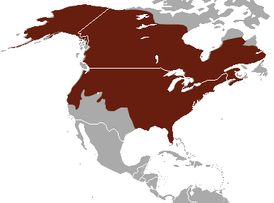
Distribution: North America. It has also been introduced in Europe and North Asia, including Japan .
The animal is medium in size. The skull is flattened, the skull is shorter and wider than the columns and European minks , but not as powerful as the forest ferret . The muzzle is relatively long, the ocular region is elongated, the ridges are well developed. The teeth of minks are larger than those of a forest ferret. The back is dark brown, the lower jaw of the animal is white. Plantar surfaces are pubescent. There is a baculum with a hook at the distal end and with a distinct “collar” that resembles a rapier hilt - a structure partially similar to that seen in wolverines and dressings .
During discontent, hisses and snorts, and, frightened or attacking, shouts in a hoarse and squeaky voice (the European mink only screams). Mink can also yap. Domesticated minks can yap to attract host attention. Sick or being in a bad mood can squeak. During a good mood, he buzzes - he makes sounds similar to a high staccato and reminiscent of a cackling chicken [2] .
An early ethological study was conducted in the 1960s to assess visual learning skills in mink, ferrets, skunks, and domestic cats. Animals were tested for their ability to recognize objects, study their valency and make a selection of objects from memory. It was found that minks are superior to ferrets, skunks and cats in this task, but this letter (short) does not take into account the possible combination of cognitive abilities (decision making, associative training) with a predominantly perceptual ability (invariant recognition of objects). Thanks to this, they quickly get used to people, and even become impudent, for example, asking fish from fishermen. Also, thanks to the developed intellect, the American mink was able to domesticate, however, it is rather difficult to keep them at home due to aggressiveness and arrogance.
The mink karyotype is 2n = 30, which is very different from the karyotypes of other marten. Embryo implantation is delayed; pregnancy normally lasts 44-60 days. There are significant differences between the American mink and other marten at the cellular and biochemical levels, and the level of these differences is greater than the difference between the individual species of marten. According to some characteristics, the American mink is close to the genus Martes (especially to the species Martes zibellina ). Due to significant differences at the cellular level between the American mink and other species of marten, American minks, scientists sometimes even refer to a separate genus.
A source of valuable fur , actively bred on fur farms. Some of the largest manufacturers are American Legend Cooperative and NAFA .
For a long time, the species was considered close to the European mink, but recent studies have shown that American minks are closer to the genus marten , while European minks are closer to the columns (Siberian mink). On this basis, scientists carried the American mink into a new genus - Neovison .
American Mink, Neovison vison , in the wild
American mink in a natural habitat on the Veduga River, a tributary of the Don.
American mink in a natural habitat on the Veduga River, a tributary of the Don.
Mink albino, fur farm in Poland
Gray mink, fur farm in Poland
- ↑ Sokolov V.E. The pagan dictionary of animal names. Mammals Latin, Russian, English, German, French. / edited by Acad. V. E. Sokolova. - M .: Rus. lang., 1984. - S. 101. - 10,000 copies.
- ↑ Mink noises l YouTube Mink Sounds