“Moscow” is a sailing battleship of the Baltic Fleet of the Russian Empire , designed by Peter the Great , the second of the ships of the “Ingermanland” type, a participant in the Northern War , during which he was twice the flagship of Admiral General Count F. Apraksin .
| Moscow | |
|---|---|
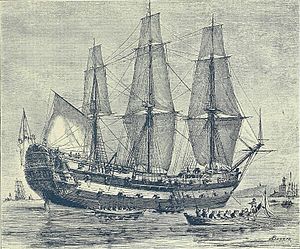 The battleship Ingermanland, the first of the ships of the same type | |
| Service | |
 Russia Russia | |
| Class and type of vessel | rank 3 sailing ship of the line |
| Type of sailing weapon | Three mast ship |
| Port of registry | Kronstadt |
| Organization | Baltic Fleet |
| Manufacturer | St. Petersburg Admiralty |
| The author of the ship drawing | Peter I |
| Ship master | Richard Cosenz |
| Construction started | October 30 ( November 10 ) 1712 |
| Launched | June 27 ( July 8 ) 1715 |
| Commissioned | Summer 1715 |
| Withdrawn from the fleet | Disassembled after 1732 |
| Main characteristics | |
| Displacement | About 1,400 tons |
| Upper Deck Length | 46.3 m |
| Midship Width | 12.8 m |
| Draft | 5,6 m |
| Crew | 470 people |
| Armament | |
| Total number of guns | 64 |
Content
Ship Description
One of two ships of the Ingermanland type [comm. 1] . These ships were designed by Peter I, were distinguished by good firepower, speed, seaworthiness and proportionality of the hull, also had sailing weapons quite advanced for their time [1] .
Ships of this type were two-deck with a short tank . The length of the ships was 46.3 meters [comm. 2] , width - 12.8 meters [comm. 3] , and draft - 5.6 meters [comm. 4] . The crew of the ship consisted of 470 people. Armament consisted of 64 guns, and there are several versions of the description of weapons [2] [3] :
- According to one version, twenty six 24-pound guns were located on the gondek , twenty-six 18-pound guns on the midsection, from 12 to 16 cannons on the forcastel, and up to 4 guns on the tank [4] .
- According to another version, the armament consisted of twenty-four 30-pound, twenty-four 16-pound, fourteen 14-pound and two 2-pound guns [2] [5] .
- According to the third version, 32-pound guns were installed on the ship’s gondek [6] .
Service History
The battleship “Moscow” was laid down in the St. Petersburg Admiralty on October 30 ( November 10 ), 1712 , and after launching on June 27 ( July 8 ), 1715 became part of the Baltic Fleet of Russia . The construction was carried out by ship master Richard Cosenz [1] [5] [7] [8] .
He took part in the Northern War. In the campaign of 1716, the ship was carried out from St. Petersburg to Kotlin , after which in July he moved from Kronstadt to Revel , where he took part in training maneuvers. September 23 ( October 4 ), together with the battleship Shlisselburg , left Revel to join the squadron of ships of the Baltic Fleet under the command of Peter I, who was in Copenhagen . However, having met a frigate on the way with an order to return, both ships took the opposite course and returned to Revel [9] [10] on October 28 ( November 8 ).
In the campaign of 1717 from June 4 (15) to July 16 (27) he was at the head of the squadron under the flag of Admiral Count F.M. Apraksin, whose ships cruised off the Swedish coast and took part in the landing of Russian troops on the island of Gotland . In the campaign of the following 1718, from July to September, he participated in cruising voyages in the Gulf of Finland as part of a squadron, Admiral General F.M. Apraksin again held his flag on the ship [11] [12] .
In the campaign of 1719 in June and July, he was cruising ships of the Baltic Fleet near the Gangut Peninsula, the purpose of which was to ensure the safe movement of the rowing fleet , carrying Russian troops to the Swedish coast. In the campaign of 1720, the ship was part of the Kotlin squadron [11] [13] .
In the June 1721 campaign, he took part in escorting the battleship Ingermanland , which sailed under the flag of Peter I to Rogervik Bay, after which he took part in naval training exercises near Krasnaya Gorka . After the conclusion of the Nystadt Peace Treaty and the end of the Northern War, the ship returned to Kronstadt [14] [15] .
In 1722 and 1723, the ship as part of the squadron of ships of the Baltic Fleet took part in practical voyages in the Gulf of Finland, in 1723, including to Revel. In 1724 it was used as a training vessel on the Kronstadt roadstead. In 1725 he went on a practical voyage to the Gulf of Finland to the island of Gotland, and in 1726 he was again used to train ship crews on the Kronstadt roadstead [11] [16] .
The ship "Moscow" was dismantled after 1732 [11] [17] .
Ship Commanders
The table shows the commanders of the battleship "Moscow" for the entire time of his service as part of the Russian Imperial Fleet [11] .
| Years of service | Rank | First and last name | Comment | Note |
|---|---|---|---|---|
| 1716 | 1st rank captain | J. van Hooft | Sending a ship from St. Petersburg to Kronstadt. | [ten] |
| 1717-1718 | captain commander | P.I. Sivers | The command of the ship during the Northern War in the campaign, when Admiral General Count F.M. Apraksin held his flag on it. | [18] |
| 1719 | 1st rank captain | V. Gay | Englishman in Russian service. Command of the ship during the Northern War. | [nineteen] |
| 1720 | 2nd rank captain | I. Blorius | Dutchman in Russian service, original Jan Blaruy [comm. 5] . Command of the ship as part of the Kotlin squadron. | [20] |
| 1721 | lieutenant captain | M. Antufiev | Command of the ship during the Northern War, including during maneuvers near Krasnaya Gorka. | [21] |
| 1721 | 1st rank captain | V. Fangent | Original named W. Fan Gent . Command of the ship during the Northern War. | [22] |
| 1723 | 1st rank captain | V. Gay | Englishman in Russian service. Command of the ship in practical navigation. | [nineteen] |
| 1725-1726 | 2nd rank captain | D. Delap | An Englishman in Russian service, the original is named after John Delapp . Command of the ship in practical navigation and on the Kronstadt raid. | [23] |
See also
- List of sailing battleships of the Russian Imperial Fleet
Notes
Comments
- ↑ The second ship was called Ingermanland , was laid down on October 30 ( November 10 ), 1712 , and launched on May 1 ( 12 ), 1715 .
- ↑ 151 feet
- ↑ 42 feet.
- ↑ 18 feet 3 inches .
- ↑ In Russian transliteration there is also a variant of writing Jan Blaruy
Links to sources
- ↑ 1 2 Chernyshev, 1997 , p. 39-40.
- ↑ 1 2 Chernyshev, 1997 , p. 39.
- ↑ Veselago, 1872 , p. 14.
- ↑ Krainyukov, Larionov, 1987 .
- ↑ 1 2 Shirokorad, 2007 , p. eight.
- ↑ Mikhailov, 1971 .
- ↑ Veselago, 1872 , p. 14-15.
- ↑ Veselago I, 2013 , p. 298.
- ↑ Chernyshev, 1997 , p. 38, 40.
- ↑ 1 2 Veselago I, 2013 , p. 484.
- ↑ 1 2 3 4 5 Chernyshev, 1997 , p. 40.
- ↑ Veselago I, 2013 , p. 155, 439.
- ↑ Veselago I, 2013 , p. 185.
- ↑ Chernyshev, 1997 , p. 38-40.
- ↑ Veselago I, 2013 , p. 152.
- ↑ Veselago I, 2013 , p. 224, 253-254.
- ↑ Veselago, 1872 , p. 15.
- ↑ Veselago I, 2013 , p. 438-439.
- ↑ 1 2 Veselago I, 2013 , p. 223-224.
- ↑ Veselago I, 2013 , p. 184-185.
- ↑ Veselago I, 2013 , p. 151-152.
- ↑ Veselago I, 2013 , p. 482-483.
- ↑ Veselago I, 2013 , p. 253-254.
Literature
- Veselago F.F. List of Russian warships from 1668 to 1860. - SPb. : Printing Ministry of the Ministry of the Sea, 1872. - 798 p.
- Veselago F.F. General marine list from the base of the fleet until 1917. - St. Petersburg. : “Atlant”, 2013. - T. 1. - 544 p. - (Military Historical Library). - ISBN 978-5-906200-02-0 .
- Chernyshev A. A. Russian sailing fleet. Directory. - M .: Military Publishing House, 1997 .-- T. 1. - 312 p. - (Ships and ships of the Russian fleet). - 10,000 copies. - ISBN 5-203-01788-3 .
- Shirokorad A. B. 200 years of the sailing fleet of Russia / Ed. A. B. Vasiliev. - 2nd ed. - M .: Veche, 2007. - 448 p. - ISBN 978-5-9533-1517-3 .
- Gerardo Etcheverry. Listado de navíos de línea rusos .
- Mikhailov M.A. Models of sailing ships of the Russian fleet. - DOSAAF, 1971.
- Kraynyukov V.G., Larionov A.L. What was the Peter's ship Ingermanland? // Shipbuilding. - 1987. - No. 8 .