Dimorphodon ( lat. Dimorphodon ) - a genus of mid-sized pterosaurs from the early Jurassic period . The name was given in 1859 by the English naturalist Richard Owen . The name means “two forms of teeth,” referring to the fact that the pterosaur had two different types of teeth in its jaws — a sign that is extremely rare in reptiles .
| † Dimorphodon | |||||||||||||||||||||||||||||||||||||||||
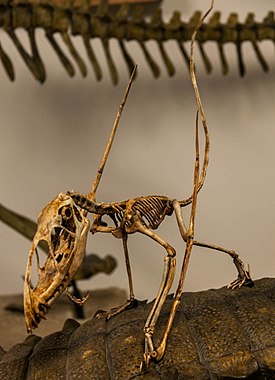 Mounted Dimorphodon Skeleton | |||||||||||||||||||||||||||||||||||||||||
| Scientific classification | |||||||||||||||||||||||||||||||||||||||||
|---|---|---|---|---|---|---|---|---|---|---|---|---|---|---|---|---|---|---|---|---|---|---|---|---|---|---|---|---|---|---|---|---|---|---|---|---|---|---|---|---|---|
| |||||||||||||||||||||||||||||||||||||||||
| International scientific name | |||||||||||||||||||||||||||||||||||||||||
Dimorphodon Owen , 1859 | |||||||||||||||||||||||||||||||||||||||||
| Kinds | |||||||||||||||||||||||||||||||||||||||||
see text | |||||||||||||||||||||||||||||||||||||||||
| Geochronology 201.6-183.0 Ma
◄ Nowadays◄ Cretaceous-Paleogene extinction◄ Triassic extinction◄ Mass Permian Extinction◄ Devonian extinction◄ Ordovician-Silurian extinction◄ Cambrian explosion | |||||||||||||||||||||||||||||||||||||||||
Content
Description
The body structure of dimorphodon shows many basal characteristics, such as a very small skull box and proportionally short wings [1] . The first phalanx of the wing toe is only slightly longer than the humerus [1] . The neck was short but strong and flexible and may have been equipped with a neck bag. The cervical vertebrae had voids. The adult dimorphodon reached a size of 1 meter with a wingspan of 1.45 meters [1] [2] . The tail was long and consisted of thirty vertebrae. The first five or six were short and flexible, and the rest gradually increased in length and were strengthened by chevrons - elongated bone processes [1] . At the tip of the tail, there may have been a rhomboid process-stabilizer inherent in rhamphorhinchae , although no remains of it were found among the dimorphodon fossils [1] .
Skull
Dimorphodon had a large, bulky skull about 23 centimeters long, the weight of which decreased due to large voids separated from each other by thin bone partitions [1] . Its design, resembling the vaulted arches of the bridge, allowed Richard Owen to immediately report that, combining light weight and great strength, not a single bone structure was more economical [3] . In the front of the upper jaw were four or five fang-shaped teeth, followed by an indefinite number of smaller teeth; the maxillary bone of all specimens is damaged in the back. The lower jaw carried five long teeth and thirty or forty tiny, flattened sharp teeth in the shape of a lancet [1] .
Opening
The first fossils, now attributed to dimorphodon, were found by amateur paleontologist Mary Enning in Lyme Regis , Dorset , UK , in December 1828 [2] . Now this region is listed as a World Heritage Site under the name Jurassic Coast ; layers of the formation are exposed here, starting from the lower section of the Jurassic system. The sample was purchased by William Buckland and reported it at a meeting of the Geological Society on February 5, 1829 [4] . In 1835, after careful study, and published this report, greatly expanded, in the Proceedings of the Geological Society, where they described and named fossils as a new species. As with most finds of early pterosaurs, Buckland classified the remains as belonging to the genus Pterodactylus and created a new species, Pterodactylus macronyx [5] . Species epithet comes from Greek. makros is “large,” and onyx is “claw,” with reference to the large claws of the forelimbs. Sample NHMUK PV R 1034 consisted of an incomplete, disconnected skeleton on a plate with a missing skull. In 1835, Buckland also attributed a piece of jaw from the collection of to P. macronyx . Later, many imaginary species of Pterodactylus became so anatomically diverse that they began to be carried into separate genera.
In 1858, Richard Owen announced the discovery of two new samples, NHMUK PV R 41212 and NHMUK PV R 1035 - again partial skeletons, but this time with a skull. Having discovered that the skull is very different from Pterodactylus , Owen isolated Pterodactylus macronyx in a separate genus, which he called Dimorphodon [6] . His first report did not contain a description, and the name remained nomen nudum . However, Owen's next publication in 1859 contained a description [7] . After several studies highlighting the anatomy of dimorphodone, Owen made the NHMUK PV R 1034 sample a holotype [8] .
At the same time, although dimorphodons are not a common fossil, other fragmentary samples were found. Some of them were acquired by London Charles Marsh between 1873 and 1881 from a London fossil merchant. One of them was extracted from the Early Jurassic strata on the southern bank of the River Severn , at Aust Cliff [1] . In 1998, James Clark and colleagues named an additional species of dimorphodon, Dimorphodon weintraubi , based on a partial skeleton found in the early Jurassic formation of La Boca, Tamaulipas , Mexico , where the remains of sphenodonts , dinosaurs and mammals were also discovered [9] . It is known for its IGM 3494 model, which contains the articulated parts of the skeleton, including the back of the skull, four cervical vertebrae, scapulocoracoids , left humerus, fragments of the right wing and right leg. Animals of this species were larger than D. macronyx , and a well-preserved leg shows that when moving on the hind limbs, these pterosaurs did not rest on their fingers, but on their feet. Traces found also speak of this. A species epithet is given in honor of Dr. Robert Weintraub [10] .
Systematics
In 1870, Harry Seeley ranked dimorphodon as his own family, Dimorphodontidae , with dimorphodon as the only representative. In 1991, the German paleontologist Peter Wellnhofer suggested that dimorphodon may be derived from the earlier European pterosaur peteinosaurus [1] . However, further cladistic analyzes did not confirm this assumption. According to Anvin, dimorphodon was associated with a peteinosaurus, but probably was not a descendant of it, and included these two genera in the clade Dimorphodontidae, the most basic group of Macronychoptera , and within it created the sister group Caelidracones . This would mean that both of these species are the most basic of all known pterosaurs, with the exception of preondactyl . According to Alexander Kellner, dimorphodon, however, has far fewer primitive traits than a peteinosaurus.
Phylogeny
The cladogram below reflects the results of a phylogenetic analysis performed by B. Andres and T. Myers in 2013 [11] .
| Pterosauria |
| ||||||||||||||||||||||||||||||||||||
Classification
According to the Paleobiology Database website, as of December 2017, 3 extinct species are included in the genus [12] :
- Dimorphodon banthensis (Theodori, 1831) [ syn. Ornithocephalus banthensis Theodori, 1831 ]
- Dimorphodon macronyx ( Buckland , 1829) [syn. Pterodactylus macronyx Buckland, 1829 , Pterodactylus marderi Owen, 1874 ]
- Dimorphodon weintraubi Clark et al. 1998
Paleobiology
Owen considered dimorphodon a four-legged. He suggested that the fifth finger supported the membrane between the tail and legs, and therefore the animal was extremely awkward on the ground [1] . His rival, Harry Seeley, who shared the view on the warm-bloodedness and activity of pterosaurs, claimed that dimorphodon was an agile four-legged or even two-legged running because of its well-developed hind limbs and anatomical characteristics of the pelvis [13] . This hypothesis was again expressed by Kevin Padian in the 1980s [14] . However, the fossilized traces of other pterosaurs indicate a four-legged way of moving on the ground, and all these traces belonged to pterosaurs with a short fifth finger. The fifth finger of dimorphodon was elongated, devoid of a claw and directed to the side [1] . Therefore, even David Anvin claimed that dimorphodon was four-legged, which was confirmed in the computer model [15] .
Nutrition
Knowledge of how dimorphodons lived is very scarce. Perhaps they inhabited coastal areas and may have had a very diverse diet. Buckland suggested they ate insects. Later it became common to portray them with ichthyophages , although Buckland's initial idea is well supported by biomechanical research and is not consistent with animal habits (see Flight below). Dimorphodon had developed jaw muscles, adapted for grasping and holding. The jaw could close very quickly, but with little force and penetration of the teeth. Along with a short and high skull and long, pointed front teeth, this suggests that dimorphodon was an insectivore, although it could have eaten small vertebrates or carrion [16] . Mark Whitton argues that the animal was a specialized carnivore because it was too large for the insectivore, and therefore preyed on small lizards, sphenodonts, and mammals, although its relatively weak jaw muscles probably meant that it ate proportionally to small prey [17] .
Flight
Like many other pterosaurs, in the past, dimorphodon was attributed to soaring animals, considering them to be analogues of modern seabirds. However, more recent studies have shown that the animal was actually a pretty poor flyer: its wings were too short in relation to the body, and the skeleton was too heavy. In life, dimorphodon probably traveled by short hops, like modern owls or woodpeckers . Unable to fly long distances, dimorphodon rose into the air as a last resort [17] [18] .
D. macronyx in flight
Interestingly, the separate position occupied by dimorphodon among primitive pterosaurs indicates that its inability to fly is an acquired trait and not a hereditary characteristic, since earlier pterosaurs, such as preondactyl , were excellent flyers.
Tenacity
Like most non-pterodactyloid pterosaurs, dimorphodon was an excellent poison frog, had proportionally large claws and a low center of gravity. Like modern squirrels, he moved along the tree trunk in short leaps [17] .
See also
- Pterosaur list
- Phylogeny of pterosaurs
Notes
- ↑ 1 2 3 4 5 6 7 8 9 10 11 Cranfield, Ingrid. Dimorphodon // The Illustrated Directory of Dinosaurs and Other Prehistoric Creatures. - London: Salamander Books, Ltd. - P. 288-291.
- ↑ 1 2 Wellnhofer P. The Illustrated Encyclopedia of Pterosaurs. - New York: Barnes and Noble Books, 1996 [1991]. - P. 69-71. - ISBN 0-7607-0154-7 .
- ↑ Padian K. Pterosaurs and Typology: Archetypal Physiology in the Owen-Seeley Dispute of 1870 // Vertebrate fossils and the evolution of scientific concepts: writings in tribute to Beverly Halstead, by some of his many friends / Sarjeant WAS, Halstead LN. - Gordon & Breach, 1995.
- ↑ Buckland W. (Eng.) // Proceedings of the Geological Society, London. - 1829. - Vol. 1 . - P. 127 .
- ↑ Buckland W. On the discovery of a new species of Pterodactyle in the Lias at Lyme Regis (Eng.) // Transactions of the Geological Society of London. - 1835. - Vol. series 23 . - P. 217—222 .
- ↑ Owen R. On a new genus ( Dimorphodon ) of pterodactyle, with remarks on the geological distribution of flying reptiles (Eng.) // Rep. Br. Ass. Advmnt Sci .. - 1859. - Vol. 28 (1858) . - P. 97-103 .
- ↑ Owen R. On the vertebral characters of the order Pterosauria (Ow.), As exemplified in the genera Pterodactylus (Cuv.) And Dimorphodon (Ow .) // Proceedings of the Royal Society of London. - 1857/1859. - Vol. 9 . - P. 703–704 .
- ↑ Owen R. Monograph of the fossil Reptilia of the Mesozoic Formations // Palaeontographical Society of London. - 1874. - Vol. 27 . - P. 1-14 .
- ↑ Marisol Montellano, James A. Hopson, James M. Clark. [20491044 Late Early Jurassic Mammaliaforms from Huizachal Canyon, Tamaulipas, México] (Eng.) // Journal of Vertebrate Paleontology. - 2008 .-- 12 December ( vol. 28 , no. 4 ). - P. 1130-1143 .
- ↑ Clark JM, Hopson JA, Hernández R., Fastovsky DE, Montellano M. Foot posture in a primitive pterosaur (Eng.) // Nature . - 1998 .-- February 26 ( vol. 391 ). - P. 886-889 . - DOI : 10.1038 / 36092 .
- ↑ Andres B., Myers TS Lone Star Pterosaurs : [ eng. ] // Earth and Environmental Science Transactions of the Royal Society of Edinburgh. - 2012. - Vol. 103, no. 3-4 (September). - P. 383—398. - DOI : 10.1017 / S1755691013000303 .
- ↑ Dimorphodon (English) information on the Paleobiology Database website. (Retrieved January 11, 2018) .
- ↑ Seeley HG Remarks on Prof. Owen's Monograph on Dimorphodon (Eng.) // Annals and Magazine of Natural History. - 1870. - Vol. Series 4 , no. 6 . - P. 129 .
- ↑ Padian K. Osteology and functional morphology of Dimorphodon macronyx (Buckland) (Pterosauria: Rhamphorhynchoidea) based on new material in the Yale Peabody Museum (English) // Postilla. - 1983. - Vol. 189 . - P. 1-44 .
- ↑ Sangster S. Anatomy, functional morphology and systematics of Dimorphodon (English) // Strata. - 2001. - Vol. 11 . - P. 87-88 .
- ↑ Osi, A. Feeding-related characters in basal pterosaurs: implications for jaw mechanism, dental function and diet (Eng.) // Lethaia. - 2010. - DOI : 10.1111 / j.1502-3931.2010.00230.x .
- ↑ 1 2 3 Witton MP Pterosaurs: Natural History, Evolution, Anatomy. - Princeton University Press, 2013 .-- ISBN 0691150613 .
- ↑ Rayner et all 2011