
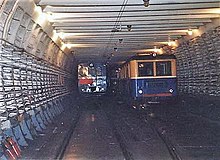
Metro-2 is the unofficial name of the formerly classified Moscow underground transport facilities for mobilization purposes [1] , which were under the jurisdiction of the Special Facilities Service of the Main Directorate of Special Programs of the President of the Russian Federation (GUSP, formerly 15 Main Directorate of the KGB of the USSR) [2] and the Ministry of Defense (9 Central control).
Content
- 1 Origin of the term
- 2 Description
- 3 Verified Information
- 3.1 US Department of Defense Report
- 3.2 Data from officials
- 3.3 Data from defectors
- 3.4 Declassified Objects
- 4 Underground "city" in Ramenki
- 5 The main lines of Metro-2
- 5.1 D-6 system
- 5.1.1 Some data on the device of the D-6 line [28] [ non-authoritative source? ]
- 5.1.2 Objects and stations of the system
- 5.1.3 Connection of D-6 with the usual metro
- 5.1 D-6 system
- 6 Other lines
- 6.1 System to Stalin's former Near Summer Cottage
- 6.2 Tunnel to the Izmailovo Stadium
- 6.3 Council of Ministers system
- 6.4 Systems towards Dawn
- 6.5 Other lines
- 7 Rolling stock updates
- 8 In culture
- 8.1 In video games
- 8.2 In fiction
- 8.3 In the cinema
- 9 Analogs in other countries
- 10 Documentary Films
- 11 See also
- 12 Notes
- 13 Literature
- 14 References
- 14.1 Publications
- 14.2 Related Sites
The origin of the term
In the summer of 1992, the literary and journalistic journal Yunost published a novel by writer and screenwriter Vladimir Gonik Hell, the action of which takes place in the underground bunkers of Moscow. Earlier, in the spring of that year, excerpts from the novel were published by the Top Secret weekly. In an interview with a Kommersant newspaper correspondent in 1993 at the presentation of his book, the writer said that he had introduced the term “Metro-2” and that the novel was written on the basis of information that he had personally collected over twenty years about bunkers and secret metro lines connecting them [3] . Gonik admitted that he wrote the novel from 1973 to 1986 [4] , and also that he deliberately distorted some information about the traces of the passage of special tunnels and the location of special objects in the text of the novel.
Later, writer Vladimir Gonik claimed that the bunkers of the so-called Metro-2 served to house the leadership of the Politburo and the CPSU Central Committee , as well as their family members in case of war. According to him, the General Secretary of the CPSU Central Committee Leonid Brezhnev allegedly personally visited the main bunker in the early 1970s, after which in 1974 he awarded the Chairman of the KGB of the USSR Yury Andropov with the Hero of Socialist Labor medal. In the bunker, each member of the CPSU Central Committee relied on apartments up to 180 m² in size with an office, a relaxation room, a catering unit and a bathroom. Gonik collected his information, as he claims, from his patients, working as a doctor in a clinic of the Ministry of Defense [5] .
After the publication of the novel, in 1992-1993, the topic of allegedly existing secret lines of the Moscow metro was raised in their publications by the Russian media , in particular, the Ogonyok magazine, calling these underground objects Metro-2.
Description
General parameters of probable data about Metro-2:
- It is laid at a very great depth: the depth of laying varies from 50 to 250 meters;
- No contact rail ;
- The tunnels are single-track, with rides at some stations;
- As the rolling stock, contact-accumulator electric locomotives of type L [6] are used together with railcars Ezh-6 [7] according to the scheme Hedgehog- L- Hedgehog 6 or Hedgehog- L-H -Hedgehog 6, four-car diesel train DPS-01 [8] and AC1A car rails. Recently (according to rumors, in March 2009) 2 two-car diesel trains RA1 built by the Mytishchi MetroVagonMash plant have also been received ;
- For the transportation of household goods, trailed platforms UP-2 and MK 2/15 motor vehicles are used;
- According to some reports, it has 4 main lines, the largest of which is Chekhovskaya, with a length of over 60 km;
- Metro-2 stations are unclad and represent narrow platforms, similar to the technical platforms of a regular metro (with the exception of large bunkers );
- The rails are recessed into concrete to allow cars to travel;
- Under Ramenki there is a depot and a maintenance station, a large bunker for local residents (the location of the bunker is associated with the special location of this area) [9] . Former Moscow Mayor G. Kh. Popov in an interview with Ekho Moskvy radio said that, according to his information, the secret metro line led to the building of the Central Committee of the CPSU and had access to the government airport Vnukovo-2 . This secret line was, in his opinion, used in the evacuation of Central Committee employees after the defeat of the Emergency Committee [10] .
Verified Information
US Department of Defense Report
In 1991, the U.S. Department of Defense published a report called Military forces in transition , a few pages of which are dedicated to the secret government metro in Moscow. The data were collected based on publications in the Soviet and Russian press of that time. A system diagram was also attached, superimposed on a map of the city [11] .
| The Soviet government built command posts deep underground both in Moscow and beyond. These facilities are connected by a network of special deep metro lines that provide a quick and safe way of evacuation for leaders of the country. ... There are deep command posts in Moscow. One of them is located under the Kremlin. The Soviet press noticed the existence of a huge underground government bunker near Moscow State University. These facilities are intended for national command during the war. They are at a depth of supposedly 200-300 meters and are estimated at 10,000 people. A special metro line runs between some points in Moscow and, possibly, a VIP terminal at Vnukovo Airport.Military forces in transition, p. 40 |
Data from officials
In 2004, the head of the protocol of the President of the USSR Mikhail Gorbachev and the first president of Russia Boris Yeltsin, Vladimir Shevchenko, the first of the former senior government officials actually confirmed the presence of a secret metro in Moscow [12] :
| Information about the number of underground utilities is greatly exaggerated. Under Stalin, who was very afraid of attempts on his life, a single-track underground metro line from the Kremlin to the so-called near dacha in Volynsky actually worked. Today they don’t use the summer house or the metro line. |
In 2008, Shevchenko again touched on the subject of "Metro-2" [13] :
| Currently, the Kremlin metro cannot be called a transport artery, and, as far as I know, major repairs are needed for its further operation: after all, there are many underground utilities that deteriorate over time. |
According to Mikhail Poltoranin , deputy prime minister and minister in the government of Boris Yeltsin in the early 1990s [13] :
| ... this is an extensive network of tunnels, and a reserve command post in case of war, from where you can command the country's nuclear forces. A large number of people can take refuge there - this was necessary for its maintenance. I know that in Metro-2 there are branches that leave in the suburbs so that the command can move away from the epicenter of a nuclear strike. |
The ex-head of the Moscow Metro Dmitry Gaev in 2007 answered the question “Does Metro-2 exist” [14] :
| I would be surprised if it did not exist. |
In the same year, in an interview with the Izvestia newspaper, he noted [5] :
| There is a lot of talk about the existence of secret transport tunnels. I will not deny anything. I would be surprised if they were not there. You ask: can they be used to transport passengers? This is not for me to decide, but to those organizations on whose balance these objects are. I do not exclude this possibility. |
In 2008, in an interview with the newspaper “ Arguments and Facts ”, the head of the independent trade union of the Moscow metro Svetlana Razina admitted [15] :
| Several years ago, among the drivers of the Izmailovo depot, a set was made for service on secret lines. And although there were many who wanted, only one was selected. Only people with special access can enter the territory of these tunnels. Most often, very short trains are used on these branches, consisting of an electric locomotive on batteries and one passenger car. |
As the correspondent of the ITAR-TASS state news agency in 2007 reported in his material [16] :
| The Metro-2 lines were for a long time in the KGB department, and subsequently went under the wing of the FSB. |
Back in 1992, in an interview with the American magazine Time, the deputy director of the State Radio and Television Igor Malashenko spoke about the existence in Sofrin , 30 km north-east of Moscow, of a television relay center built during the time of Khrushchev at great depths underground in the event of a nuclear war . According to Malashenko, at that time the equipment of the center turned out to be unsuitable for use, since it was outdated. Malashenko says that the same fate befell many underground bomb shelters, in particular, the system of underground bunkers under the building of Moscow State University, which, he said, were flooded and became worthless [17] .
Defector Data
- Oleg Gordievsky , a former colonel of the KGB of the USSR who worked for British intelligence for 11 years and fled to the UK in 1985 , in 2001, in an interview with the newspaper Argumenty i Fakty , called Metro-2 “the main secret of the KGB, which has not yet been revealed " [18] :
| You still do not know the main secret of the KGB: huge cities underground, entire communications, a network of similar structures. But they will never be shown to you, of course. |
Declassified Objects
In 2006, in the center of Moscow, the Museum of the Cold War was opened for access (Exposition Center “ZKP Tagansky”) , located at a depth of more than 60 meters. Previously, it housed a secret air defense bunker. However, the depth of the bunker is less than the depth of the Metro-2 lines, and the bunker was connected only to the tunnel of the Ring Line of the usual metro, therefore it is incorrect to attribute it to the Metro-2 system.
In 1996, a branch of the Museum of the Armed Forces was opened on the basis of the former Reserve Command Post of the Supreme Commander-in-Chief of the USSR Armed Forces I.V. Stalin in the Moscow district of Izmailovo . According to the official website of the museum, the object is connected by a 17-kilometer underground road to the Kremlin , designed to travel by car. Its construction was carried out in the 1930s and was part of the state program to ensure the country's defense capability [19] .
In 2018, it was declassified and became available for legal visits to Bunker-703 (Object ChZ-703). At one time, it served as a special archival repository for documents of special state importance, including with the stamps "secret" and "top secret." Like many secret state objects, Bunker-703 is connected to a closed metro line through a technological platform for stopping special trains. [twenty]
Underground "city" in Ramenki
In the south-west of Moscow, in the Ramenki district, under the wasteland south-west of the main building of Moscow State University [21] , the largest in Moscow is located in a complex of buildings of the Scientific Research Base of the Nauka association (NIBO Nauka) underground bunker. According to the same data, it is connected with other underground facilities of Moscow by tunnels. Allegedly, it is designed to accommodate 15 thousand people [22] . The complex of ground buildings was built in 1975 by the architect Evgeny Rozanov. The object was built by Glavspetsstroy [23] .
One of the first to write about it was the American Time magazine in 1992. In his material, the journalist refers to an unnamed KGB officer of the USSR , who claims to have participated in the construction of a large underground facility in Ramenki, which began in the mid-1960s and was completed by the mid-1970s. This object, called the Moscow-2 diggers, is supposedly designed to allow 15,000 people to take refuge within 30 years after a nuclear strike on Moscow.
On December 26, 2002, a fire occurred in the underground collectors of this facility at 12 A Vernadsky Avenue, which resulted in damaged cables [24] . Rostelecom , whose cables were damaged in a fire, filed a lawsuit against Mosenergo in this regard [25] .
The name of this object "Ramenki-43" appears in the media . The name comes from st. Ramenki, 43, where, allegedly, is one of the entrances to the underground city. At this address are the Militarized Rescue Squad 21 (VGSO 21) Federal State Institution “UHGSC in Construction” and the 1st paramilitary mountain rescue platoon (1st VGSV) VGSO 21 FGU “Directorate of Militarized Rescue Units in Construction” [26] .
According to some reports, the functions of the general customer for the construction of a special facility in Ramenki ("construction No. 110") were performed by the 9th Central Department of the Ministry of Defense (9 TsUMO), created in 1955 (military unit 57328 [27] ).
Main Metro-2 lines
D-6 system
Some data on the device line D-6 [28]
- It is laid at a very great depth, the depth of occurrence varies from 50 (in the center) to 210 meters (University 2 station in the NIKO Nauka area);
- There is no contact rail in the tunnels;
- Tunnels are most often lit (fluorescent lights and emergency lights), but there are also completely dark areas;
- Single-track traffic;
- As the rolling stock, we used L-type battery-powered electric locomotives [6] together with Yezh6 [7] wagons according to the Yezh6-L-Yezh6 or Yezh6-L-L-Yezh6 scheme, a four-car diesel train DPS-01 [8] and AC1A . Recently (according to rumors, in March 2009) 2 two-car diesel trains RA1 built by the Mytishchi MetroVagonMash plant have also been received ;
- For the transportation of household goods, trailed platforms UP-2 and MK 2/15 motor vehicles are used;
- Stations do not have official names and more resemble technical subway platforms. They are located in a tunnel of the usual section, have one platform, laid out with tiles or iron plates. The walls of the station can be made of uncovered tunnel tubing, or they can be covered with a shield made of aluminum profile or drywall;
- The stations and some places in the tunnels are equipped with surveillance cameras of the 80s model;
- The rail track is recessed into reinforced concrete slabs to enable cars to travel (using Toyota Hiace minibuses, previously RAF minibuses);
- Lateral failures lead to special facilities and rare ventilation shafts. The latter in some cases use a common infrastructure on the surface with the metro - ventilation kiosks and more;
- Remote areas are vented using wells;
- Under Ramenki there is a depot and a maintenance station. Former Moscow Mayor G. Kh. Popov in an interview with Ekho Moskvy radio said that, according to his information, the secret metro line led to the building of the Central Committee of the CPSU and had access to the government airport Vnukovo-2. This secret line was, in his opinion, used in the evacuation of Central Committee employees after the defeat of the State Emergency Committee.
- If you go from Sportivnaya metro station to Vorobyovy Gory station, you can see the arrow in the tunnel connecting the two tunnels of a regular metro. Another path departs from it. It leads to the iron gate. About 20 meters to the gate, the contact rail breaks. According to some reports, the Metro-2 path begins behind the gates.
System objects and stations
| D6 system | ||||||||||||||||||||||||||||||||||||||||||||||||||||||||||||||||||||||||||||||||||||||||||||||||||||||||||||||||||||||||||||||||||||||||||||||||||||||||||||||||||||||||||||||||||||||||||||||||||||||||||||||||||||||||||||||||||||||||||
|---|---|---|---|---|---|---|---|---|---|---|---|---|---|---|---|---|---|---|---|---|---|---|---|---|---|---|---|---|---|---|---|---|---|---|---|---|---|---|---|---|---|---|---|---|---|---|---|---|---|---|---|---|---|---|---|---|---|---|---|---|---|---|---|---|---|---|---|---|---|---|---|---|---|---|---|---|---|---|---|---|---|---|---|---|---|---|---|---|---|---|---|---|---|---|---|---|---|---|---|---|---|---|---|---|---|---|---|---|---|---|---|---|---|---|---|---|---|---|---|---|---|---|---|---|---|---|---|---|---|---|---|---|---|---|---|---|---|---|---|---|---|---|---|---|---|---|---|---|---|---|---|---|---|---|---|---|---|---|---|---|---|---|---|---|---|---|---|---|---|---|---|---|---|---|---|---|---|---|---|---|---|---|---|---|---|---|---|---|---|---|---|---|---|---|---|---|---|---|---|---|---|---|---|---|---|---|---|---|---|---|---|---|---|---|---|---|---|---|---|---|---|---|---|---|---|---|---|---|---|---|---|---|---|---|
Legend
| ||||||||||||||||||||||||||||||||||||||||||||||||||||||||||||||||||||||||||||||||||||||||||||||||||||||||||||||||||||||||||||||||||||||||||||||||||||||||||||||||||||||||||||||||||||||||||||||||||||||||||||||||||||||||||||||||||||||||||
The main purpose of the system is the transport connection of the objects of the Ministry of Defense in the city center with the "underground city" in Ramenki.
The construction of a separate underground transportation system was required primarily because the shallow areas of the Sokolniki line, like the metro bridge, would have been destroyed in the event of a nuclear war, making it impossible to connect between the central facilities and the Ramen complex using the usual metro.
The main part of the system was built in the 1950s and 1960s; the entire construction was completed in the 1980s. The length of the line, along with all branches, is slightly less than 25 km. Depth of laying - from 50 meters in the center to 210 meters in the area of the NIBO "Science"
The main move goes from the General Staff of the Ministry of Defense of the Russian Federation to the NIBO “SCIENCE”. Помимо этого, линия имеет два ответвления, которые отходят незадолго до станции Университет-2 (НИБО «НАУКА»). Одно ответвление заканчивается станцией и двумя тупиками под Лабораторией измерений и испытаний Московского метрополитена в Тропарёвском лесопарке. Другое ответвление заканчивается в районе СМУ-155 ОАО «Трансинжстрой» и Материально-технической базы в/ч 95006 недалеко от платформы Матвеевское .
Александр Добровольский, «Московский комсомолец», 25 сентября 1999 г. :
Прокладку тоннелей мы вели ниже уровня «гражданского» метро. Все наши объекты для пущей конспирации были обозначены номерами. Например, в районе Никольской улицы располагалась шахта, именовавшаяся «Сотым строительством»
«Метростроевец» №12, 2006 [29] :
Строительством № 100, куда нас направили, командовал Василий Дементьевич Полежаев .
«Метростроевец» №19, 2006 [30] :
Коллектив Тоннельного отряда № 6 провожал Виктора Фроловича на заслуженный отдых. Уходил последний из поколения пятидесятников, а их тогда на строительство № 100 только из Таманской дивизии пришло более трёхсот человек. Бравые гвардейцы-таманцы появились в Москве, у ветхого домика за номером десять на улице Разина вскоре после ноябрьского (1951 года) парада на Красной площади, где большинство из них в седьмой раз за время службы прошагали стройными рядами мимо Мавзолея В. И. Ленина. Адрес конторы они узнали от представителя Метростроя, который приезжал в часть незадолго до демобилизации.
Соединение Д-6 с обычным метро
Существует соединение между гражданским метро и системой Д-6, начинающееся как ответвление от южного направления Сокольнической линии после станции « Спортивная ». Официально это оборотный тупик. Контактный рельс в этом тоннеле обрывается за 20 метров до решётчатых ворот, прикрытых стеклотканью. Затем идёт короткий участок тоннеля, где пространство между рельсами занимает арматурная сетка с двумя люками.
По свидетельству диггеров [31] :
…Итак, Вы подлезли под решетчатые ворота, и попали во владения Метро-2 (типа). Контактный рельс здесь действительно обрывается, но отрезок до вторых ворот настолько короткий (12—15 метров), что, возможно КР тут просто не требуется (как на стрелке). Продолжения КР за вторыми воротами, по-моему, более чем вероятно, судя по множеству проходящих сквозь бетонную переборку силовых кабелей…
…До часу ночи здесь (между воротами) темно, хотя у самых вторых ворот установлено два сильно запылённых прожектора, да и лампы идут по потолку. К сети рабочего освещения подключён один прожектор. Всё здесь в большом запустении. Пространство между рельсами занимает арматурная сетка с двумя люками (на замках). Перед самыми вторыми воротами есть дренажная решетка (без мазы)…
…Вторые ворота — это не гермозатвор. По крайней мере, под ними виден свет с той стороны плюс мощный фиксатор, упирающийся в рельс. Больше ничего не разглядеть, щель узкая. Сами ворота выполнены из литого бетона в метр толщиной, слева есть камера, куда отъезжает плита. По её торцу идут скобы, по ним можно залезть. В пол вделаны специальные ролики. Справа на стене — пульт управления затвором. Похоже, что не живой. Датчики (1989 год) открывания частично зафиксированы проволокой, частично легко демонтируются. Очень похоже, что они ничегошеньки не делают. Есть ручка ручного привода, но он, похоже, сломан. Крути, не крути — ворота не сдвигаются ни на миллиметр! Думаю, диггер-кулибины могли бы разобраться, как «оживить» агрегат, хотя остаётся блокировка за рельс. Может, конечно, как водится, побеспокоить её ломом, который стоит тут же…
…Ещё интереснее оказалось на полпути между воротами. Ближний к 1-м воротам люк между рельс, хоть и заперт на новенький замок, не имеет петель и при желании легко открывается. Вниз уходит 50-ступенчатая лесенка (15 метров), заканчивающаяся аналогичной камерой, запертой по ходу уже настоящими стальными гермоворотами. Сзади на стене такой же неработающий пульт привода и телефон со знаком качества (без гудка). Рельсов на полу нет. Самое забавное, что ворота разгерметизированы! Все четыре (с каждой стороны!) засова не закрыты. Мотор привода герметизации имеет четырёхгранный штырь для ручного поворота (но этого, как я уже сказал, и не требуется). Рядом такой же штырь на открытие (!) — только покрути. Ручка, как водится, лежит тут же, ржавая. Ворота на неё отзываются — то есть механизм ручного открытия работает! Это очень перспективное место. Хотя, конечно, должны быть и ещё одни парные гермоворота. Тюбинги стен помечены 1956 годом (у стрелки — 1952-м)…
Далее — бетонный блок Д28. Тоннель продолжается дальше, подныривает под тоннель Сокольнической линии в сторону Воробьёвых гор и сразу после пары гермодверей Д29 и Д29А находится стрелка гейта с линией Д6.
Портал « Популярная механика » [32] :
Говорят, что переходы к секретным линиям существуют едва ли не на всех центральных станциях обычного метро, но это явно не так. Действительно, большинство из этих станций строились и с учётом того, чтобы служить бомбоубежищами — на многих из них можно увидеть большие стальные, всегда раскрытые створы, которые установлены как раз на тот случай. Однако многочисленные двери и переходы, ведущие к секретным линиям, нивелировали бы саму идею секретности. Судя по всему, «точек соприкосновения» «Метро-2» и обычного метро не слишком много.
Прочие линии
Система до бывшей Ближней дачи Сталина
| External Images | |
|---|---|
| Обзорная схема зон ВРК-1 и -2 | |
Связывает Кремль (уровень−59, зона ВРК-2), некоторые объекты на Арбате , в районе Смоленской (здание МИД ), Киевской , в сторону Парка Победы , бывшей Ближней дачи Сталина и бывшей Волынской больницы . Тоннель от Кремля до МИД и объектов вокруг Киевского вокзала строили параллельно с глубоким Арбатским радиусом . Участок до Ближней дачи и больницы закончили к 1956 году. Ныне система частично находится в ведении МЧС .
Венткиоск 370 (бывшая шахта 459 Трансинжстроя) , ствол в ангаре на территории Резервной базы МЧС у Сортировочной и объект «Загородный» Гохрана также имеют отношение к системе.
Тоннель к стадиону Измайлово
Бывшее ответвление от перегона Семёновская — Партизанская к стадиону Измайлово. Съезд с перегона забутовали в конце 70-х, когда строили гостиничный комплекс «Измайлово». Тогда же уничтожили часть тоннеля. Оставшаяся часть до стадиона была использована как кабельный коллектор от гостиничного комплекса до ТЭЦ-23. Участок до стадиона строился открытым способом, глубина залегания — 5 метров [33] . Строительство завершено в 1942 году. К началу войны рельсы в тоннеле Покровского радиуса уже были уложены до Партизанской.
От бункера в сторону Кремля идёт 15-километровый тоннель, по которому может проехать бронетехника. Военные, которые владеют этим бункером, отрыли в сторону центра метров сто. Бункер есть, он с хорошей архитектурой. Находится он не под территорией рынка, а под стадионом.
Система Совмина
Об этой линии существует лишь отрывочная и неподтверждённая информация. Предполагается, что линия была построена в середине 70-х годов. Начинается под Домом правительства РФ (зданием Совмина РСФСР). По другим данным, линия представляет собой ответвление от системы до бывшей Ближней дачи Сталина и не ведёт к Белому дому. Дальше частично идёт под Кутузовским проспектом , пересекая Киевский вокзал , где находится один из бункеров связи. Существует распространённое мнение о существовании станции под гостиницей « Украина ». Линия продолжает идти вдоль Бережковской набережной через гостевые дома ФСО и Мосфильмовскую улицу до блоков «подземного города», расположенных под спецавтобазой ФСО и в/ч 95006 ГУСП .
По утверждениям различных источников [34] во время событий 1993 года большинство укрывавшихся в « Белом доме » покинуло его через подземные коммуникации. Однако в воспоминаниях участников нет упоминаний каких-либо специальных транспортных систем под «Белым домом»:
Под нашумевшими подземными ходами «Белого дома» подразумеваются два подземных «сухих» коллектора с трубами горячего водоснабжения, идущих от «Белого дома» вдоль набережной соответственно влево (в сторону Плющихи и далее до Новодевичьего монастыря) и вправо (в сторону Хаммеровского центра).
Затем проверил все выходы — они, к сожалению, оказались не самыми удачными. Один выводил к Шмидтовскому парку, на открытую местность, рядом с Белым домом. По другой дороге можно было попасть к парадному подъезду нашего же здания. Третий путь оказался просто тупиковым — он выводил внутрь Белого дома. Логика строителей подвалов уникальна: главное — побыстрее заполнить людьми бомбоубежище, а уж выбираться из него совсем необязательно. Четвертый выход оказался таким же бесперспективным, как и предыдущие три. Он начинался из второго отсека. Приоткрыв металлическую решетку, можно было увидеть бесконечную, уходящую круто вниз винтовую лестницу. Я не поленился и спустился по ней.
Ступеньки не считал, но лестница показалось длинной, будто я шел с пятнадцатого этажа. Наконец уперся в «потайную» дверь, почти как в сказке про Буратино, только вот ключик был у меня отнюдь не золотой. Дверь открылась, и я попал в туннель между станциями метро «Краснопресненская» и «Киевская».
— А .В. Коржаков. Борис Ельцин: от рассвета до заката
Системы в сторону Зари
В 1970-х планировалась система, соединяющая спецобъекты Минобороны в Балашихинском районе (дислокацию спецподразделений), в частности ЦКП ПВО в пос. Заря, со зданием КГБ (ныне ФСБ ) на Лубянской площади в Москве. Предположительно система имеет индекс Л-35.
Известно также о системе, проходящей через Войсковые части ВВС в Балашихе ( Вентшахта на территории одной из в/ч , В/ч № 33749 . На территории последней ранее был гейт с железнодорожной веткой). Скорее всего, линия идёт дальше в сторону Щёлково .
Тоннели в сторону Москвы, возможно, проходят через объект В/ч № 3747 внутренних войск МВД РФ, В/ч 11135, 18 ЦНИИ ГШ ) и заканчиваются у объекта под ФГУП «403 Военный завод» Министерства обороны РФ . Систему обслуживает Московский военизированный горноспасательный отряд (МВГСО) ФГУ «УВГСЧ в строительстве», находящийся по адресу ш. Энтузиастов, д. 17а [26] . Строительством этих спецтоннелей занималось СМУ-13 Метростроя. Предположительно, имеется сбойка с ВШ 732 Калининской линии у « Авиамоторной ».
Некоторые стройплощадки, имеющие отношение к системам: Производственная база ОАО «Трансинжстрой» в Кучинском лесопарке , база ФГУП «Спецстрой» в Реутове , СМУ-13 Метростроя у станции метро Шоссе Энтузиастов
По состоянию на 2007 год строительный ствол Р-1 объекта главного командования ВВС УК-90Б в Заре был затоплен водой [35] .
Другие линии
По различным слухам существует линия, проходящая через Рублёвское шоссе , бункер ГО А-50 рядом с домом Ельцина на Осеннем бульваре и далее в Барвиху и Власиху . Однако её существование ничем не подтверждено. Данное направление указано в схеме Юрия Зайцева и в схеме, опубликованной в 1997 году в Washington Times [36] .
Также, возможно, существует линия, идущая на север в сторону Санкт-Петербурга и имеющая шлюз с ж/д путями в области, так как в перегоне между « Белорусской » и « Краснопресненской » есть гермоворота с надписью «Д-6 вых. 23».
На уровне слухов и предположений есть также информация о тоннеле из 59-го Арсенала в «Зарю».
Обновление подвижного состава
В декабре 2007 года по заказу в/ч 95006 (Мосфильмовская ул, 80) Метровагонмаш выполнил ремонт оборудования изделия РА 730.15 на сумму 1 млн. 728 тыс. 900 рублей [37] (недоступная ссылка) . В декабре 2008 года выполнен ремонт оборудования изделия 730.15 на сумму 1 млн. 255 тыс. 800 рублей [38] . В ноябре 2009 года выполнен ремонт оборудования изделия 730.15 на сумму 505 тыс. 100 рублей [39] . В ноябре 2010 г. выполнен ремонт оборудования изделия 730.15 и изделия 730.05 на сумму 3 млн. 653 тыс. 220 рублей [40] .
В 2007 году электродепо «Планерное» выполнило текущий ремонт вагонов ЕЖ-6М и ЛМ на сумму 186 тыс. 574 рубля [41] . В 2009 году то же депо выполнило текущий ремонт трёх изделий № 117 на сумму 532 тыс. 228 рублей [42] .
В 2007 Учебно-производственный центр Московского метрополитена обучил для ГУСП 7 человек по специальности «машинист электропоезда» [43] . В 2008 году по специальности «машинист электропоезда» было обучено ещё 6 человек [44] .
В 2008 году поставлен новый подвижной состав от Метровагонмаша [45] — было выпущено 7 штук РА 730.15 (дизельный подвижной состав) и 2 штуки 730.05 (грузопассажирская мотодрезина).
In Culture
В видеоиграх
- В 2005 году вышла компьютерная игра « Метро-2: Смерть вождя », в которой действие происходит в тоннелях системы Д-6.
- В 2010 году вышла видеоигра « Метро 2033 » для Xbox 360 и персональных компьютеров, в которой по сюжету необходимо отыскать и воспользоваться секретными ветками метро. Также в игре присутствует многоуровневый подземный бункер с командным центром и атомным реактором, прототипом которого послужил комплекс в Раменках.
- В 2013 году вышла видеоигра « Метро: Луч Надежды » для ПК и игровых приставок. В начале сюжета главный герой находится в многоуровневом бункере. В конце игры также присутствует бункер где проводится битва между Орденом СПАРТА и Красной линией (Коммунистами)..
- В 2019 году вышла видеоигра « Metro Exodus » для ПК и игровых приставок .В начале главный герой находится в бункере, но позже вынужден уехать оттуда.
В художественной литературе
В рассказе «Тёмное прошлое человека будущего» Евгения Чижова, опубликованном в журнале «Октябрь» в 2000 году, действие которого происходит в сентябре 1993 года, повествование идёт от лица человека, случайно попавшего на секретную линию московского метро [46] .
В романе Александра Иличевского «Матисс» действие которого происходит в начале 1990-х годов, главный герой исследует «Метро-2» [47] :
| Королёв находил интересным исследовать недостроенные или заброшенные по разным причинам станции секретного метро. Они нравились ему своей грандиозной мрачностью, были словно бы несвершившиеся большие сущности, этакие нерождённые мастодонты общественного достояния. Одна из этих станций строилась как узловая. Называлась она «Советская» и находилась в месте пересечения с легальной веткой |
Метро-2 или Д6 упоминается в следующих произведениях:
- Ольги Чередниченко «Метро-2010» и «Москва Сталкеров»;
- Владимира Гоника «Преисподняя»;
- « Вселенная Метро 2033 » (проект Дмитрия Глуховского);
- Виктора Суворова «Контроль», «Выбор»;
- Данила Корецкого «Рок-н-ролл под Кремлём», «Поймать шпиона», «Спасти шпиона», «Пешка в большой игре»;
- Максима Рублева «Не прислоняться»;
- Матвея Гречко «Засекреченные линии метро Москвы в схемах, в легендах, в фактах».
В кинематографе
- В кинофильме «Диггеры» упоминается Метро-2, а также показываются различные объекты, имеющие к нему отношение. В частности, сеть радиационных лабораторий.
- В телесериале «Рок-н-ролл под Кремлём» Метро-2 исследует один из главных героев, диггер Алексей Синцов («Леший»). Впоследствии, в конце последней серии он возглавляет охрану Метро-2.
Аналоги в других странах
- In the Beijing Metro, line 1 continues to the west and has three stations on the territory of military facilities, including a bunker for top officials of the state. Unlike Metro-2 in Moscow, the existence of these stations is not classified.
- A network of secret tunnels has been built near Pyongyang , the capital of the DPRK , at a depth of 300 meters, which is connected to several important strategic sites in various regions of the DPRK and can be used to evacuate high-ranking officials in case of emergency [48] .
- In Washington, there is a 3-line government metro system connecting Capitol facilities. The system is not classified, and visitors are allowed to use it when accompanied by one of the employees [49] .
Documentary Films
- In the film “Secret Metro” (Russia, 2004; director Alexander Gromov; television on REN TV channel on February 10, 2004) Metro-2 is devoted to the first few minutes.
See also
- US Capitol Metro System
- London Post Railway
Notes
- ↑ Secret metro in Moscow: legend and reality . naked-science.ru. Date of treatment January 31, 2019.
- ↑ Head Office of the President’s Special Programs (Inaccessible link) . Date of treatment September 11, 2011. Archived September 11, 2011.
- ↑ ! A book about Moscow dungeons has been published . Kommersant No. 41 (264) (March 6, 1993). Date of treatment August 13, 2010.
- ↑ W. Gonick. The underworld. Introduction, part 1 .
- ↑ 1 2 Will Stalin's Secret Metro be opened to everyone? . News.
- ↑ 1 2 Contact-accumulator electric locomotives of type L . vagon.metro.ru. Date of treatment January 31, 2019.
- ↑ 1 2 Electric cars of the type Hedgehog 6 . vagon.metro.ru. Date of treatment January 31, 2019.
- ↑ 1 2 DPS1-04 diesel train designed for the Moscow Metro-2 . www.parovoz.com. Date of treatment January 31, 2019.
- ↑ Metro-2 . www.metro.ru. Date of treatment January 31, 2019.
- ↑ Popov Gabriel. Interview / Russia 15 years ago and now / Gavriil Popov . Echo of Moscow. Date of treatment January 31, 2019.
- ↑ US Department of Defense . Military forces in transition . - 1991. - S. 40–41 . - ISBN 0-16-035973-2 . Archived {a. copy Archived March 7, 2016 on Wayback Machine
- ↑ Underground cities . www.aif.ru (May 26, 2004). Date of treatment January 31, 2019.
- ↑ 1 2 The Moscow government may open access to the secret Stalin metro . NEWSru (March 23, 2007). Date of treatment August 13, 2010.
- ↑ Online conference of the head of the Moscow metro Dmitry Gaev . The magazine "Rosbank" (July 1, 2007). Archived August 14, 2009.
- ↑ George Alexandrov. Secret metro. Special lines continue to be built today . Arguments and Facts (October 15, 2008). Date of treatment August 13, 2010.
- ↑ Authorities are preparing maps of underground Moscow: will we find out the whole truth about the “failures” and the “secret metro” . Prime TASS (March 28, 2007). Archived January 19, 2014.
- ↑ Moscow's Secret Plans . TIME (unavailable link from 01/23/2016 [1348 days]) . Archived February 4, 2013.
- ↑ Interview in the newspaper “Arguments and Facts” - Oleg Gordievsky: “With the word“ KGB “the world no longer trembles” in issue No. 30 (1083) dated July 25, 2001
- ↑ Stalin's bunker . www.cmaf.ru. Date of treatment January 31, 2019.
- ↑ Bunker 703 - BUNKER 703 in Moscow - Museum of Modern Fortification - Special Vault of the Ministry of Foreign Affairs of the USSR (Russian) (neopr.) ? . Circulation date May 29, 2019.
- ↑ Sitting on a beautiful hill . Russian life (unavailable link from 01/23/2016 [1348 days]) . Archived on September 11, 2012.
- ↑ Underground city of Ramenki . Square meter.
- ↑ UM No. 213 under the Special Construction of Russia . archive.is (August 30, 2013). Date of treatment January 31, 2019.
- ↑ The fire of the collector electrical cables on Vernadsky Avenue Was extinguished . NEWSru (December 27, 2002). Date of treatment August 13, 2010.
- ↑ Arbitration proceedings in cases of damages caused by a fire. - Lawfirm.ru. (inaccessible link)
- ↑ 1 2 Structure of the Federal State Institution 'Directorate of Paramilitary Mine Rescue Units in Construction' (Unavailable link) . Date of treatment October 4, 2009. Archived February 21, 2011.
- ↑ ORDER OF THE MINING COUNTRY OF THE RUSSIAN FEDERATION FROM 10.10.98 N 1251-R ON THE TRANSFER OF A MILITARY CITY OF THE MILITARY PART 57328 RUSSIAN DEFENSE TO THE OPERATIONAL DEPARTMENT OF THE RUSSIAN MINISTRY OF INTERNAL AFFAIRS> . (inaccessible link)
- ↑ Diggerstvo (Moscow) . (unavailable link from 01/23/2016 [1348 days]) . Archived August 16, 2013.
- ↑ Metrostrovets No. 12, 2006 (unavailable link) . "Metrostrovets" No. 12, 2006 . Date of treatment August 7, 2010. Archived October 24, 2014.
- ↑ Metrostrovets No. 19, 2006 (unavailable link) . Metrostrovets No. 19, 2006 . Date of treatment July 20, 2009. Archived October 24, 2014.
- ↑ Gate next to Sportivnaya station (Inaccessible link) . (unavailable link from 01/23/2016 [1348 days]) . Date of treatment March 8, 2010. Archived April 22, 2009.
- ↑ Alexey Chikurnikov. Secrets of the dungeon: metro-2 (unavailable link from 01/23/2016 [1348 days ]] (unopened) (09-09-28). Archived on September 10, 2012.
- ↑ The military dug a tunnel leading to Stalin's bunker . msk.newsru.com. Date of treatment January 31, 2019.
- ↑ 1 2 Anathema: Chronicle of a coup d'etat (notes of a scout)
- ↑ Current repair of pressure drainage equipment of the UK-90B facility (# 484448) | Tender region: Moscow region . tenderer.ru. Date of treatment January 31, 2019.
- ↑ Secrets' Metro'-Style . Archived August 4, 2012.
- ↑ Contract 3982107000021 - Repair of equipment of the product 730.15 (inaccessible link) . RosGosZatraty (unavailable link from 01/23/2016 [1348 days]) . Date of treatment July 9, 2010. Archived on February 7, 2016.
- ↑ Contract 3982108000347 - Repair of equipment of product 730.15 . RosGosZatraty (unavailable link from 01/23/2016 [1348 days]) . Archived on September 10, 2012.
- ↑ Contract 3982109000340 - Repair of equipment of the product 730.15 . RosGosZatraty (unavailable link from 01/23/2016 [1348 days]) . Archived on September 9, 2012.
- ↑ Contract 3982110000171 - Repair of equipment of product 730.15 and product 730.05 . RosGosZatraty (unavailable link from 01/23/2016 [1348 days]) . Archived on September 12, 2012.
- ↑ Contract 3982107000082 - Maintenance of wagons EZh-6M, LM . RosGosZatraty (unavailable link from 01/23/2016 [1348 days]) . Archived on September 11, 2012.
- ↑ Contract 3982109000352 - Maintenance of the second volume of three products No. 117 . RosGosZatraty (unavailable link from 01/23/2016 [1348 days]) . Archived on September 9, 2012.
- ↑ Contract 3982107000004 - Training 7 specialists in the specialty of “electric train driver” . RosGosZatraty (unavailable link from 01/23/2016 [1348 days]) . Archived on September 10, 2012.
- ↑ Contract 3982108000092 - Training 6 specialists in the specialty of “electric train driver” . RosGosZatraty (unavailable link from 01/23/2016 [1348 days]) . Archived on September 11, 2012.
- ↑ Archived copy (inaccessible link) . Date of treatment February 10, 2015. Archived October 18, 2014.
- ↑ http://infoart.udm.ru/magazine/october/n7-20/chigo002.htm Archived March 22, 2007 on Wayback Machine October magazine, No. 7, 2000
- ↑ A. Ilchevsky, the novel "Matisse", the magazine "New World", 2007, No. 2, 3.
- ↑ Secret tunnels , Interfax (12/9/09) were built under the DPRK capital . Date of treatment March 9, 2010.
- ↑ The United States Capitol Subway System . www.belowthecapital.org. Date of treatment January 31, 2019.
Literature
- Matvey Grechko. The classified lines of the Moscow metro in schemes, legends, facts. - M .: AST, Astrel, 2012 .-- 336 p. - 3000 copies. - ISBN 978-5-17-075558-5 .
- Olga Cherednichenko. Metro 2010. Underground City Guide. - M .: AST, Astrel, 2010 .-- 408 p. - 10,000 copies. - ISBN 978-5-699-45064-0 .
Links
Publications
- Diggerstvo (Moscow) . Site diggers Moscow State University. Date of treatment March 8, 2010. Archived May 18, 2012.
- Andrey Soldatov . Disguise , Version (May 27, 2002). Archived December 20, 2010. Date of treatment October 3, 2010.
- Denis Baranets . Metro Special Purpose "Soviet Belarus" 12.01.96.
- Secret metro. Special lines continue to be built today. Arguments and Facts , Oct. 15 2008
- Military forces in transition. Washington, DC: Department of Defense. 1991. ISSN: 1062–6557. ISBN 0-16-035973-2 (English)
Related Sites
- Metro-2 on the website of Artemy Lebedev .
- Secret metro on the site metro.molot.ru .
- Official site Metro-2 (comic, open by April 1, 2008)
- An article about Metro-2 in Odessa .