Serdica ( Latin Serdica ) is an ancient city in Thrace . Serdika - Sredets is an antique and medieval fortified city in the center of Sofia , the capital of Bulgaria .
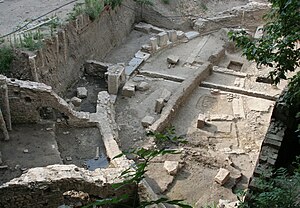
Disclosed and exhibited Rotunda St. George IV century. with the remains of the palace of Emperor Constantine I the Great and the ancient street; East fortress gate; the ruins of the fortress bastion near the Serdyky thermal mineral spring ; family paraclis of St. Nicholas with the walls of the palace of Sevastocrat Kaloyan (13th century); Church of St. Petka (Paraskeva), old 1241 ; Church of the Holy Savior; Late medieval Church of St. Petka of Samarjah and others.
History
The settlement of the Thracian tribe of Serds , which appeared near the Serdikian thermal mineral spring , one of many in the Sophia Basin in the VIII century BC. e. , archaeologically traced to the Neolithic site. Around the VI century BC e. conquered by the Odris , whose kingdom was conquered by the Macedonians under King Philip II . The name Serdica was given to the city by the Romans , after being conquered by the Odris in 29 , apparently contrasting their memory with ancient hearts against their historical claims. Emperor Trajan (98–117) granted the city the rights of Roman citizenship (Ulpia Serdica municipality , named Trajan Ulpius). Having become the center of the Roman province of Lower Dacia , subsequently Thrace (since 395 in the Eastern Roman Empire - Byzantium), Serdika during the 2nd century grew strongly into a “large and impregnable” (according to Ammianus Marcellinus , 357 ) city, the beloved residence of the Roman emperor Constantine (306–337). ("Serdika is my Rome"). Here in 343 in the Cathedral of St. Sofia hosted the Serdian Cathedral .
In the 5th - 6th centuries, during the era of the Great Migration of Peoples, the city experienced the invasions of the Goths and other barbarian tribes, was captured by the Huns of Attila . Under the emperor Justinian (527-565), the city is reborn as an important administrative center and a powerful fortress under the name Triaditsa . The episcopal department (since the time of Emperor Constantine ) is subordinate to the archbishop of the city of Justinian Prim .
During the Bulgarian-Byzantine war (807–815), Khan Krum Khan in 809 penetrated the city with a vile cunning, then breaking his oath promise when agreeing on the honorable surrender of the Byzantine garrison, brutally tortured and exterminated all unarmed surrendered soldiers and many civilians, and the city was captured and plundered. The city became the border Bulgarian fortress Sredets (Latin Serdica → Old Slav. Sѣѣьь).
Architecture
The city was small in scale, but magnificent in its urban development plan and architecture. During the Roman period, towers, ramparts, baths , administrative and religious buildings, a civilian basilica and a boulevard (a large amphitheater) were built in the city. In the Byzantine era, the Roman rotunda was restored, later converted into an early Christian church - the Church of St. George.
Gallery
Serdika - Sredets archaeological reserve plan
The ruins of ancient Serdica - St. Rotunda George and the residence of Emperor Constantine I the Great ІV century.
Poterna at the Eastern Fortress Gate.
The ruins of the residence of Emperor Constantine I the Great .
See also
- Sofia
Literature
- Tabula Imperii Romani K 34, Naissus, Dyrrhachion-Scupi-Serdica-Thessalonike , Ljubljana, 1976
- Itineraria Provinciarum et Maritimum, ed. O. Cuntz, Itineraria Romana I , Leipzig, 1929