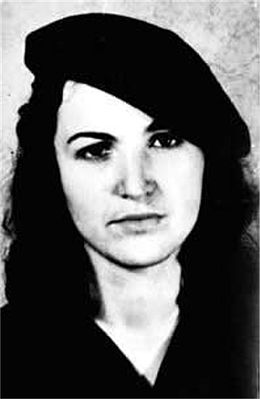
Aide Tamara Bunke Bider ( German: Haydée Tamara Bunke Bider , pseudonym - Tanya-guerrilla ( Spanish: Tania la Guerrillera ); November 19, 1937 , Buenos Aires , Argentina - August 31, 1967 , Bolivia ) - Latin American revolutionary of German origin, fighter of the Bolivian detachment Che Guevara .
| Aide Tamara Bunke Bider | |
|---|---|
| Haydée Tamara Bunke Bider | |
 | |
| Aliases | Tania la guerrillera |
| Date of Birth | November 19, 1937 |
| Place of Birth | Buenos Aires , Argentina |
| Date of death | August 31, 1967 (29 years old) |
| Place of death | Bolivia |
| Citizenship | |
| Occupation | Revolutionary - Internationalist |
| Education | |
| The consignment | |
Content
The early years
Tamara Bunke was born November 19, 1937 in Argentina , in the family of German Communists Eric Bunke and Nadi Bider, who fled from Germany in 1935 . In Argentina, Tanya’s parents participated in an underground struggle, and in 1952 the family returned to Germany - in the GDR . After graduating from high school in Argentina, Tanya entered the GDR first at the Leipzig Pedagogical Institute, and then at the Humboldt University of Berlin , at the Faculty of Philosophy and Literature. Tamara is a vibrant person, fluent in Spanish, German and Russian (her mother is from Russia ), a great singer who knows how to play the piano , guitar , accordion , athlete and ballerina.
Ernesto Che Guevara first appeared in her life in December 1960 , when she was only 23. During a tour of the socialist countries, Guevara visited Leipzig Latin students studying in the GDR. Tanya was his translator. May 12, 1961 Tanya arrives in Havana , works here at the Ministry of Education, studies at the Faculty of Journalism of the University of Havana.
In March 1963, in Cuba, she was invited to become an underground guerrilla in one of the countries of Latin America, where there is a hotbed of anti-imperialist revolution. Over the next year, Tamara, now the "partisan Tanya" (in honor of Zoya Kosmodemyanskaya ), studies cryptography, radio communications, rules of conspiracy. In April 1964 she was thrown into Western Europe for the yet unencrypted “underground work”.
Bolivian Campaign
On November 16, 1964, with fake documents addressed to Laura Gutierrez Bauer, an Argentine of German descent (now she is “Argentine, daughter of an Argentine businessman and German anti-fascist, amateur ethnographer”), Tanya arrives in La Paz . Here she gives private German lessons, which help to get in touch with many important dignitaries, such as Gonzalo López Muñoz, Head of the Presidential Information Department, and later Bolivian President Rene Barrientos himself , about the closeness of Tanya rumors - so, in the fall of 1965 she was seen with the president at the weekend in Peru [2] . Acquaintances in such high spheres allowed traveling around the country, climbing into its most remote corners, fulfilling Che Guevara’s assignment to select the place of the central base of the future center of the liberation war. She explains her trips to remote areas by her interest in Native American folk songs (later, during a search of Tanya’s apartment, she will discover a unique collection of Native American decorative art and folklore). In addition, in order to obtain Bolivian citizenship, she enters into a fictitious marriage with a young Bolivian official (it is possible that both Barrientos and Che could recommend her this step, being sworn enemies and not knowing about each other).
Tanya is hosted by the host of the radio program “Tips for Unrequited Loves” on Santa Cruz radio, so her encrypted reports go unhindered on the air.
Since January 1966, Tanya receives Cuban officers - the core of the future guerrilla warfare , provides them with a temporary residence. The result of her ethnographic trips was the purchase in June of that year of the Kalamina ranch in the Nyankauasu river valley in the southeast of the country in the name of partisan Roberto “Coco” Peredo. This acquisition cost the Cuban Ministry of Defense $ 25 thousand (300 thousand Bolivian pesos). At the end of October, Che Guevara drove into Bolivia with documents addressed to a Uruguayan businessman named Ramon Benitez Fernandez ; since the real Benitez was 24 years older than Che, he was forced to make up for a gray-haired elderly man. Guevara’s early receipt of a Bolivian visa was facilitated by Tanya’s acquaintance with Gonzalo Lopez. On November 7, Che arrived at the Kalamina Ranch. He hoped that Calamina would become the most important link in the partisan chain of Latin America, which stretches from Peru to Argentina.
On December 31, Tanya arrived in Kalamina, accompanying the first secretary of the Communist Party of Bolivia, Mario "Estanislao" Monhe . The next day, when it became clear that the local Communists were gradually merging with the regime to support the uprising, Che sent her to Argentina in search of the followers of the partisan detachment of Masetti. With Tanya, he conveys New Year's wishes to his father, Don Ernesto, which, among other things, says about her: "I entrusted my wishes to a passing star, who met me on the way by the will of the Magic King." Only on March 5, 1967, the Passing Star “in the gymnast, in trousers and with a gun” returns to Kalamina, the Argentinean Ciro “Pelado” Roberto Bustos, the Bolivian Moises Guevara (not Che's relative) with a detachment of about 20 people, the Peruvian Juan Pablo arrived with her Chino Chang Navarro and French correspondent Rezhi Danton Debray .
Unfortunately, two volunteers of Moises Guevara deserted from the detachment and gave the authorities in Camiri all the information about him, including a description of the girl. During a roundup of troops, a Tanya jeep left in this city with a notebook was found, listing numerous contacts of the girl among the wanted persons. Police searched the apartment of the owner of the jeep and was surprised to find photographs of Tanya in the company of Barrientos and Secretary of Defense General Alfredo Owando . The president regarded Tanya’s communication with the partisans as a betrayal and, according to the descriptions of the journalists, became furious. Tanya was put on the wanted list, her further communication with the Bolivian elite became impossible, staying incognito in the cities or trying to break through the border is too dangerous. She had no other choice but to become an ordinary fighter of a partisan detachment.
Che was forced to turn down the base camp and go to the mountains. On April 16, Che left Tanya in a detachment of 17 soldiers under the command of Vitalio “Joaquin” Akuni and told them to wait for him for three days, but he was no longer destined to meet with the Passing Star. To destroy Joaquin, a plan of Operation Cynthia was developed, named after the daughter of Barrientos.
Doom
On August 31, nine fighters led by Joaquin crossed a ford of the Native American chain at about five in the evening without preliminary reconnaissance. “A thin blonde in a light green blouse and camouflage soldier’s trousers, a duffel bag over her shoulders, a rifle in her hands over her head” was the third. She was on a scorpion, in the water above the belt, when a bullet hit her chest.
The body of Tanya was found only on September 6 - by Bolivian soldiers three kilometers from the battlefield downstream of the river. Her face was disfigured by river piranhas, and the military, unfamiliar with the deceased, could not find out her identity. Barrientos arrived at the place of the find by helicopter and personally identified a friend. Tanya was tied to a helicopter runner and transported to Valle Grande. The murdered men were buried without identification marks, but the president ordered Tanya to give full military honors and honored the ceremony with his presence.
Further Events
Che learned about the death of Tanya on September 7 , leaving a note in his diary: “Radio La Cruz del Sur announces the discovery of the corpse of Tani-partisan on the banks of the Rio Grande . The evidence leaves no true impression. ” He will find his death on October 9 of that year, marking it the fortieth day since the death of the Passing Star.
President Barrientos will find his death in a year and a half, April 27, 1969 in a plane crash. After his death, rumors will circulate for many years that his helicopter was shot down in revenge for Tanya and Che. His successor was Vice President Luis Salinas . The reign of Salinas lasted less than six months and ended in a putsch, as a result of which the country was also headed by Defense Minister General Owando, personally acquainted with Tanya.
In the fall of 1998, the remains of Tanya were discovered in the local military unit of the cemetery of Vallegrande, where she was buried as "an unknown 27-32 years old, a bullet wound in the chest." Tanya was removed from the grave, transported to Cuba and solemnly buried in the mausoleum of Che Guevara in the city of Santa Clara.
Of all the characters in this story, Mario Monche, the general secretary of the local Communist Party, was the most fortunate. Within a few months after the death of Tanya and Che, he fled to the USSR, where he was immediately employed for a professorship at the Institute of Latin American countries with the issue of living space in the center of Moscow and a personal car, attaching to the departmental clinics of the CPSU Central Committee and restaurant services from the same buffet. He died in Moscow on January 15, 2019 at the 90th year of his life.
The collection of Native American arts and crafts collected by Tanya is currently on display at the branch of the National Museum of Bolivia, Sucre .
Rumors
In the foreign literature of the 1970s. The version of Tanya’s cooperation with the special services of East Germany was repeatedly mentioned. Opening up the Stasi archives in the early 1990s showed the lack of personnel or intelligence documents on it. Mother Tanya Nadia (1912 - 2003), shortly before her death, achieved a complete refutation of this rumor in an open press.
The pregnancy of Tanya at the time of death was also repeatedly mentioned. This version from the very beginning seemed unlikely: she would have been in her fifth month of pregnancy in the event of Guevara’s paternity, which contradicts all references to her as a woman of thin physique. In the case of paternity of Barrientos, Tanya would have been already in the ninth month, which would have called into question the possibility of her participating in such a difficult campaign. A number of sources mentioned the possibility of pregnancy for Tanya from the lieutenant of Joaquin’s detachment, an Afro-Cuban named Israel “Braulio” Reyes Sayyas , who died with her. Forty years later, in 2007, Dr. Abraham Batista, who performed an autopsy on Tanya, put an end to these rumors, unequivocally stating that she had no signs of pregnancy [3] .
President Barrientos died when, when taking off from the high-mountain village of Arka ( Cochabamba department ), his helicopter collided with a high-voltage transmission line pylon. In addition to him, all those aboard the helicopter, including the guard and the pilot, died. This brought to life the version that the aircraft could be shot down in revenge for Tanya and Che. The examination revealed that a pilot error had occurred, but the results of the examination have not yet been made public, which is why the rumor about the violent nature of the death of the 49-year-old president periodically appears in the press.
Memory
- In honor of Tamara Bunke, the small planet (2283) Bunke , discovered in 1974 by the Soviet astronomer Lyudmila Zhuravleva, was named.
- In 1972, a stamp was issued in Cuba in memory of Tamara Bunk.
- In 1989, the National Bank of Cuba issued a 1 peso commemorative copper-nickel coin with the image of partisan Tanya Guerrilliere on the reverse side.
- In 2010, the punk band Electric Partisans used the image of revolutionary Tamara Bunke in the lines of the song Bolivia dedicated to the revolution in Bolivia.
- Rostov poet Maria Gurova dedicated a poem to Tamara Bunka
Notes
- ↑ 1 2 3 Estrada U. Tania la guerrillera y la epopeya suramericana del Che - ISBN 978-1-920888-21-3
- ↑ Haydée Tamara Bunke Bider: the woman who died with Che Guevara by Christine Toomey, The Sunday Times , August 10, 2008
- ↑ Es hora de decir cómo murió el Che