

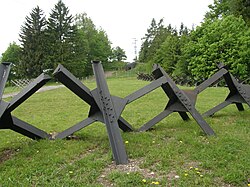
Anti-tank hedgehog - the simplest anti-tank obstacle , which is a voluminous six-pointed cross.
They have been actively used in the construction of fortifications since the thirties, for example, in the construction of the Czechoslovak wall on the border of Czechoslovakia and Germany. In 1941, Mikhail Lvovich Gorikker , Major General of the Technical Forces , then Head of Defense of Kiev and Head of Kiev Tank School, proposed a new principle of operation and an improved model of this non-explosive anti-tank defense weapon. Hedgehogs are less effective than minefields , but they can be produced in large quantities from improvised materials without the use of high technology and can be easily transferred from one site to another, which is especially valuable in wartime .
Content
Application and principle of operation
A hedgehog is made of three pieces of rolled steel , usually I-beams with a profile number of 25-40 (rail, corner, etc., etc., are less durable) so that the ends of the beams form an octahedron . They connect the beams with rivets on the scarves (the design must withstand the weight of the tank - up to 60 tons). Hedgehogs of industrial production leave holes for barbed wire , one of the beams is made removable. To complicate the work of enemy sappers , hedgehogs can be connected with chains or cables, mine the area around, etc.
Hedgehog is installed on solid ground ( asphalt street coating is best suited) [1] [2] . Concrete is not good - the hedgehog will slide on it. If the tankman tries to push the hedgehog, he rolls under the bottom, and the tank is raised. Caterpillars lose traction, the tank begins to slip and is often unable to move off the hedgehog [3] ; the protruding beam can even break through the bottom. The defending forces can only destroy the stopped tanks and prevent the tankers from pulling the hedgehogs with tow cables. And if the enemy led the tanks in a different way - the anti-tank defense all the more fulfilled its task.
Gorikker hedgehogs should have a size of up to 1 m in height - more than the ground clearance of the enemy tank, but below the upper edge of the lower frontal sheet. It is impractical to make larger hedgehogs - the hedgehog, which is higher than the frontal sheet, the tank can easily move [3] .
History
Slingshots - barriers against infantry and cavalry - have been known since ancient Rome. With the advent of barbed wire, slingshots began to braid with it, which led to positional warfare - for a successful attack, the attacking forces had to be several times superior to the defending ones. However, the tank was invented just in order to effectively overcome such barriers.
An attempt to use this barrier against tanks was first made in Czechoslovakia (hence the English name for the hedgehog - Czech hedgehog , "Czech hedgehog"). The Czech design repeated the principle of the ancient slingshots, since it was assumed that the fence should be massive and absolutely motionless. The obstacle was imperfect also because its production required considerable time and money, since the structure was made of reinforced concrete.
The new principle of the anti-tank “hedgehog” was discovered and proposed in the USSR by Major General Mikhail Gorikker [1] [2] . The idea was revolutionary in that the hedgehog did not fasten in place, like Czech structures, and did not dig into the ground like a bullet. When a tank hit a hedgehog, the latter began to roll over, gradually raising the tank above the ground. When trying to move back from the hedgehog, the tank was often unable to do so. Tests have confirmed the effectiveness of the "six-pointed asterisk" (as Gorikker called the device, which is why hedgehogs sometimes appear in the documents as "Gorikker stars"). Gorikker considered the I-beam steel profile to be the optimal material for the “star”, and rivet scarves were the best way to connect the parts. In practice, hedgehogs were made from any rental that was at hand — a channel , a corner, a rail — often connected by welding, even without scarves. In World War II, hedgehogs (often made not according to the rules - too large, not strong enough or related) were used in urban battles, becoming a symbol of anti-tank defense. However, German tanks with front-mounted transmissions were especially vulnerable to hedgehogs - hitting a hedgehog often put the transmission units out of order. On the Leningrad highway of Moscow there is a monument in the form of three hedgehogs [4] - this is the way (albeit symbolically) marked the line reached by German troops in 1941 .
To manufacture anti-tank hedgehogs for the defense of Moscow , steel beams were launched, originally intended for the construction of the Palace of Soviets . Hedgehogs were also used in the defense of Normandy .
For the creation of an anti-tank hedgehog, Major General Gorikker was awarded a camera brand FED .
See also
- Anti-tank gouges
- Garlic (window fence)
- Hedgehogs (anti-barricade)
Notes
Literature
- Dubrovsky A. Hedgehogs with steel needles // Science and Life : Journal. - 2010. - No. 7 . - S. 66–67 .
- Fedoseyev S. Hedgehog ordinary anti-tank // "Weapon": magazine. - 2015. - No. 5 . - S. 58-62 .
Links
- Anti-tank hedgehogs description with photos
- Tarut moat - against Russia or smugglers? (concrete hedgehogs-tetrapods)