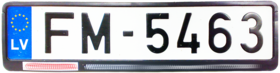
Latvian car license plates are license plates intended for registration of cars, trucks, buses, trailers, motorcycles and special equipment in the territory of Latvia.
Content
History
The first numbers on the territory of modern Latvia appeared in 1904 , when Latvia was part of the Russian Empire in the form of three provinces - Livonia , Courland and Vitebsk . Each province had its own license plates, which should be changed every year.
In 1909, in the Livonia province, numbers assigned to police stations were entered, numbers began to be drawn in red numbers on a white background.
In 1913, the type of numbers changed again: the background of the numbers turned red, four numbers and the letters RA were written on it.
After the First World War and the subsequent proclamation of the independence of Latvia, cars did not need registration because of their extremely small number.
The registration of cars by Latvian own standard numbers began in 1925. The number was carried out in the standard black and white scale and contained up to four digits, each county was allocated its own range of numbers.
In the 1930s, the numbers were modified - on the left, the city and the year of issue were written on the numbers.
In 1940 , after the accession of Latvia to the USSR , new license plates began to be issued on its territory. These signs were similar to the signs of the Soviet standard of 1936 , but differed in type, as well as in the presence of the Latin series LR , three figures instead of four, and the seal of the USSR Traffic Police.
In 1941-1944, the territory of Latvia was occupied by German troops and was part of the Reich Commissariat of Ostland . First, Latvia began issuing its own LS series numbers (1-5000 for passenger cars, 5001-9999 for buses) and LT (1-5000 for trucks, 5001-9999 for official vehicles), but since the autumn of 1942 the German system was introduced ( RO series and five numbers in the range of 30000-49999).
After the liberation of Latvia, the issue of numbers of the Soviet standard of all-republican series belonging to the Latvian SSR (republican LA and LT series) began on its territory.
In the first years of independence, the numbers repeated the last Soviet standard , but instead of Cyrillic letters, the Latin alphabet. The only exception was export numbers - they repeated car numbers, but instead of the first letter a wide pale yellow band was drawn.
In 1992, a modern standard was adopted, only a blue bar was missing on the left, and instead of the EU flag, the numbers depicted the Latvian flag .
Since 2004, a modern format of Latvian rooms.
License plates
The car registration license plate of Latvia consists of two letters and a hyphen between one and four (usually) digits. The difference in the number of digits is due to the fact that in Latvia it is impossible to start a number from scratch. If the number uses less than four digits, there are spaces in the place of missing zeros. That is, the number that in another country would have the format AA-0001, in Latvia looks like AA-1.
Color and size
Modern rooms, both front and rear, are made in black letters on a white background. From June 26, 2015, numbers are also performed by blue symbols on a white background; These numbers are intended for registration of electric vehicles that have the right to move along the public transport lanes.
Until 2004 , on the left of the number was a small national flag with the initials LV . After Latvia joined the European Union, a blue rectangle with the EU symbol and the initials LV is located on the left of the sign. The size of the front license plate - 520 × 111 mm. Rear sign sizes can vary:
- 520 × 111 mm (normal)
- 285 × 203 mm (square double row, for jeeps)
- 320 × 111 mm (reduced, American type). On the numbers of this type only 4 characters fit, and without a hyphen (such as AB12), although a hyphen is present on the front sign (of normal size) (AB-12).
Unlike most EU countries, Latvian numbers do not contain designations associated with the regions. That is, by the number it is impossible to determine where it was issued.
Individual (registered) numbers
In Latvia, authorized numbers. The cost of their receipt in 2006 increased from 542 lats and 80 centimes to 2500 lats [1] . Name numbers can contain from two to eight characters, including spaces. The same symbol can not be repeated more than three times in a row. A name mark cannot contain only numbers, that is, the minimum acceptable option is one letter plus one number.
The entire fleet of the Riga airport also actually has individual numbers - they all start with the word LIDOSTA , after which the serial number is put.
Other Issued Number Types
| Trailer numbers differ from car by the presence of only one letter in the series. They can be either single or double row. | |
| Motorcycle license plates have a reduced size, and the letter combination starts with T. For mopeds, license plates have even smaller dimensions, in the upper row one letter is contained, in the lower one there are two numbers and a letter. Since 2015, electric scooters, as well as electric cars, are issued with numbers made in blue symbols. | |
| Taxis have yellow numbers, and their letter combination is TX and TQ. Until 2004, instead of the blue strip with the flag of the European Union , a letter T was drawn on the taxi numbers, under which three "checkered" were painted. | |
| Non-special equipment and trailers for it have a two-row version, flag and car code "LV" on them are missing. In the upper row closer to the left corner is the letter T (for tractors) or P (for trailers); closer to the right corner - two letters of the series. In the bottom row are the numbers (from one to four). During the transition period (1991-1992), the corresponding Soviet number of the last standard was used for special equipment, only the plate was painted blue, the upper row was the letter L and three digits, and the lower row remained free. | |
| Transit numbers have the same format as car numbers, there is no hyphen between letters and numbers, and a red stripe is located to the right, approximately equal in width to the blue stripe to the left of the letters. On the double-row version of the number, the blue bar is drawn to the full width of the sign, and the red one - only to the middle. Until 2004, the red bar was located on the left, which made it possible to repeat the format of the car number accurate to a hyphen. | |
| Dealer numbers are actually a kind of transit numbers, but have their own format. The number is executed in red characters, followed by a blue euro strip followed by the letter B , then two or three digits, and a hyphen is another digit. Somewhere before 2010, the last figure had a smaller size and to the top corner, after 2010 the size of all the characters became equal. There are also dealer motonomera: they have a two-row version, in the upper row of the letter (most often - A ), in the lower - the numbers as in the car dealer number. Until 2004, the numbers had a different format: two to three digits, and the hyphen had the letter T. | |
| Non-cars of foreign diplomats have a red background. Their letter group may be of the form C , CC or CD , and the first two (three) of the four (five) numbers indicate the state that the diplomat represents (for example, Russia - 33). From 2015, also issued diplomatic numbers for electric cars, the color of the characters in these numbers - blue. | |
| The numbers of vehicles belonging to the armed forces are no different from ordinary car numbers, but the first two letters of the series are LA (Latvijas armija). | |
| The numbers of retro cars and retro motorcycles also look nothing different from ordinary numbers, but the first two letters of the series are VS. | |
| Car of the President - on the number plate instead of the number there is a large emblem of Latvia . |
Notes
- ↑ CSDD raises the prices of registered numbers , DELFI ( 2006-12-08 ). The appeal date is May 21, 2008.
See also
- Car code
- Road traffic