Rubskoe [1] [2] [3] or Rupskoe [2] is a lake in the Teykovsky district of the Ivanovo region , 2.5 km from the Vladimir - Ivanovo highway. The largest lake in the region [1] .
| Lake | |
| Rubskoye | |
|---|---|
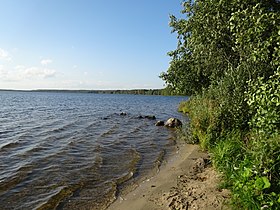 View of the lake in the fall of 2017 | |
| Morphometry | |
| Absolute height | 130.8 [1] m |
| Dimensions | 2.9 [1] × up to 1.5 [1] km |
| Square | 2.97 [1] km² |
| Volume | 0,0157 [1] km³ |
| Coastline | 7.2 [1] km |
| Deepest | 16 [1] m |
| Average depth | 5.33 [1] m |
| Hydrology | |
| Type of mineralization | fresh |
| Salinity | 50 mg / l [1] |
| Pool | |
| Flowing river | Scum |
| Flowing river | Scum |
| Location | |
| A country |
|
| The subject of the Russian Federation | Ivanovo region |
| Area | Teykovsky district |


Hydrography
The lake has an oval shape extended from the southeast to northwest, its area is 297 hectares. It is a relict lake of glacial origin. The Rubskoe lake is flowing, the Smerdyaga river flows through it [1] [3] .
Mixed food - ground (in the form of numerous keys at the bottom), rain and snow. The water level in the lake is unstable, its flow is not regulated. The pond is chained with ice from the end of November to April; the ice thickness reaches 70-80 cm. In summer, the water warms up to 20-22 ° C, in shallow water - up to 24-26 ° C.
The lake water is clear, clean, slightly colored in a bluish-green color, the oxygen content is high. Mineralization is small (50 mg / l), there is a low content of calcium, magnesium, nitrate nitrogen and dissolved phosphorus.
The bottom of the reservoir is covered with sand and loamy deposits with a large amount of boulder material. At a depth of 2.5 and more meters, the bottom is covered with dark brown silt, which at a depth of more than five meters passes into a gray-black finely dispersed [4] .
Flora and Fauna
The coastal flora has 520 species of vascular plants, of which 54 species are rare and vulnerable, 2 species are included in the Red Book of Russia . 61 algae species grow in the water, the most numerous of which are green and diatoms.
In the reservoir live: roach and perch - the most numerous, also pike, crucian carp, ruff; ide, crucian carp, burbot and rotan are rare. In the late 1990s. there was an attempt to introduce into the Rubskoye peled , which by now is no longer seen here [4] .
Reaction
On the shore of the reservoir there are many recreation centers, health camps. At the same time, the lake experiences a strong anthropogenic impact caused by the resting population, especially the east coast, where recreational loads are not controlled. The shores remain heavily littered; vegetation is degraded in places of mass recreation [4] .
The mineralization of the water of the Rubskoye Lake is almost three times higher than the total mineralization of Lake Baikal (it contains large amounts of calcium , magnesium , and hydrogen carbonate ). In this regard, the lake has great potential for use in balneological purposes .
Notes
- ↑ 1 2 3 4 5 6 7 8 9 10 11 12 Passport of the nature monument of the Ivanovo Region “Rubskoe Lake” . Government of the Ivanovo region (2014).
- ↑ 1 2 Rupskoe // Dictionary of names of hydrographic objects of Russia and other countries - members of the CIS / ed. G.I. Donidze. - M .: Kartgeotsentr - Geodezizdat, 1999 .-- S. 316. - ISBN 5-86066-017-0 .
- ↑ 1 2 Rubskoye ( No. 0006527 ) / Register of names of geographical objects on the territory of the Ivanovo Region as of 25.2.2019 // State Catalog of Geographical Names. rosreestr.ru.
- ↑ 1 2 3 Protected Areas of Russia. Lake Rubskoye . oopt.aari.ru. Date of treatment April 22, 2019.