Tellurium is a chemical element of the 16th group (according to an outdated classification - the main subgroup of the VI group, chalcogenes ), the 5th period in the periodic system , has atomic number 52; denoted by the symbol Te ( lat. Tellurium ), belongs to the metalloid family.
| Tellurium | ||||
|---|---|---|---|---|
| ← Antimony | Iodine → | ||||
| ||||
| The appearance of a simple substance | ||||
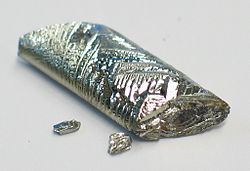
| Silver shiny non-metal | ||||
 | ||||
| Atom properties | ||||
| Name, symbol, number | Tellurium / Tellurium (Te), 52 | |||
| Atomic mass ( molar mass ) | 127.60 (3) [1] a. E. m. ( g / mol ) | |||
| Electronic configuration | [Kr] 4d 10 5s 2 5p 4 | |||
| Atom radius | 160 pm | |||
| Chemical properties | ||||
| Covalent radius | 136 pm | |||
| Ion radius | (+ 6e) 56 211 (−2e) pm | |||
| Electronegativity | 2.1 [2] (Pauling scale) | |||
| Electrode potential | 0 | |||
| Oxidation state | +6, +4 , +2, −2 [3] | |||
| Ionization energy (first electron) | 869.0 (9.01) kJ / mol ( eV ) | |||
| Thermodynamic properties of a simple substance | ||||
| Density (at N. at. ) | 6.24 g / cm³ | |||
| Melting temperature | 722.7 K | |||
| Boiling temperature | 1263 K | |||
| Beats heat of fusion | 17.91 kJ / mol | |||
| Beats heat of vaporization | 49.8 kJ / mol | |||
| Molar heat capacity | 25.8 [4] J / (K · mol) | |||
| Molar volume | 20.5 cm³ / mol | |||
| The crystal lattice of a simple substance | ||||
| Lattice structure | hexagonal | |||
| Lattice options | a = 4.457 c = 5.929 [5] | |||
| C / a ratio | 1,330 | |||
| Other characteristics | ||||
| Thermal conductivity | (300 K) 14.3 W / (mK) | |||
| CAS Number | ||||


| 52 | Tellurium |
Te 127.60 | |
| 4d 10 5s 2 5p 4 | |
Content
History
It was first found in 1782 in the gold ores of Transylvania by the mountain inspector Franz Josef Müller (later Baron von Reichenstein), in Austria-Hungary . In 1798, Martin Heinrich Klaproth isolated tellurium and determined its most important properties.
Name Origin
From the Latin tellus , genitive telluris , Earth (name suggested by Martin Klaprot ) [6] [7] .
Being in nature
The content in the earth's crust is 1–10 −6 % by mass [8] . About 100 tellurium minerals are known. The most common tellurides are copper , lead , zinc , silver and gold . An isomorphic admixture of tellurium is observed in many sulfides , however, Te - S isomorphism is less pronounced than in the Se - S series, and a limited admixture of tellurium is included in sulfides. Among tellurium minerals, of particular importance are altaite (PbTe), sylvanite (AgAuTe 4 ), calaverite (AuTe 2 ), hessite (Ag 2 Te), krennerite [(Au, Ag) Te], petcite (Ag 3 AuTe 2 ), mutmannite [ (Ag, Au) Te], monbreit (Au 2 Te 3 ), nagiagite ([Pb 5 Au (Te, Sb)] 4 S 5 ), tetradimite (Bi 2 Te 2 S). There are oxygen compounds of tellurium, for example, TeO 2 - tellurium ocher .
Native tellurium is found along with selenium and sulfur (Japanese tellurous sulfur contains 0.17% Te and 0.06% Se).
Field Types
Most of these minerals are developed in low-temperature gold-silver deposits, where they are usually released after the bulk of sulfides together with native gold, silver and lead sulfosalts, as well as with bismuth minerals. Despite the development of a large number of tellurium minerals, the bulk of tellurium extracted by industry is part of the sulfides of other metals. In particular, tellurium, to a somewhat lesser extent than selenium , is a part of chalcopyrite of copper-nickel deposits of magmatic origin, as well as chalcopyrite developed in copper pyrite hydrothermal deposits. Tellurium is also composed of pyrite , chalcopyrite, molybdenite and galena from deposits of porphyry copper ores, Altai-type polymetallic deposits, galena from lead-zinc deposits associated with skarn, cobalt sulfide, antimony-mercury and some others. The tellurium content in molybdenite ranges from 8–53 g / t, in chalcopyrite 9–31 g / t, in pyrite - up to 70 g / t.
Getting
The main source is sludge from electrolytic refining of copper and lead. Sludge is fired, tellurium remains in the cinder, which is washed with hydrochloric acid. Tellurium is isolated from the obtained hydrochloric acid solution by passing sulfur dioxide SO 2 through it.
Sulfuric acid is added to separate selenium and tellurium. In this case, tellurium dioxide TeO 2 precipitates, and H 2 SeO 3 remains in solution.
From TeO 2 oxide, tellurium is reduced with coal.
For the purification of tellurium from sulfur and selenium, its ability under the influence of a reducing agent (Al, Zn) in an alkaline medium to transform into soluble disodium ditelluride Na 2 Te 2 :
To precipitate tellurium, air or oxygen is passed through the solution:
To obtain high purity tellurium, it is chlorinated.
The resulting tetrachloride is purified by distillation or rectification. Then the tetrachloride is hydrolyzed with water:
- ,
and the resulting TeO 2 is reduced with hydrogen:
Prices
Tellurium is a rare element, and significant demand for a small volume of production determines its high price (about $ 200-300 per kg, depending on purity), but despite this, the range of its applications is constantly expanding.
Physical Properties
Tellurium is a fragile silver-white substance with a metallic sheen. In thin layers the lumen is red-brown, in pairs - golden yellow. When heated, it acquires plasticity. The crystal lattice is hexagonal . The coefficient of thermal expansion is 1.68 · 10 −5 K −1 . Diamagnet . A semiconductor with a band gap of 0.34 eV , the type of conductivity is p under normal conditions and at elevated temperature, n is at lower temperature (the transition boundary is from –80 ° C to −100 ° C depending on purity) [9] .
Isotopes
38 nuclides and 18 nuclear tellurium isomers with atomic numbers from 105 to 142 are known [10] . Tellurium is the lightest element whose known isotopes are subject to alpha decay (isotopes from 106 Te to 110 Te). The atomic mass of tellurium (127.60 g / mol) exceeds the atomic mass of the next element - iodine (126.90 g / mol).
Eight tellurium isotopes are found in nature. Six of them, 120 Te, 122 Te, 123 Te, 124 Te, 125 Te and 126 Te are stable [10] [11] . The other two - 128 Te and 130 Te - are radioactive, they both experience double beta decay, turning into xenon isotopes of 128 Xe and 130 Xe, respectively. Stable isotopes make up only 33.3% of the total amount of tellurium found in nature, which is possible due to the extremely long half-lives of natural radioactive isotopes. They range from 7.9⋅10 20 to 2.2⋅10 24 years. The 128 Te isotope has the longest confirmed half -life of all radionuclides — 2.2⋅10 24 years or 2.2 septillion [12] years, which is approximately 160 trillion times the estimated age of the Universe .
Chemical Properties
Tellurium exhibits oxidation states of –2 in chemical compounds; +2; +4; +6. It is an analogue of sulfur and selenium , but is chemically less active than sulfur. It is soluble in alkalis, amenable to the action of nitric and sulfuric acids, but it is slightly soluble in dilute hydrochloric acid. Metallic tellurium begins to react at 100 ° C [9] .
With oxygen forms compounds TeO, TeO 2 , TeO 3 . In the form of a powder, it is oxidized in air even at room temperature, forming TeO 2 oxide. When heated in air, it burns out, forming TeO 2 - a strong compound with less volatility than tellurium itself. This property is used to purify tellurium from oxides that are reduced by flowing hydrogen at a temperature of 500-600 ° C. Tellurium dioxide is poorly soluble in water, and well in acidic and alkaline solutions [9] .
In the molten state, tellurium is rather inert, therefore, graphite and quartz are used as container materials for its melting.
Tellurium forms a compound with hydrogen when heated, easily reacts with halogens, interacts with sulfur, phosphorus and metals. When reacted with concentrated sulfuric acid, it forms sulfite . It forms weak acids: telluric (H 2 Te), telluric (H 2 TeO 3 ) and telluric (H 6 TeO 6 ), most of whose salts are poorly soluble in water [9] .
Application
Alloys
Tellurium is used in the production of lead alloys with increased ductility and strength (used, for example, in the manufacture of cables). With the introduction of 0.05% tellurium, lead dissolution losses under the influence of sulfuric acid are reduced by a factor of 10, and this is used in the production of lead-acid batteries . It is also important that tellurium-doped lead is not softened during plastic deformation, and this allows the technology of manufacturing down conductors of battery plates by cold die cutting and significantly increase the service life and specific characteristics of the battery.
As part of the CZT alloy (cadmium zinc telluride, CdZnTe) it is used in the production of X-ray and gamma-ray detectors that operate at room temperature.
Thermoelectric materials
Its role in the production of semiconductor materials and, in particular, tellurides of lead , bismuth , antimony , and cesium is also great. Very important in the coming years will become the production of lanthanide tellurides, their alloys and alloys with metal selenides for the production of thermoelectric generators with a very high (up to 72-78%) efficiency , which will allow them to be used in the energy and automotive industries.
So, for example, a very high thermo-EMF was recently discovered in manganese telluride (500 μV / K) and in combination with selenides of bismuth, antimony and lanthanides , which allows not only to achieve a very high efficiency in thermal generators, but also to be carried out in one step semiconductor refrigerator cooling down to the region of cryogenic (temperature level of liquid nitrogen) temperatures and even lower. The best tellurium-based material for the manufacture of semiconductor refrigerators in recent years has been an alloy of tellurium, bismuth and cesium , which allowed for record cooling to −237 ° C. At the same time, as a thermoelectric material, the tellurium- selenium alloy (70% selenium), which has a thermoelectric coefficient of about 1200 μV / K, is promising.
Narrow- gap semiconductors
The SRT alloys ( cadmium - mercury- tellurium), which have fantastic characteristics for detecting radiation from rocket launches and observing the enemy from space through atmospheric windows (cloudiness does not matter), also received absolutely exceptional significance. CMT is one of the most expensive materials in the modern electronic industry.
High Temperature Superconductivity
A number of systems with tellurium recently discovered the existence of three (possibly four) phases in them, in which superconductivity does not disappear at a temperature slightly above the boiling point of liquid nitrogen .
Rubber Production
A separate field of application of tellurium is its use in the process of vulcanization of rubber .
Chalcogenide Glass Manufacturing
Tellurium is used when cooking special grades of glass (where it is used in the form of dioxide ), special glasses alloyed with rare-earth metals are used as active bodies of optical quantum generators .
In addition, some tellurium-based glasses are semiconductors; this property is used in electronics.
Special grades of tellurium glass (the advantage of such glasses is transparency, fusibility and electrical conductivity) are used in the design of special chemical equipment ( reactors ).
Light Sources
Tellurium finds limited use for the production of lamps with its vapors - they have a spectrum very close to the sun.
CD-RW
Tellurium alloy is used in rewritable compact discs (in particular, Verbatim brand Mitsubishi Chemical Corporation ) to create a deformable reflective layer.
Biological role
The trace amounts of tellurium are always found in living organisms; its biological role has not been elucidated .
Physiological Action
Tellurium and its volatile compounds are toxic. Ingestion causes nausea , bronchitis , pneumonia . The maximum concentration limit in air varies for different compounds 0.007-0.01 mg / m³, in water 0.001-0.01 mg / l. The carcinogenicity of tellurium has not been confirmed [13] .
In general, tellurium compounds are less toxic than selenium compounds. .
In case of poisoning, tellurium is eliminated from the body in the form of foul-smelling volatile organelle tellurides - alkyl tellurides , mainly dimethyl telluride (CH 3 ) 2 Te. Their smell resembles the smell of garlic , so when even small amounts of tellurium enter the body, the air exhaled by a person acquires this smell, which is an important symptom of tellurium poisoning [14] [15] [16] .
Notes
- ↑ Michael E. Wieser, Norman Holden, Tyler B. Coplen, John K. Böhlke, Michael Berglund, Willi A. Brand, Paul De Bièvre, Manfred Gröning, Robert D. Loss, Juris Meija, Takafumi Hirata, Thomas Prohaska, Ronny Schoenberg , Glenda O'Connor, Thomas Walczyk, Shige Yoneda, Xiang ‑ Kun Zhu. Atomic weights of the elements 2011 (IUPAC Technical Report ) // Pure and Applied Chemistry . - 2013 .-- Vol. 85 , no. 5 . - P. 1047-1078 . - DOI : 10.1351 / PAC-REP-13-03-02 .
- ↑ Tellurium: electronegativities . WebElements. Date of treatment August 5, 2010.
- ↑ Leddicotte, GW (1961), The radiochemistry of tellurium , Nuclear science series, Subcommittee on Radiochemistry, National Academy of Sciences-National Research Council, p. 5 , < http://library.lanl.gov/cgi-bin/getfile?rc000049.pdf >
- ↑ Editorial board.: Zefirov N.S. (Ch. Ed.). Chemical encyclopedia: in 5 volumes. - Moscow: Soviet Encyclopedia, 1995. - V. 4. - P. 514. - 639 p. - 20,000 copies. - ISBN 5-85270-039-8.
- ↑ WebElements Periodic Table of the Elements | Tellurium | crystal structures
- ↑ Ilya Leenson. The language of chemistry. Etymology of chemical names . - Litres, 2017-09-05. - 433 p. - ISBN 9785040301225 .
- ↑ Nikolai Alexandrovich Figurovsky. Discovery of chemical elements and the origin of their names . - Science, 1970 .-- 218 p.
- ↑ Glinka N. L. General chemistry. - M .: "Chemistry", 1977, revised. - S. 395. - 720 p.
- ↑ 1 2 3 4 Tellurium - article from the Great Soviet Encyclopedia .
- ↑ 1 2 Audi G. , Bersillon O. , Blachot J. , Wapstra AH The NUBASE evaluation of nuclear and decay properties // Nuclear Physics A. - 2003 .-- T. 729 . - S. 3—128 . - DOI : 10.1016 / j.nuclphysa.2003.11.001 . - .
- ↑ The tellurium-123 isotope was considered radioactive (β - active with a half-life of 6⋅10 14 years), however, after additional measurements, it was found to be stable within the experimental sensitivity.
- ↑ 2.2 quadrillion years - on a long scale .
- ↑ Tellurium . International Program on Chemical Safety (January 28, 1998). Date of treatment January 12, 2007. Archived on August 4, 2012.
- ↑ Wright, PL; B. Comparative metabolism of selenium and tellurium in sheep and swine ( AJP - Legacy: journal. - 1966. - Vol. 211 , no. 1 . - P. 6-10 . - PMID 5911055 .
- ↑ Müller, R .; Zschiesche, W .; Steffen, HM; Schaller, KH Tellurium-intoxication (English) // Klinische Wochenschrift : journal. - 1989. - Vol. 67 , no. 22 . - P. 1152-1155 . - DOI : 10.1007 / BF01726117 . - PMID 2586020 .
- ↑ Taylor, Andrew. Biochemistry of tellurium (Eng.) // Biological Trace Element Research . - Springer , 1996. - Vol. 55 , no. 3 . - P. 231-239 . - DOI : 10.1007 / BF02785282 . - PMID 9096851 .