
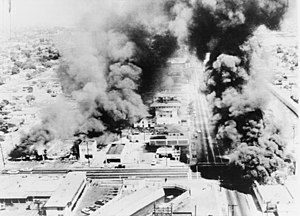
Rebellion (by means of Polish bunt - the same (from the 17th century ) from German. Bund - union, union, bond) - mass disagreement and unacceptability by the people of the existing regime of government , expressed in physical and, as a rule, bloody form [1] .
The person participating in it is called a rebel .
History
Rebellion is an active, effective resistance to the existing power with the aim of overthrowing, canceling its influence, expression of will and authority, laws and orders established by it with the aim of subsequently establishing its own power, expressing and embodying its own interests, aspirations and will.
Dahl's Explanatory Dictionary gives "rebellion" in the sense of "conspiracy, indignation, rebellion , open resistance of the people of legitimate authority." [2] Ozhegov’s Explanatory Dictionary defines rebellion as “a spontaneous rebellion, rebellion”. [3] This definition passed into specialized conflict resolution dictionaries: "rebellion - spontaneous revolt, rebellion". [four]
In political science, rebellion is defined as “an illegal form of political protest, spontaneous rebellion, rebellion; as a rule, a response to any actions of state authorities. ” [5] Special studies define rebellion as “a social protest that assumes a mass character and radical forms” (rebellion, rebellion, revolution, civil war, mass anti-government protests). [6] The term has other meanings.
Non-violent rebellion is a civil rebellion, which includes a general denial of the legitimacy of this regime , mass strikes , large-scale demonstrations , cessation of economic activity, and widespread rejection of political cooperation. Refusal of political cooperation may include actions by public servants and disobedience to the army and police . In the final stages, a parallel government is usually created. If successful, through civil revolt, it is possible to overthrow the existing regime in a few days or weeks, in contrast to a long struggle that can drag on for months and years. As a result of civil revolt, deposed leaders are usually forced to leave the country. An example is the expulsion from the country of Ferdinand Marcos ( 1986 ), the Iranian Shah Mohammed Reza Pahlavi ( 1979 ). Civil riot is also called "non-violent riot."
As a rule, the word “rebellion” is characterized by short-term so-called unrest , up to an uprising , of a spontaneous, local and poorly organized character. The reasons for the riot and the demands of the rebels are also often limited. Riot does not lead to a significant change in the existing order. The intensity of rebellion can range from simple disobedience to mass violent acts. The rebellion of legitimate armed groups or law enforcement agencies (army, police, special services, etc.) is usually called " rebellion ".
Riot in Tsarist Russia
In tsarist Russia, the concept of "rebellion" was expanded by law on June 4, 1874, and this term was understood to mean:
“... an uprising in bulk and conspiracy against the sovereign and the state , the intention to overthrow the government in the whole state or in some part of it, change the form of government or the legacy order of the throne established by laws , draw up a conspiracy to this end or take part in a conspiracy or action already drawn up for that thereof, with knowledge of the purpose of these actions, or in the collection, storage and distribution of weapons and other preparations for rebellion ” [1] ,
also any attempt to overthrow the existing order of government in a more or less distant future.
Riots
- Salt riot
- Plague riot
- Copper riot
See also
- Insurrection
- Mass riots
- Revolution
Notes
- ↑ 1 2 Riot, rebellion // Brockhaus and Efron Encyclopedic Dictionary : in 86 volumes (82 volumes and 4 additional). - SPb. , 1890-1907.
- ↑ Dal V.I. Explanatory dictionary of living Great Russian language. - SPb. – M: Partnership M.O. Wolf, 1880. - T. 1. - S. 143.
- ↑ Ozhegov S.I. Dictionary of the Russian language. - Moscow: Russian language, 1986. - S. 56.
- ↑ Antsupov A.Ya., Shipilov A.I. Dictionary conflict. - 2nd ed. - SPb. : Peter, 2006 .-- S. 41.
- ↑ Pogorely D.E., Fesenko V.Yu., Filippov K.V. Political science dictionary. - Rostov-on-Don: Science-Spectrum, 2008 .-- S. 41.
- ↑ Schulz E.E. Riot technology. (Technologies for managing radical forms of social protest in a political context). - M .: Podolsk factory of offset printing, 2014 .-- S. 6, 329. - 512 p. - ISBN 978-5-7151-0406-9 .
Links
- Unrest in the USSR. 1953-1985 (Part 1)
- Zenkovich, N. A. "Were there People's Riots in the USSR?"
- Bryman, Shiman. "Soviet riot"
- Ogloblin, N. "" Riot and escape to the Amur "thief regiment" M. Sorokin. " (Essay on the life of the 17th century) "
- Aleksandrov, V. A. “Materials on popular movements in Siberia at the end of the 17th century”
- Ryabov, Peter. Rebel man: the philosophy of rebellion by Mikhail Bakunin and Albert Camus