Queen Ming ( 1851 - 1895 ) is the main wife of Kojong ( cor. 비 , bi , usually translated as “queen”), the 26th van of the Li dynasty, who ruled in Korea in 1892-1910, until the annexation of the country by Japan . Being, by all accounts, “the most politically influential representative of this dynasty for all the time of her reign”, Queen Ming ruled Korea from the mid-1870s and until her death in 1895 “because of the screen” with weak-willed and inclined to adventurism regal spouse.
| Queen Ming | |||||||
|---|---|---|---|---|---|---|---|
| 민비 (명성 황후) 閔 妃 (明成皇后) | |||||||
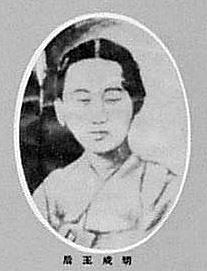 Queen Ming's alleged portrait | |||||||
| |||||||
| Birth | October 19, 1851 Joseon , Gyeonggi-do Province, Yoju County, Nunhölli Village | ||||||
| Death | October 8, 1895 (43 years old) Joseon , Hanson , Gyeongbokgung | ||||||
| Burial place | |||||||
| Kind | Lee | ||||||
| Father | Min jirok | ||||||
| Mother | unknown | ||||||
| Spouse | Kojon | ||||||
| Children | Sungjon | ||||||

The Queen’s years of life fell on the period of Korea’s “discovery” to the outside world - one of the most dramatic in its history. Since the beginning of the XVII century, Korea has traditionally followed a policy of isolation, for which it received the name "hermit country" in European historiography. Since the 1860s, she first came into contact with Western civilization and a new world order for herself. Prior to that, her foreign policy contacts were limited to China , which for many centuries was a formal “overlord” (“big brother”) of the Korean state, and with Japan, relations with which boiled down to trade through Tsushima Island and a rare exchange of embassies. In 1876, under pressure from outside, Korea concluded the first international treaty in its history - the Kanghwa treaty with Japan. He was unequal. Soon, similar treaties were concluded with the United States , Britain , Germany ( 1882 ), Russia , Italy ( 1884 ) and other Western powers. China , Japan, and Korea’s new political partners vied with each other for influence on the Korean peninsula. For a small, economically weak and completely divorced from the realities of the new time of the kingdom, there was a threat of loss of independence. The Queen realized this danger and began to actively seek a way to adapt to new conditions. Soon she found such a method and began to "fight the barbarians with the forces of other barbarians." To this end, international treaties were concluded, foreigners were invited to the Korean service. Judging by memoirs, all the "Western" messengers considered themselves personal friends of the Van couple. The Queen skillfully maneuvered between the rival sides, maintaining a balance of intrigue and smoothing out the failures of Van Kodjon.
Biography
Youth
The future queen was born on September 25, 1851 in the village of Nõnhölli, Yoju County, Gyeonggi Province, in a noble but impoverished family. Her name is unknown. Dynastic chronicles recorded only the names of the clans from where the queens came from. At the age of 8, she was completely orphaned, and relatives, hoping for a successful marriage, sent the girl to Seoul. In 1866, these hopes were realized: she became the wife of Van Kodjon . The main role in the organization of this marriage was played by the father of Kojong, Lee Haeing, better known for his honorary title, Tevong Gong (Grand Prince). In 1864-1873, he was regent with his young son and became famous for his harsh rule. The main reason why Taevongong’s choice fell on her was that she didn’t have close male relatives who could claim power. The young queen began her life at court with a study of the intricacies of palace etiquette. She was respectful of her husband's parents, kind to servants and quickly earned universal approval. She devoted her free time to an unusual occupation for women - reading the ancient Chinese treatises on government, because she believed that over time, her advice would be useful to her husband. Watching him closely, she realized that Kojon , formally being a van, did not have real power. He was afraid of his father, and he was clearly not going to give up power to his son.
Elevation
For more than five years, Kojon has not shown any interest in her as a woman. She was not beautiful, and around the van in the palace there were always many beautiful women. In an effort to defeat her rivals, the queen was looking for ways other than outward appeal to her husband’s heart. Remembering the unfortunate fate of many queens who suffered from jealousy, Queen Ming carefully concealed her feelings. So it was when the favorite of noble birth gave birth to the van of his first son, who received the honorary title of Vanhvagun . Surprisingly, it was this event that became a turning point in her fate. She immediately sent a very expensive present to Vanhwagun ’s mother, showing that the joy of Van is joy for his wife. Soon, during an official ceremony, she congratulated Kojon on the birth of her son with a happy expression on her face. It was from this time that the stage of rapprochement began in the relationship between the young Vanish couple. At the same time, the Queen's enmity with Tevongong arose, which lasted until her death and influenced many events in the history of Korea. The regent was very happy about the birth of his grandson and often went to the palace. The Queen saw this as a direct insult and danger: the father-in-law was influential enough to make the boy the rightful heir to the throne. Ten years later, he died under mysterious circumstances.
On November 9, 1871, the queen gave birth to a son, but he died the next day. In 1873, she had a daughter, but she did not survive. The shamans declared the “culprits” of two of Kojon's favorites, and they were executed after terrible torture. There was always a system of concubines at court. No one was surprised if a court lady or servant used the “favors” of the van and gave birth to a child. But Queen Ming was not going to put up with this anymore. She brutally cracked down on rivals. In 1878 - 1895, the Van did not have a single child from palace women, and this was the rarest case in the history of the monarchy. On February 8, 1874, she gave birth to a second son, Prince Chok , who, although he was very unwell, lived to adulthood and became the last emperor of the Korean Empire , the state that replaced Joseon in 1897 , known under the posthumous name of Sungjon (reigned in 1907 - 1910 ) . With the birth of the heir, the authority of his mother became indisputable. She began to influence not only the court, but also on state administration and foreign policy.
Her first political success was the victory over the powerful Taewongun , who had to give way to Kojong in 1874 . To achieve this, she created her own party: rallied the Ming clan, appointing three dozen of its representatives to important posts; with gifts and promises, she attracted her older brother and eldest son Tevongong to her side, enlisted the support of influential Confucian scholars. Relying on these people, Kojon issued a decree declaring that he was taking power into his own hands. A few days later, an explosion occurred in the chambers of the queen in the palace. She was sure that the initiator of the incident was her father-in-law, but did not begin to do anything: in Confucian society, her husband’s father is not subject to jurisdiction. Similar attempts on the life of the Queen, her relatives and close associates occurred in the future regularly, but she always managed to avoid death. It is no accident that Earl Inoue Kaoru , Minister of Foreign Affairs of Japan in the 1890s, spoke of her:
| There are few people in Korea who are equal to Her Majesty in insight and foresight. In the art of pacifying enemies and gaining the allegiance of her subjects, she has no equal. |
In 1884, supporters of the Japanese, led by Kim Oak Kun , raised the riots and owned the capital for 7 days. However, the population of Seoul revolted without exception, drove them and the Japanese; Küm Ok Kün has since lived in Japan, and in 1894, upon arrival in Shanghai , he was killed by one of his compatriots. In the same 1884, Japan sent troops to Korea, but, according to an agreement with China, recalled them from there the following year, and both states pledged not to send troops to Korea without first notifying the other side. Japan gained significant economic influence in Korea, especially in the south of the peninsula, thanks to the mass of its representatives and their trading enterprise; but in the political sphere, a Chinese resident in Seoul constantly enjoyed huge influence.
The Sino-Japanese confrontation in Korea led to a bloody Sino-Japanese war (1894–1895) . It ended with the victory of Japan, resulting in the threat of turning Korea into a Japanese colony. At the very beginning of the war, the Japanese made a government coup in Seoul: they created a cabinet of ministers from their proteges, surrounded the van with their “advisers” and began to carry out reforms on his behalf. But the situation changed when in April 1895 Russia , France and Germany , among which Russia was the initiator, intervened in the negotiations on peace conditions between China and Japan and forced the latter to abandon its main trophy - the Liaodong Peninsula . This event made a great impression on Korea, where they saw that in the world there is a force capable of withstanding the seemingly so powerful Japan - Russia. As a result, the "pro-Japanese" group at the Korean court was replaced by the "pro-Russian", which put forward a new political course: "closer to Russia, further from Japan." The main initiator and guide of this course was Queen Ming. That the Japanese did not forgive her.
Murder
At dawn on October 8, 1895, a group of armed Japanese — the so-called “hired swords,” disguised as gendarmes from the embassy guards, diplomats, and journalists — escorted Taewong Gong and a detachment of Korean soldiers trained by Japanese military instructors broke into Gyeongbokgung Palace, dispersed the guards, and killed Queen Ming in her own bedroom, in front of the horrified paralyzed court ladies and servants. The plot was organized by the Japanese envoy to Korea, retired General Miura Goro . The murder was carried out in deep secrecy, and the world would never have known anything about its circumstances if it had not been for the testimonies of two foreigners, including the Russian citizen A. I. Seredin-Sabatin , who served in the palace as a “noble witness”. On that fateful morning, he accidentally ended up in the courtyard of the Queen’s sleeping pavilion and saw a lot. A few hours later he described in detail the events to the Russian attorney in Korea K.I. Weber . But what the last minutes of the queen were, no one knows.
According to one version, when the Japanese broke into her bedroom, they saw several almost equally dressed women. What exactly the queen looks like, they did not know, and therefore, for the sake of fidelity, they killed four court ladies of about the same age as her. “Which of you is the queen?” Show us the queen! ”The assassins threatened, shaking their weapons. The tension was so great that the queen's nerves could not stand it. She ran out into the corridor. One of the Japanese caught up with her, pushed her to the floor and thrust a sword into her chest several times. Then the body was wrapped in a carpet and burned in a pine grove at the back of the palace. According to another version, when the killers entered the bedroom, the court minister, Lee Gyongsik, unwittingly issued the queen. He covered it with his body, arms spread wide and begging for mercy, and the conspirators chopped off his hands, and then killed the queen. The devoted minister crawled several tens of meters to the king’s bedroom and died on its steps, leaving behind a wide bloody trail.
Consequences of the kill
At an emergency meeting of foreign representatives in Seoul, Miura Goro attempted to shift the responsibility for the deed to the Koreans. He claimed that the incident arose as a result of enmity between Koreans trained by the Japanese, on the one hand, and palace guards and police, on the other, and that not a single Japanese was involved in the attack on the palace. In response to this, K.I. Weber announced the testimony of Mid. The Japanese government was forced to immediately recall Miura and his henchmen to their homeland. There they were enthusiastically met by the crowd.
The case of the murder of the Queen from the first day was shrouded in mystery. There were powerful forces interested in burying the truth about this crime in a heap of rumors, and to expose the deceased not as a victim, but as a criminal deserving of worthy retribution. The trial courts did not shed light on him. One took place in December 1895 in Seoul and condemned three Koreans who had nothing to do with the murder. The second took place in Hiroshima in January 1896 and found the conspirators innocent. At the trial, none of the participants in the murder of Queen Ming repented of their deeds. The Hiroshima court emphasized that everything that happened was a personal initiative of Miura Goro and that the Japanese government did not know anything about his plans. This version remains official until now.
After the death of his wife, van Kodjon lost all influence on state affairs. The Japanese and their henchmen ruled on his behalf, and he ended up under house arrest and spent days in constant fear for his life. At his insistence, food was carried to him from the Russian diplomatic mission and the home of the American missionaries of the Underwoods in a lockable casket. This continued until February 11, 1896 , when the van and the heir fled to the Russian diplomatic mission . The people met the news of the release of their master with glee. Kodjon and the heir stayed in the Russian diplomatic mission until February 20, 1897. This time was the period of the greatest Russian-Korean rapprochement. Then the situation was relatively stabilized and the van returned to the palace.
The American missionary Lilias Underwood, who was the Queen’s personal physician in 1888–1895 , mentioned in her memoirs that the Queen did not allow anyone to photograph herself. And yet, a photograph, which, according to many, depicts Queen Ming, exists. It was published in 1906 with the caption: "The court lady in full dress" in the book of the American missionary, journalist and historian G. Halbert who lived in Korea in 1886-1907, Leaving Korea. It is not clear when and by whom the photograph was taken, who was the first author to call this lady “Queen Min” and on what basis. Zealots of Confucian values, according to which no stranger could see the face of the queen, categorically refuse to recognize the woman depicted in her queen. Their opponents have a different argument: a conscious guardian and an involuntary violator of traditions, Queen Ming was too ambiguous a figure to judge her from the canon - as it should have been. It remains a mystery and today inspires historians, writers, screenwriters and artists, not only in their own country, but also abroad.
Personality Ratings
In world historiography, opposing opinions about the queen coexisted for many years. Some authors called her “a cunning politician who led Russia, China and Japan by the nose”, “a woman who enriched Korean history with her bold struggle for the country's prosperity”, “the founder of the modern type of diplomacy in Korea”. Others, for example, the Korean historian of the colonial period, Chan Tobin, considered her "the embodiment of all the evils of the decaying dynasty." The Korean-American writer Henry Chan ( 1891 - 1985 ) compared her to Elizabeth I and called her "a woman of iron will of patriotism and wise decisions, who could solve the issue in ten minutes, which cabinet members discussed for ten months."
In Korea, she was blamed for a long time because she "planned to expel the Japanese from the Korean Peninsula, having entered into an alliance with Russia." Only in the 1990s, when the Cold War ended, did Queen Ming be recognized in her homeland as a national heroine who gave her life for the independence of her country.
In the movie
- Empress Myeongseong ( Empress Myeongseong ) - series, directors Shin Chan Suk and Yoon Chan Bom ( Republic of Korea , 2001)
- The Nameless Blade ( The Sword with No Name ) - film, director Yong Kyung Kim (Republic of Korea, 2009)
Notes
- ↑ Simbirtseva T. M. Murder in the Gyeongbokgung Palace p. 132
Literature
- Симбирцева Т. М. Убийство во дворце Кёнбоккун // Восточная коллекция : ежеквартальный журнал. — 2004. — № 3(18) . — С. 127—142 . (Проверено 8 октября 2018)
- К. Асмолов . История Кореи. Глава восьмая, в которой королеву Мин наконец убивают, а аудитория пытается разобраться в подоплеке истории (Проверено 8 октября 2018)
Links
- Императрица Мёнсон или королева Мин — жизнь как драма (недоступная ссылка) Архивировано 21 апреля 2013. Проверено 8 октября 2018.