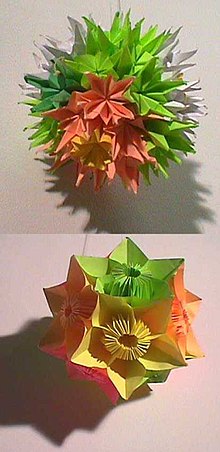
Kusudama ( 薬 玉 , lit. “medicine ball”) is a paper model that is usually (but not always) formed by stitching together the ends of many identical pyramidal modules (usually these are stylized flowers folded from a square sheet of paper), so that a body is spherical forms. Alternatively, the individual components can be glued together (for example, the kusudama in the bottom photo is completely glued, not stitched). Sometimes, as a decoration, a brush is attached from below. In ancient Japan, kusudamas were used for medicinal gatherings and incense.
Content
- 1 History
- 2 Creators of Kusudam
- 3 See also
- 4 Literature
- 5 notes
- 6 References
History
The art of kusudama comes from the ancient Japanese tradition, when kusudam was used for incense and a mixture of dry petals; perhaps these were the first real bouquets of flowers or herbs. The word itself represents a combination of the two Japanese words kusuri (medicine) and tama (ball). Nowadays, kusudamas are usually used for decoration or as gifts.
Kusudama is an important part of origami , in particular, the direction of modular origami . Currently, the border between these concepts is being erased.
Creators of the Bites
Along with classic kusudamas, dozens of new original models appear annually in modern origami - balls, polyhedrons, bouquets and others. In the world of modular origami, the most famous masters are Tomoko Fuse, Miyuki Kawamura, Mio Tsugawa, Makoto Yamaguchi and Yoshihide Momotani from Japan, Meenakshi Mukherji and Jim Planck from the USA and many others from around the world. [one]
A significant part of modern modular origami designs, including kusudam, is based on the sonobe module, invented at the end of the 20th century by Japanese origami player Mitsunobu Sonobe. Modern origami masters such as Tomoko Fuse have created new kusuda designs that are completely assembled without cutting, glue or thread (except for the suspension).
See also
- Modular origami
Literature
- Fuse, Tomoko . Unit Origami: Multidimensional Transformation. - Japan Publications, 1990. - ISBN 978-0870408526 .
- Fuse, Tomoko . Floral Origami Globes. - Japan Publications, 2007. - ISBN 978-4889962130 .
- Fuse, Tomoko . Kusudama Origami. - Japan Publications, 2002. - ISBN 978-4889960877 .
- Yamaguchi, Makoto. Kusudama: Ball Origami. - Japan Publications, 1990. - ISBN 978-0870408632 .
- Romanenko N.V. Kusudamy. Magic paper balls. M .: Iris, 2015.192 s. ISBN 978-5-8112-5248-0 . Read more about the book on the Origami Echo portal.
Notes
- ↑ Meher McArthur, Robert J. Lang Folding Paper, The Infinite Possibilities of Origami. - International Arts and Artists, 2011. - S. 96. - ISBN 978-0-9662859-6-3
Links
- Origami in a directory of links Open Directory Project (dmoz) (rus.) - a directory of sites dedicated to origami and kusudam
- Origami / Geometry and Modulars in the Open Directory Project (dmoz) link catalog (English) - a directory of modular origami sites
- http://ru-kusudama.livejournal.com/ - one of the largest Russian-speaking LJ communities, dedicated directly to the Kusudam.