Lalande 21185 ( born Lalande 21185 ) is a star located in the constellation Ursa Major . It is one of the stars closest to the Sun (a distance of about 8.31 light years ).
| Laland 21185 | |||
|---|---|---|---|
| Star | |||
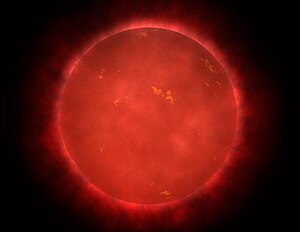 Laland 21185 as presented by the artist. | |||
| Research history | |||
| Discoverer | Joseph Laland | ||
| opening date | 1801 | ||
| Observational data ( Age J2000.0 ) | |||
| Type of | Single star | ||
| Right ascension | |||
| Declination | |||
| Distance | 8.31 St. of the year | ||
| Visible magnitude ( V ) | 7.47 | ||
| Constellation | Big Dipper | ||
| Astrometry | |||
| Radial velocity ( R v ) | −84.8 km / s | ||
| Own movement (μ) | RA: −580.20 mas per year Dec: −4767.09 mas per year | ||
| Parallax (π) | 393.42 ± 0.70 mas | ||
| Absolute magnitude (V) | 10.46 | ||
| Specifications | |||
| Spectral class | M2v | ||
| Color Index ( B - V ) | 1.51 | ||
| Color Index ( U - B ) | 1.13 | ||
| Variability | UV Cet | ||
| physical characteristics | |||
| Weight | 0.46 M ☉ | ||
| Radius | 0,393 R ☉ | ||
| Age | ≈ 5-10⋅10 9 years | ||
| Temperature | 3 400 K | ||
| Luminosity | 0,0016 L ☉ | ||
| Metallicity | 63% | ||
| |||
| Database Information | |||
| SIMBAD | |||
The star was first recorded in observations by Joseph Lalande , a French astronomer, in 1801 , then it was given the name.
Laland 21185 is a red dwarf of spectral class M2. Is a flashing star . The mass is 0.46 of the mass of the Sun, the radius is 0.393 ± 0.008 of the radius of the Sun [2] .
Content
The existence of a planetary system
In 1951, Peter van de Camp and Sarah Lippincott announced astrometric detection of the planetary system at Lalande 21185. The studies were carried out by positional measurements on photographic plates obtained with a 24-inch refractor at the Sproule Observatory , owned by Sworthmore College (Pennsylvania, USA). In 1960, Sarah Lippincott reiterated the 1951 statement. However, in 1974, astronomer George Gatewood of the Allegheny Observatory, after conducting additional research using astrometric methods, declared the results of the claims of van de Kamp and Lippincott erroneous.
In 1996, however, the same George Gatewood announced that a star may have a planetary system with several planets [3] . This information was based on the analysis of photographing data for the period 1930 - 1984 and data on the motion of a star from 1988 to 1996 .
The data obtained suggest the presence of three planets [4] :
- Laland 21185 b: orbit radius ( semimajor axis ) - 2.2 a. e. , eccentricity - 0.0, mass - 0.9 masses of Jupiter , circulation period - 5.8 years.
- Lalande 21185 c: radius - 11 a. e., eccentricity is about 0, mass is 1.6 masses of Jupiter, the circulation period is 30 years.
- Laland 21185 d: radius - greater than 11 a. e., eccentricity is about 0, mass is about one mass of Jupiter, the circulation period is more than 30 years.
According to the results of modern (2010) studies obtained by the radial velocity method, Laland 21185 does not have a planetary system - in any case, in the form in which it was presented according to the statements of Peter van de Kamp, Sarah Lippincott and George Gatewood. The measured radial velocity of Laland 21185 is constant, which, according to the research results, excludes the presence of planets with a mass above the mass of Jupiter .
Studies of the radial velocity with the SOPHIE échelle spectrograph at the Haute-Provence Observatory and a review of the source signal showed that the planet Lalande 21185 b (Gl 411 b) with a minimum mass of 2.99 Earth masses has a major semi-axis upholstered 0.0785 a.u. and the orbital period of 12.95 days, the eccentricity of the orbit is 0.22. It is too close to the mother star and cannot be in the habitable zone, since the planet receives 3.5 times more energy than the Earth from the Sun. With an albedo of 0.3, the equilibrium temperature is estimated at ~ 350 K. If the existence of the planet is confirmed, then Laland 21185 b will become the third known exoplanet remotely from Earth [5] . A group of astronomers from the Keck Observatory determined that the super-earth of the red dwarf Laland 21185 (GJ 411) has a mass of 3.8 Earth masses and an orbital period of 9.8693 days [6] .
| Planet | Weight ( M ⊕ ) | Circulation period ( days ) | Semimajor axis orbits ( a.u. ) | Eccentricity orbits |
|---|---|---|---|---|
| b | ≥ 2.99 | 12.9532 ± 0.0079 | 0,0785 ± 0,0027 | 0 22 ± 0 13 |
Nearest star environment
The following star systems are located within 10 light-years of Laland 21185:
| Star | Spectral class | Distance, st. years old |
| Wolf 359 | M5.8 Ve | 4.1 |
| Ross 128 | M4,1-5 Ve | 6.5 |
| DX Cancer | M4 ve | 6.7 |
| WX Big Dipper AB | M1 Ve / M5.5 Ve | 7.6 |
| Grumbridge 1618 | K5 Ve | 8.3 |
| The sun | G2 v | 8.3 |
| Wolf 424 AB | M5.5 Ve / M5.5 Ve | 8.2 |
| AD Leo | M3 ve | 8.5 |
| Procyon AB | F5 IV-V / DQZ | 9.6 |
| LTT 12352 | M3.5 V | 9.7 |
See also
- List of nearby stars
Notes
- ↑ 1 2 3 4 Leeuwen F. v. Validation of the new Hipparcos reduction // Astron. Astrophys. - EDP Sciences , 2007. - Vol. 474, Iss. 2. - P. 653–664. - ISSN 0004-6361 ; 0365-0138 ; 1432-0746 ; 1286-4846 - doi: 10.1051 / 0004-6361: 20078357 - arXiv: 0708.1752
- ↑ Newton, Elisabeth R .; et al. (February 2015), An Empirical Calibration to Estimate Cool Dwarf Fundamental Parameters from H-band Spectra , The Astrophysical Journal, 800 (2): 20
- ↑ Astronet> Laland 21185 - the closest planetary system?
- ↑ Lalande 21185
- ↑ Díaz, RF; Delfosse, X .; Hobson, MJ; Boisse, I .; Astudillo-Defru, N .; Bonfils, X .; Henry, GW; Arnold, L .; et al. (February 15, 2019), "The SOPHIE search for northern extrasolar planets. XIV. A temperate ($ T_ \ mathrm {eq} \ sim 300 $ K) super-earth around the nearby star Gliese 411", arΧiv : 1902.06004 [astro- ph.EP]
- ↑ THE LCES HIRES / KECK PRECISION RADIAL VELOCITY EXOPLANET SURVEY