
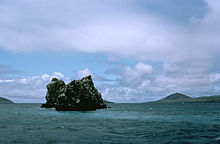

Reef ( Netherlands rif - rib) - underwater or surface elevation of the seabed in shallow water. It is formed during the destruction of the rocky bottom and coasts, or as a result of the growth of colonies of coral polyps , [1] [2] [3] [4] some algae and other reef-building organisms. [five]
Many reefs are formed as a result of abiotic processes - sand deposition, erosion of exposed rocks and other natural processes, but the most famous reefs are coral reefs in tropical waters, formed as a result of the growth of colonies of reef-forming organisms, among which coral polyps and calcareous algae predominate. In this regard, from the point of view of biology, reefs began to be defined as localized, shallow, wave-resistant structures built by lime-secreting organisms and lying on underlying formations, from which they clearly differ. [6] [7] In the future, this term was also used in geology to refer to paleontological rocks formed by organisms with calcareous skeletons. [eight]
Content
Modern Reefs
Biotic Reefs
Coral Reefs
The most common and famous of biotic reefs are coral reefs . Despite the fact that coral polyps make the greatest contribution to the main substance that makes up the reef, coralline algae are an even more important organism responsible for bonding reef material and protecting against the damaging effects of waves. [9] [10]
Coral reefs are classified according to how they are located in relation to land. Distinguish fringing or coastal type , barrier type and atolls . [11] Fringing reefs are a terrace-like platform extending from the coast into the depths of the sea and ending with a raised edge. They are usually located along a recently exposed or stable coast. [11] Barrier reefs surround individual islands, are located at some distance from the coast and are separated from it by a strait or lagoon. The largest of these is the Great Barrier Reef off the east coast of Australia . [11] The atolls are ring-shaped reefs surrounding lagoons, within which there are no land areas. [eleven]
Despite the fact that it is traditionally believed that coral reefs are distributed mainly in tropical seas, colonies of coral polyps living in cold water are known. These include most of the coral polyps of the genera Lophelia , Goniocorella , Solenosmilia , Madrepora , Antipathes and Primnoa , which build large reefs deep in cold water (although The coral reef of the genus Lophelia is known in the Norwegian fjords at shallow depth) located in different areas around the world. These corals are independent of zooxanthellae, and therefore can grow at a depth of up to 1000 meters. Endemic species of the genus Primnoa have been discovered on some seamounts.
Other Biotic Reefs
Coral polyps living in tropical seas are not the only organisms capable of creating reefs. In the marine environment, several species of marine invertebrates can create reefs. In some Scottish estuaries , for example, reefs built by tubular worms of the species Serpula vermicularis are found. [12] In many other places on Earth, there are reefs created by oysters or sponges ( sponge reef ), mainly belonging to the genus Vaceletia , which were ubiquitous before the appearance of coral polyps, and now their habitat is limited to some areas of the Pacific Ocean . Some sponges from the genus Heterochone in the cold waters of the northern part of the Pacific Ocean can create reefs over 20 meters high, spreading several kilometers and reaching a depth of 100 to 250 meters. Bryozoans reefs are also known. [13]
In addition to coralline algae, other plants can also create reefs. Among marine monocotyledonous plants, these include sea grass , Posidonia , Cymodocea , which can create in the shallow water “barrier reefs or meadows” that protect the coast from storms.
Cyanobacteria build formations called stromatolites , which were widely distributed on Earth about 3.5 billion years ago. Living stromatolites are still found in Shark Bay in Australia and in some other parts of the world. [14] [15]
Fossil Reefs
Terminology
In its original geographical and oceanographic meaning, the term “reef” was called a narrow, often rocky, stranded , dangerous for sailing ships and usually indicated by breakers at low tide. [8] [16] [17] [18]
Since many such formations were coral-algal reefs, later this term was also used in geology to refer to paleontological rocks formed by organisms with calcareous skeletons (carbonate rocks), regardless of the depth of their formation, shape and size. The term “reef” as applied to nutrients was first used by R. Murchison in 1847 to refer to the Silurian reef deposits of Gotland. Currently, “reefs” in geology means a complex set of interconnected facies , which usually distinguishes between zones of the reef itself, zones of the plume of destruction products on the front side of the reef and the zone of the lagoon behind the reef body. In paleontology and lithology it is recommended to use the term “fossil reef”. [eight]
Paleontological Reef History
In different epochs of the history of the Earth, the role of the main reef builders was played by various organisms that used the strategy of collective defense against enemies and obtaining food. [19] When environmental conditions changed during different periods, reefs either spread widely or significantly reduced their distribution zones. [20]
Precambrian
The first reef-like formations, stromatolites, were formed by cyanobacteria in the Paleoarchean about 3.4 billion years ago. Their growth occurred very slowly due to the deposition of thin calcareous layers one above the other on the surface of stromatolite mats . The formations erected in this era surpassed the Great Barrier Reef in size. In the Vendian period, stromatolite communities from normal marine conditions were replaced by skeletal organisms in places with abnormal salinity or strong currents, and the main organogenic structures were formed by calcareous algae Renalcis and Korilophyton . Such formations were 2-3 meters wide and 10-15 cm high, they were usually solitary and extremely rarely formed massifs. [20] Then, in the Ediacar period , reefs formed by the association of claudins and namacalatuses , reaching a length of 7 kilometers and a width of 300 meters, were known . [nineteen]
Paleozoic
In the Paleozoic, the main builders of reef-like formations were calcareous algae, to a lesser extent spongiform, bryozoans and coral polyps ( tablates , helioids and four- rayed corals ). During this period, sea lilies played an auxiliary role in the construction of organogenic structures. The first real reefs appeared at the beginning of the Cambrian period in connection with the appearance of archeocytes - one of the first animals with a mineral skeleton. They settled together with algae (Renalcis, Epiphyton , Girvanella ), creating powerful reef systems. Together with them oncoliths , trilobites and brachopods settled on reefs. The greatest development of reefs from archaeocytes reached in the Atdaban and Botomian centuries, but on average the Cambrian archaeocytes died out, and before Ordovician reef construction almost stopped. [20]
In the middle and upper Cambrian, as well as the lower Ordovician, the main organogenic structures were bacterial in nature. Since the May century, the main builders of reef systems were the ordinary sponges of lithistide and axinellid , which built silt hills on the outer shelf. [20]
In the Lower Ordovician, the construction of reef structures was carried out by stromatoporoids , bryozoans and the first coral polyps, which still did not play a big role. [20] The Middle Paleozoic stage of reef development passed from the Middle Ordovician to the Famennian Devonian . During this period, the shelf zone increased, and accordingly, the number of shelf seas increased. The main role in the construction of reefs from the Middle Ordovician began to play stromatoporoid, settled on the shells of large mollusks and tabulate colonies. The reefs that existed in the Karadok age , in our time, can be traced in the form of fine-grained limestones containing siphon green algae , saline red algae , sponges, bryozoans, less commonly tabulates and tecoidea . In the Ashgil century , they already exceeded Cambrian reefs in size and reached 150 - 350 meters, and sea lilies , shells , recipe culids and cephalopods were added to their inhabitants. The icing that occurred at the end of the Upper Ordovician led to a sharp decrease in sea level, the drainage of many shallow basins and the death of the reef population. [20]
The transgression at the beginning of the Silurian period led to the appearance of a large number of shallow seas, which began to be actively inhabited by reef-builders. During this period, reefs were more common than in the Ordovician, and their sizes reached 1000 kilometers. The main reef builders were algae, stromatoporoid, tabulata, to a lesser extent - rugose and bryozoans. Among the inhabitants of the reefs were brachopods, sea lilies, and recipeculites. The reefs of this period are characterized by associations of stromatoporoids and corals, when rugoses and tablates formed a single colony with stromatoporoids. Bryozoans were rarely found in large reefs. In the Ludlow period , afrosalpingoids are found in stromatolite reefs. [20]
In the Devonian period, reef belts reached such dimensions that they stretched across all of Eurasia . During this period, sea lilies took part in the construction of reefs, and the role of cyanobacteria, on the contrary, gradually decreased from the Devonian, giving way to red and green calcareous algae. In the Middle Devonian, the role of coral polyps (primarily tabular morphs ) became significant in the formation of reefs, despite the fact that they played a secondary role with the rest of the Paleozoic . In addition to them, stromatoporoids (especially amphiporids ) and bryozoans played a significant role in the construction of reefs during this period. In the Upper Devonian , the contribution of foraminifera becomes noticeable. At the end of the Devonian, shelf reduction and cooling led to a reduction in reef formation. In the Famennian century , coral polyps and stromatoporoids became extinct. Favosides and alveolides , heliolithoids and triplasmatids completely disappeared. At the same time, due to the lack of competitors, the number of stromatolite buildings increased. [20]
In the Carboniferous period, reefs were less common than in the Devonian. In the Visean century , reef construction intensified somewhat, while the leading role passed from coral polyps to algae and bryozoans, which at that time were in their prime. Then the role of stromatoporoids again increased, but soon they finally lost the role of reef builders. In the Serpukhov century, reefs form algae and bryozoans, less often coral polyps, stromatoporoids, crinoids, and attached foraminifera. Among the reef population were Khetetids , brachopods and shells. [20]
In the Permian period, reefs were not widespread. In reef deposits of this period, calcified thalli of green algae, colony of bryozoans and sphinctozoa , shells of brachiopods, bivalves and gastropods , fusulinids are found . At this time, several powerful reef formations formed, such as the modern Mount El Capitan in Texas (USA). [20]
Mesozoic
The mass extinction of species on the border of the Permian and Triassic periods led to the death of almost all coral polyps and in the lower Triassic of the sea were very poor in life forms. The main reef-forming species again became algae and, in part, bryozoans, which completely renewed their species composition in the Mesozoic . Only in the Middle Triassic did new species of reef-forming coral polyps appear, among which are the madreporic corals , which have played the role of reef-builders to date. In the Upper Triassic, the reefs again spread widely, while the role of sphinctozoa again increased. [20]
Throughout all the Mesozoic and Cenozoic eras, the main builders of reefs were algae and coral polyps, the main role among which began to play six-pointed corals . Sea reefs built by them are widespread in the Pacific Ocean and in the modern era. From the Upper Jurassic and the entire Cretaceous period , systems of real reefs developed widely in the seas. In the Upper Cretaceous of coral polyps, the rudists pressed the role of the main reef builders, but they could not survive the Cretaceous – Paleogene extinction . [20]
Cenozoic
In the Paleocene, the seas were poor in life forms. Widespread reefs began in the mid- Eocene and continue to this day. Currently, the main reef builders are maderepore corals and calcareous red algae. [20]
Artificial Reefs
- Main article: Artificial Reef
Artificial reefs are formed as a result of human activities, such as the intentional flooding of ships, to develop marine life in certain areas, to combat erosion, block shipping or improve the quality of surfing .
See also
- Scythe (relief)
Notes
- ↑ Geographic encyclopedia. Reef
- ↑ Glossary of Nautical Terms (Inaccessible link) . Date of treatment July 1, 2014. Archived March 4, 2016.
- ↑ Geographical dictionary
- ↑ Geological Encyclopedia
- ↑ Marine Dictionary
- ↑ Goreau et al., 1972
- ↑ Latypov Yu. Coral reef ecosystem
- ↑ 1 2 3 Terminological Dictionary of Paleontology (Inaccessible link) . Date of treatment July 1, 2014. Archived July 14, 2014.
- ↑ Coralline algae communities: Coralline algae are the red algae of this family. Corallinaceae
- ↑ CORAL REEF | Encyclopaedia Round the World
- ↑ 1 2 3 4 CORAL REEF | Encyclopaedia Round the World
- ↑ Biogenic Reefs UK Marine SAC's Project. Retrieved 2011-11-01.
- ↑ Bryozans on the site of Igor Garshin
- ↑ Shark Bay Spoils | Magazine | Around the world
- ↑ Archean. Stromatolites and the emergence of life
- ↑ Dictionary of foreign words that make up the Russian language.- Chudinov A.N., 1910
- ↑ Natural sciences. encyclopedic Dictionary
- ↑ Explanatory Naval Dictionary, 2010
- ↑ 1 2 Build a reef to survive
- ↑ 1 2 3 4 5 6 7 8 9 10 11 12 13 Ancient reef builders