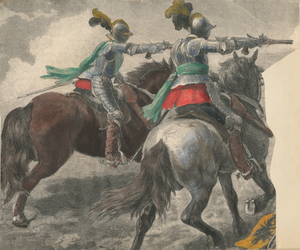
Caracol ( Spanish caracol - “snail”) - maneuver in horseback riding and, earlier, in military tactics .
Content
Equestrian
Dressage
In horsemanship, karakol means one half-turn of the horse in place, it doesn’t matter - to the left or to the right.
Warfare
Tactics, called “karakol” in the modern sense of the term, arose in the mid- 16th century as an attempt to incorporate the use of firearms into cavalry tactics. The riders, armed with two pistols with wheel locks , almost galloped approached the target in a formation consisting of twelve lines. As soon as the next line was approaching the distance of the shot, the riders of this line stopped, slightly turning their horses in one direction, fired from one pistol, then to the other, fired from another pistol, then turned around, drove through the remaining lines and became in the rear of the line. The time that the remaining 11 rows spent repeating the maneuver allowed the shooters to reload their pistols first, which ensured continuous firing by constantly alternating ranks. This tactic was spread with the growing popularity of German reitars in the Western armies in the middle of the 16th century [1] . Gaspard de Tavann wrote in his memoir: “ Since pistols were invented under Charles V , the German nobility, who had previously served in the ranks of the Landsknechts , mounted their horses and formed these squadrons 15 or 16 lines deep. These squadrons went on the attack, but did not make a breakthrough. The first line turns left, opening the road to the second, which, in turn, shoots, etc., forming a “snail” to reload its pistols ” [2] .
Reitars often had up to 6 pistols and were built by deep masses, 17 lines deep. The spread of this maneuver caused the infantry the need to increase the number of musketeers, since the pikemen, without covering the musketeer, suffered tangible losses from the actions of the rebar [3] . So, if the karakoliruyushchy squadron encountered the infantry in close formation, then he could really inflict substantial harm to it; this, for example, happened at the battle of Dreux with a Swiss square column [2] .
Karakol was distinguished by tactical complexity, it was not always possible to execute it harmoniously in practice in a battle, the maneuver itself could cause confusion among its performers. For its correct execution, brave and experienced warriors were required who could calmly get close to the enemy (taking into account the low range of pistol firing of those times), but if it was carried out disciplined and decisively, this method turned out to be very effective [4] [5] .
It should be noted that sources of the corresponding period did not always use the term “karakol” in the modern sense. For example, John Crusoe, an authoritative military specialist of that era, explained the term as a maneuver in which the cuirassier detachment attacked by the enemy is divided into two parts, allowing the attacking fist to pass between the two parts, and then attacks simultaneously from two flanks .
Notes
- ↑ Dupuis R.E., Trevor N.D. War. Complete Encyclopedia. All battles, battles and military campaigns of world history from the 4th millennium BC until the end of the 20th century . - Litres, 2017-12-30. - 4497 p. - ISBN 9785040350087 .
- ↑ 1 2 Hans Delbrück. The history of military art Volume 4. New time. . - Multimedia publishing house Strelbitsky, 2016-03-28. - 777 p.
- ↑ Svechin A.A. The military art of the reformation. The evolution of military art. From ancient times to the present day. Volume One . history.wikireading.ru. Date of treatment January 29, 2018.
- ↑ Oakeshott E. Knight and his castle. Medieval fortresses and siege structures . - Litres, 2017-09-05. - 234 p. - ISBN 5457035441 .
- ↑ Montgomery B. A Brief History of Warfare . - Litres, 2017-09-05. - 490 s. - ISBN 5457026655 .
Literature
- Delbrück G. History of military art. T. 4. New time. (Conversion of chivalry into cavalry). - SPb .: Science; Juventa, 1997.
- Svechin A.A. The evolution of military art. Volume I. (The Military Art of Reformation). - M.-L .: Voengiz , 1928.
See also
- Reitars
- Karakol (infantry) - a similar tactic for arquebusiers and musketeers
- Cantabrian circle - an alternative way to use horse shooters, characteristic of Russia and the East