The Grand Master of the Teutonic Order is the highest executive position in the Teutonic Order . He was responsible for internal policy: territorial management, personnel policy, management of other affairs of the order, as well as foreign policy.
Content
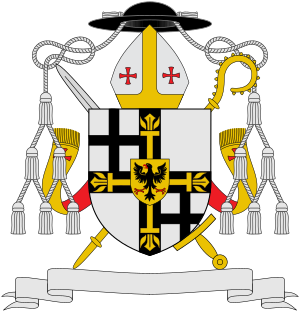
Emblem of Grand Master
The coat of arms of the great master consists of a black cross on a silver background. Inside is a golden cross with lilies on the tops. In the middle of the cross there is a heraldic shield with a black eagle on a gold background.
Election
After the death of the grand master, his deputy — the great commander of the order — convened a chapter consisting of 12 members: 7 knights, 4 sergeants (brothers without knighthood), and one priest. The decision was made by a majority vote. Elections were held within three months after the death (or resignation) of the Grand Master.
Hospital Fraternity Managers (1190–1198)
The creation of a knightly order was preceded by a hospital fraternity created to support German pilgrims in Palestinian lands. It is believed that the founders of the hospital assisted wounded Christians in Acre around 1190 . Information about this stage in the history of the order is not holistic.
- 1190 Sibrand (presumably the founder and the first head of the fraternity)
- 1190-1192 Konrad (Konrad), Chaplain of the Duke Friedrich Schwabsky
- 1192 Gerhard
- 1193-1194 Heinrich (Heinrich), prior
- 1195 Ulrich (Ulrich)
- 1196–1198 Heinrich, praeceptor
List of great masters of the Teutonic Order
The seat of the capital of the Order has changed several times. The list of great masters is based on chronological and geographical criteria.
Acre ( 1198 - approx. 1230 )
Founded in 1198 on the basis of the German hospital, the Order was greatly influenced by the “senior” knightly orders: the Hospitallers and the Templars . The main difference of the Order from the fraternities mentioned was in the national principle. If the senior orders did not have a certain nationality (although the French-speaking knights played a major role in them), the Teutonic Order initially positioned itself as a German Order.
The first great masters are little known, but they have worked to create an independent Order. The Charter of the Order was adopted and the management structure was formed. The residence of the Masters of Acre was the last city in the hands of the Crusaders in the Holy Land . It was located by the sea at the crossroads of trade routes. In 1230 the 4th Grand Master Hermann von Salz transferred his residence to the castle of Montfort .
| Name | German spelling | Start | end | Notes |
|---|---|---|---|---|
| Heinrich Walpot von Bassenheim | Heinrich walpot von bassenheim | 1198 | 1200 | The first great master, the founder of the order. |
| Otto von Kerpen | Otto von Kerpen | 1200 | 1208 | Strengthened the independence of the order. |
| Heinrich von Tunna (Barth) | Heinrich von tunna | 1208 | 1209 | He continued the policy of Otto von Kerpen. |
| Hermann von Salza | Hererman von salza | 1209 | 1239 | Moved the capital of the order in the castle of Montfort |
Monfor Castle ( 1230 - 1271 )
| Name | German spelling | Start | end | Notes |
|---|---|---|---|---|
| Konrad Thuringian | Konrad von Thüringen | 1239 | 1240 | |
| Gerhard von Malberg | Gerhard von Malberg | 1240 | 1244 | |
| Heinrich von Hohenlohe | Heinrich von hohenlohe | 1244 | 1249 | |
| Gunter von Wüllersleben | Gunther von wüllersleben | 1249 | 1252 | |
| Poppo von Osterna | Poppo von osterna | 1252 | 1256 | |
| Anno von Sangershausen | Anno von sangershausen | 1256 | 1273 | He transferred the capital of the order back to Acre. |
Accra ( 1271 - 1291 )
| Name | German spelling | Start | end | Notes |
|---|---|---|---|---|
| Hartman von Heldrungen | Hartmann von heldrungen | 1273 | 1283 | |
| Burchard von Schwanden | Burchard von schwanden | 1283 | 1290 |
Venice ( 1291 - 1309 )
| Name | German spelling | Start | end | Notes |
|---|---|---|---|---|
| Konrad von Feuchtwangen | Konrad von Feuchtwangen | 1291 | 1296 | He transferred the capital of the Order to Venice . |
| Gottfried von Hohenlohe | Gottfried von hohenlohe | 1297 | 1303 | |
| Siegfried von Feuchtwangen | Siegfried von feuchtwangen | 1303 | 1311 | In 1309 he transferred the capital of the Order to Prussia in Marienburg . |
Marienburg (1309–1457)
| Name | German spelling | Start | end | Emblem |
|---|---|---|---|---|
| Karl von Trier | Karl von Trier | 1311 | 1324 | |
| Werner von Orzeln | Werner von orseln | 1324 | 1330 | |
| Luther von Braunschweig | Luther von braunschweig | 1331 | 1335 | |
| Dietrich von Altenburg | Dietrich von Altenburg | 1335 | 1341 | |
| Ludolf König von Watsau | Ludolf könig von wattzau | 1342 | 1345 | |
| Heinrich Duzemer | Heinrich dusemer | 1345 | 1351 | |
| Winrich von Kniprode | Winrich von kniprode | 1352 | 1382 | |
| Konrad Zöllner von Rotenstein | Konrad Zöllner von Rotenstein | 1382 | 1390 | |
| Konrad von Wallenrode | Konrad von Wallenrode | 1391 | 1393 | |
| Konrad von Jungingen | Konrad von Jungingen | 1393 | 1407 | |
| Ulrich von Jungingen | Ulrich von jungingen | 1407 | 1410 | |
| Heinrich von Plauen | Heinrich von plauen | 1410 | 1413 | |
| Michael Kühmeister von Sternberg | Michael Küchmeister von Sternberg | 1414 | 1422 | |
| Paul von Rusdorf | Paul von Rusdorf | 1422 | 1441 | |
| Konrad von Erlichshausen | Konrad von Erlichshausen | 1441 | 1449 |
Koenigsberg ( 1457 - 1525 )
| Name | German spelling | Start | end | Coat of Arms, Notes |
|---|---|---|---|---|
| Ludwig von Erlichshausen | Ludwig von erlichshausen | 1450 | 1467 | In 1457 he was forced to move the capital. |
| Heinrich Roiss von Plauen | Heinrich reuß von plauen | 1469 | 1470 | |
| Heinrich Reffle von Richtenberg | Heinrich Reffle von Richtenberg | 1470 | 1477 | |
| Martin Truchses von Wetzhausen | Martin Truchsess von Wetzhausen | 1477 | 1483 | |
| Johann von Tiefen | Johann von tiefen | 1489 | 1497 | |
| Frederick of Saxony | Friedrich von sachsen | 1498 | 1510 | |
| Albrecht Brandenburg-Ansbach | Albrecht von Brandenburg-Ansbach | 1511 | 1525 | Secularized the lands of the Order in Prussia in 1525 to the Duchy of Prussia |
Mergentheim (1525–1809)
The Order continued its existence outside Prussia after 1525 , having lost its former strength and influence. The residence of the supreme power of the order became the city of Mergentheim . The Grand Master began to be called the Great and German Master (the wording existed until 1929 ), but the short name Grand Master was still in use. Due to the weakening of the order, in search of additional resources for existence, the order approaches the emperors of the Holy Roman Empire . After in 1590 the emperor Rudolf II actually appoints his brother Maximilian III of Austria to the post of grand master, the order completely falls under the influence of the Hapsburg dynasty. After that, until 1923 the Habsburgs supervised the activities of the order either directly appointing the order of the members of their families, or appointing their close ones. Many of the great masters at the same time occupied other positions in the Empire, mostly bishops. The Order took an active part in the Thirty Years War ( 1618 - 1648 ).
| Name | German spelling | Start | end | Notes |
|---|---|---|---|---|
| Walter von Kronberg | Walther von cronberg | 1527 | 1543 | He transferred the residence of the order in Mergentheim . |
| Wolfgang Schutzbar Milhling | Wolfgang schutzbar | 1543 | 1566 | |
| Georg Hund von Venkheim | Georg Hund von Wenkheim | 1566 | 1572 | |
| Heinrich von Bobenhausen | Heinrich von bobenhausen | 1572 | 1590 | He was forced to resign due to disagreements with the emperor Rudolf II . |
| Maximilian of Austria | Maximilian von Österreich | 1590 | 1618 | The first representative of the Habsburg dynasty |
| Karl Austrian | Karl von Österreich | 1619 | 1624 | Maximilian's cousin. |
| Johann Oistach von Westerns | Johann Eustach von Westernach | 1625 | 1627 | |
| Johann Caspar von Stadion | Johann kaspar von stadion | 1627 | 1641 | One of the commanders of the imperial troops in the Thirty Years War . |
| Leopold Wilhelm of Austria | Leopold Wilhelm von Österreich | 1641 | 1662 | Carl's nephew. Shtatgalter Spanish Netherlands (1647-1656). |
| Karl Joseph of Austria | Karl Joseph von Österreich | 1662 | 1664 | The nephew of Leopold Wilhelm. |
| Johann Caspar von Ampringen | Johann caspar von ampringen | 1664 | 1684 | |
| Ludwig Anton von der Pfalz-Neuburg | Ludwig Anton von der Pfalz-Neuburg | 1684 | 1694 | |
| Franz Ludwig von der Pfalz-Neuburg | Franz Ludwig von der Pfalz-Neuburg | 1694 | 1732 | The younger brother of Anton Ludwig. |
| Clemens August of Bavaria | Clemens August von Bayern | 1732 | 1761 | |
| Karl Alexander, Prince of Lorraine | Karl Alexander von Lothringen | 1761 | 1780 | |
| Maximilian Franz Austrian | Maximilian Franz von Österreich | 1780 | 1801 | Nephew of Karl Alexander of Lorraine. |
| Karl Ludwig Austrian (Karl-Ludwig-John) | Karl Ludwig von Österreich | 1801 | 1804 | Maximilian's nephew. |
Vienna (1809–1923)
| Name | German spelling | Start | end | Notes |
|---|---|---|---|---|
| Anton Victor Austrian | Anton Viktor von Österreich | 1804 | 1835 | The younger brother of Karl Ludwig. |
| Maximilian Josef of Austria | Maximilian Joseph von Österreich | 1835 | 1863 | Nephew of Maximilian Franz, cousin of Karl Ludwig and Anton Ludwig. |
| Wilhelm, Archduke of Austria | Wilhelm von Österreich | 1863 | 1894 | Son of Karl Ludwig. |
| Eugen Austrian | Eugen von Österreich | 1894 | 1923 | Wilhelm's nephew. The last chapter of the knightly order. |
Vienna (from 1923 to the present)
In 1923, the Order lost its knighthood status and became clerical. Currently, the clerical Catholic German Order, in addition to the clerical, is also engaged in charitable, economic and scientific activities.
| Name | German spelling | Start | end | Notes |
|---|---|---|---|---|
| dr. Norbert Klein | Norbert Johann Klein | 1923 | 1933 | |
| Paul Hyder | Paul Heider | 1933 | 1936 | |
| Robert Sheltsky | Robert Schälzky | 1936 | 1948 | |
| dr. Marian Tumler | Marian tumum | 1948 | 1970 | |
| Ildefons Pauler | Ildefons pauler | 1970 | 1988 | |
| dr. Arnold Wieland | Arnold Othmar Wieland | 1988 | 2000 | |
| dr. Bruno Platter | Bruno platter | 2000 | 2018 | |
| Frank Bayard | Frank bayard | 2018 | present tense |
See also
- Warband
- The great comtus of the Teutonic Order
- Marshals of the Teutonic Order
- High Hospitallers of the Teutonic Order
- High quartermaster of the Teutonic Order
- Chief Treasurers of the Teutonic Order
- Landmasters of the Teutonic Order in Prussia
- Landmasters of the Teutonic Order in Germany
- Landmasters of the Teutonic Order in Livonia
Sources
- List of the great masters of the Teutonic Order . Website DEUSVULT.RU. The appeal date is July 14, 2012. Archived on August 7, 2012.
- "Chronicle of the Land of Prussia" by Peter from Duisburg
- Staat des Deutschen Ordens (him.)
- Bakhtin A.P. Castles and fortifications of the German Order in the northern part of East Prussia: a Handbook. - Kaliningrad: Terra Baltic, 2005. - 208 p. - ISBN 5-98777-004-1 .
- Bokman H. The German Order: Twelve Chapters from His History / Trans. with him. V.I.Matuzova. - Moscow: Ladomir, 2004. - 273 p. - ISBN 5-86218-450-3 .
- Kretinin G.V., Bryushinkin V.N., Galtsov V.I. and other essays on the history of East Prussia. - Kaliningrad: Amber Skaz, 2002. - 536 p. - ISBN 5-7406-0502-4 .