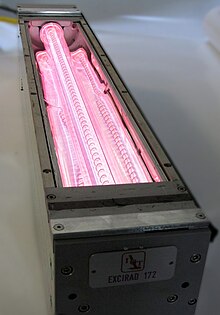
Excilamp (exciplex lamp and excimer lamp) - a variety of discharge lamps , a source of ultraviolet (UV) radiation (including those with a wavelength shorter than 200 nm). A relatively recent class of spontaneous emission sources using nonequilibrium radiation of excimer or exciplex molecules [1] [2] . A feature of these molecules is their stability in an electronically excited state and the absence of a strong bond in the main. A number of such molecules have an intense BX transition in the UV or VUV spectral ranges, which makes it possible to transform the energy introduced into the medium into optical radiation with high efficiency.
The main difference between excilamps and the available luminescent , as well as thermal, spontaneous sources of UV and VUV ranges is the radiation spectrum . Up to 80% or more of the total radiation power can be concentrated in a relatively narrow (not more than 10 nm at half maximum) band of the corresponding molecule. In this case, the specific radiation powers exceed the values characteristic of low-pressure lamps at resonant transitions of atoms. In addition, upon excitation of multicomponent gas mixtures, it is possible to simultaneously obtain radiation with a comparable intensity on two or more molecules.
The advantages of excilamps from the point of view of their application are: high photon energy (3.5-10 eV), narrow emission band, relatively high specific radiation power , the ability to scale and select an arbitrary geometry of the emitting surface. Separately, the absence of mercury in excilamps should be noted. This provides them with the advantage of relatively widespread, but environmentally unsafe mercury-containing lamps. Currently, excilamps are beginning to be used in photochemistry, microelectronics, for cleaning and modifying surface properties, for the polymerization of varnishes and paints, in the disinfection technologies for industrial wastes, water, air, biology, medicine, and other applications. This was made possible thanks to great successes in understanding the processes occurring in optical media of excilamps and in creating samples suitable for practical use.
See also
- Excimer laser
Notes
- ↑ Kogelschatz U. Silent-discharge driven excimer UV sources and their applications // J. Appl. Surface Science. - 1992. - No. 54. - P.410-423.
- ↑ Lomaev M.I., Skakun V.S., Sosnin E.A., Tarasenko V.F., Schitz D.V., Erofeev M.V. Excilamps - effective sources of spontaneous UV and VUV radiation // Uspekhi Fizicheskikh Nauk . - 2003, - T.173. - No. 2. - S.201-217.