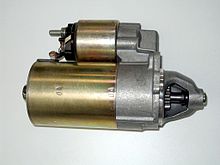
Starter relay (top left, black). Traction relay ( solenoid , in the center above, small diameter, golden brown). In the silver case - lever gear and overrunning clutch. The electric motor is of large diameter, golden color.
An electric starter is an electric motor used to start an internal combustion engine .
The most convenient way. At start-up, the engine is unwound by a collector electric motor — a DC machine powered by a battery (after starting, the battery is recharged from a generator driven by the main engine). At low temperatures, commonly used acid batteries lose power, their starting capacity drops (mainly due to a decrease in the rate of chemical reactions ), and the viscosity of the oil in the lubrication system increases. Therefore, starting the engine in the winter is difficult and sometimes impossible. In the presence of an electrical network in this case it is possible to start from a network starter (almost unlimited capacity).
Motor starters have a special design with four brushes, which allows you to increase the rotor current and the power of the electric motor.
On diesel locomotives with electrical direct current transmission, the starter is a traction generator . The same scheme was used on some scooters (" Tula ", " Tourist ", " Tulitsa ", " Ant "), where the starter function is performed by a DC generator, mounted directly on the crankshaft (in the USSR such system was called "dynamo-starter", later - "dynstarter").
Content
Electric Principle
When the starter is turned on, the electric current (through the on relay, otherwise the contacts in the ignition lock will burn) goes to the traction relay ( solenoid ). The solenoid core retracts and, via a linkage, engages the gear of the starter motor with a gear ring (a large gear ) of the flywheel. After this, the contacts of the starter relay are closed. A very large current (tens and even hundreds of amperes [1] ) to the electric motor passes through this relay. After starting, the overrunning clutch (bendix) allows rotation of the engine flywheel and the starter motor independently of each other. After turning off the starter, the starter parts return to their original state. On older cars (for example, GAZ-69 , GAZ-63 ) the traction relay ( solenoid ) was absent, the driver turned on the starter pedal on the floor of the cab. [2]
On cars with automatic transmissions, there is a holding winding that does not allow the solenoid core to move if the automatic transmission selector is installed in the “D”, “R”, “L” or “2” running positions, a switch is installed in the automatic transmission, which supplies current to the holding winding . The engine can only be started at positions “P” (parking) and “N” (neutral).
Voltage on starter
On cars with petrol internal combustion engines, the voltage of the on-board network is 12 volts , the same electrical voltage applied to the starter. A number of cars produced in the first half of the XX century, used a voltage of 6 volts.
On cars with powerful diesel engines, the voltage of the on-board network is 24 volts. This is due to the fact that a diesel engine with a large working volume and a high compression ratio requires a powerful electric starter. Two 12-volt car batteries are installed, connected in series . [3]
- With equal electric power, if the electric voltage rises twice , the current strength decreases by half , respectively: where - current strength, and - tension.
Increasing the voltage can reduce the discharge current of the battery, as well as reduce the useless heating of the wires .
On passenger cars, minibuses and light-duty trucks with diesel engines used 12-volt starters (that's enough).
On old trucks with diesel engines ( YAZ-200 , YAZ-210 ), the voltage of the on-board network was 12 volts, and the starters were designed for 24 volts. There were two 12-volt car batteries connected in parallel, when they started they switched to a serial connection . All 12-volt power consumers at start-up operated from a single battery.
See also
- Starting system of an internal combustion engine
Notes
- ↑ For example, the starter ST368 of the ZAZ-968 has a capacity of 1.1 liters. with. , no-load current 65 A , current with full braking 330 A; Starter CT142 of KAMAZ vehicles has a capacity of 10.5 liters. with. , no-load current, 130 A , current with full braking, 800 A. Data from the “Short automobile reference book” of the State Research Institute of Automobile Transport, Moscow, 1983.
- ↑ Photos of the starter motor installed on the engine, see article GAZ-11 (engine) .
- ↑ 24-volt rechargeable batteries are not commercially available, the weight of capacious 12-volt batteries approaches the limit of physical abilities of a person, for example, a KAMAZ 6ST-190 battery without electrolyte weighs 58 kg, and an electrolyte needs 12 liters.
Links
Design features of electric starters . Car device