Tetanus bacillus [1] ( lat. Clostridium tetani ) is a gram - positive spore - forming obligate anaerobic bacterium of the clostridium genus, a causative agent of tetanus . Discovered in 1883 by the Russian surgeon Nestor Monastyrsky (1847-1888) and in 1884 by the German physician Arthur Nicolaier ( German Arthur Nicolaier , 1862-1942), it was isolated in pure culture by the Japanese bacteriologist Kitasato Sibasaburo in 1889 ( 北 里柴三郎 , 1852-1931). The toxin is assigned to the pathogenicity group II.
| Tetanus stick | |||||||||||||||
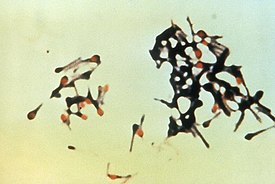 Clostridium tetani , spores visible | |||||||||||||||
| Scientific classification | |||||||||||||||
|---|---|---|---|---|---|---|---|---|---|---|---|---|---|---|---|
| |||||||||||||||
| International scientific name | |||||||||||||||
Clostridium tetani | |||||||||||||||
Content
Biological properties
Morphology
Large (3-12 × 0.3-0.6 microns), motile ( flagella are peretrichial) rod - shaped bacteria. It forms oval endospores that are 2–3 times larger than the diameter of the cell , located terminally (a characteristic morphology of the “drumsticks” type).
Cultural Properties
Hemorganorgan heterotroph , obligate anaerobic. For cultivation on nutrient media, it is necessary to provide anaerobic conditions , as well as to clear the test material from non-spore-forming anaerobes (the Drigalski method is used). On dense nutrient media they form small transparent colonies with irregular edges, after a while they acquire a glass shine. In liquid culture media it grows slowly, there is a slight turbidity and a light layer of dusty sediment on the walls of the tube. When injected into the thickness of a dense nutrient medium, it forms small colonies similar to pieces of cotton wool. It liquefies gelatin with gas formation, does not form indole , quickly restores nitrates to nitrites [2] . Does not ferment carbohydrates , has fibrinolytic activity.
Antigenic properties
It has a group specific O antigen and a type-specific H antigen. According to the structural features of the H antigen, 10 C. tetani serovars are isolated .
Pathogenicity for animals
Under natural conditions, horses and small cattle are ill with tetanus. Many animals carry tetanus.
Of the experimental animals, white mice , guinea pigs , rats , rabbits , and hamsters are susceptible to tetanus bacilli.
Tetanus in animals occurs with spastic contractions of striated muscles and lesions of the pyramidal cells of the anterior horns of the spinal cord . The limbs are initially involved, and then the trunk ( ascending tetanus ). A toxin obtained from the filtrate of the broth culture, at a dose of 0.000005 ml, kills a white mouse weighing 20 g. It causes tetanus in humans, also pathogenic to animals.
Pathogenicity for humans
The source of the disease are animals and humans, which secrete clostridia with feces in the soil. Spores are found in the soil of 50–80% of the samples studied, in some soils (especially manufac- tured ) - 100%.
Clostridium tetani produces tetanospasmin , which has neurotoxic properties and tetanolysin , which has hemolytic properties. Thetanospasmin acts on the peripheral nervous system and causes tonic contractions of the striated muscles . Tetanolizine causes red blood cell lysis. Tetanospazmin is neutralized by tetanus toxoid , unstable when heated, in an alkaline environment and under the influence of sunlight. It is not absorbed in the digestive system, is relatively safe when taken orally. The transmission mechanism is pin. About 2/3 of the diseases occur in persons employed in the household. More than 50% of them get sick as a result of wounds with a shovel , a nail or stubble while working in the garden , field. Pathology is also characteristic as concomitant with a gunshot wound during armed conflict .
Resistance
Vegetative forms of the tetanus pathogen die at a temperature of 60–70 ° C within 30 minutes and are quickly neutralized with the use of all applied disinfectants, however, spores are more stable and can withstand boiling for 10–90 minutes (and spores of some strains last 1-3 hours), 5% phenol solution causes their death after 8-10 hours, and 1% formalin solution - 6 hours. Spores can withstand direct sunlight for 3-5 days.
Application in medicine and experimental biology
Concentrates from culture media and purified tetanus bacillus toxins are used in experimental biology to study the functioning of motor neurons.
The possibility of using genetically modified (non-toxin producing) tetanus bacillus strains in oncology to combat dense neoplasms is being studied, which are difficult to treat with all known treatment methods. It is believed that in the tissues of such neoplasms, due to their insufficient oxygen supply, favorable conditions are created for the proliferation of tetanus bacillus, which can be modified so that it becomes a producer of cytotoxic metabolites and destroys the tumor from the inside.
Notes
- ↑ Biological Encyclopedic Dictionary / Ch. ed. M.S. Gilyarov ; Editorial: A.A. Baev , G.G. Vinberg, G.A. Zavarzin et al. - M .: Sov. Encyclopedia , 1986.- S. 610.- 831 p. - 100,000 copies.
- ↑ Pyatkin K. D. Microbiology with virology and immunology. - M .: "Medicine", 1971. - S. 243-246.
See also
- Tetanus
- Anaerobic infection