Hrazdan ( Armenian Հրազդան [Hrazdán]), Zangu ( Armenian Զանգու [Zangu] [1] ), a river in Armenia , the left tributary of the Araks ( basin of the Kura River).
| Handed out | |
|---|---|
| arm Հրազդան | |
 Hrazdan River on the outskirts of Yerevan , view from Karmir Blur Hrazdan River on the outskirts of Yerevan , view from Karmir Blur | |
| Characteristic | |
| Length | 141 km |
| Swimming pool | 2560 km² |
| Water consumption | 17.9 m³ / s |
| Watercourse | |
| Source | Sevan |
| • Coordinates | |
| Mouth | Arax |
| • Coordinates | |
| Location | |
| Water system | Araks → Kura → Caspian Sea |
| A country |
|
| Regions | Gegharkunik region , Kotayk region , Yerevan , Ararat region |
 - source - source  - mouth - mouth | |

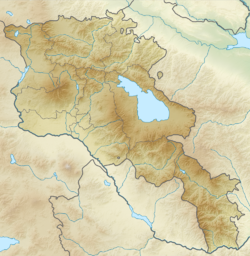


The cities of Sevan , Hrazdan , Charentsavan and the capital of Armenia, Yerevan, are located on the river. Mount Arailer [2] is located between the Hrazdan and Kasakh rivers, its height is 2575.9 m above sea level [3] .
Content
- 1 Description
- 2 Etymology of the name
- 3 Power Generation
- 4 notes
Description
The length is 141 km, the area of the pool with the Lake Sevan pool is 7310 km², the area of the Hrazdan basin itself is 2560 km². [one]
It flows from Lake Sevan in its northwestern part, not far from the city of Sevan . In the upper reaches it flows along a mountain valley to the south, to Yerevan . It makes several sharp bends within the city of Yerevan. In the lower reaches it flows along the Ararat plain , flows into Araks on the border with Turkey .
Name Etymology
The name may be associated with Zoroastrianism , since up to the adoption of Christianity at the beginning of the 4th century, a special form of Zoroastrianism was widely practiced among Armenians [4] [5] . In particular, in the Avesta , Lake Frasdan is mentioned in Sistan , where Vishtaspa studied Zoroastrianism.
At the same time, E. A. Grantovsky wrote that similar ethnonyms could have formed independently of the Avesta, either as figures in the Iranian epic tradition, or as a result of a similar formation of geographical names [6] . B. V. Tekhov associates the name with the Scythians [7] .
The name of the river is first encountered by ancient Armenian authors , in particular, Sebeos (in the form Հուրազդան = Hurazdan) and Movses Khorenatsi (in the more ancient, original form Հրազդան = Hrazdan) [8] [9] .
Power Generation
The total fall of 1097 m (1.8 m / km). Under natural conditions, the average water discharge at the source is about 2 m³ / s, near the mouth - 17.9 m³ / s. From 1930 to 1962, the Sevan cascade of six hydroelectric power stations was created at Hrazdan, after which the flow rate of the source at the expense of decreasing secular water reserves in the lake increased to 44.5 m³ / s. A sharp decrease in the level of Sevan began, to stop which the discharge of water from it since 1965 has been reduced to 16 m³ / s.
In addition to generating electricity, Hrazdan water is used for irrigation . In addition, fishing is developed on the river. Hrazdan is of great economic importance to Armenia.
Notes
- ↑ 1 2 Hrazdan - an article from the Great Soviet Encyclopedia .
- ↑ Map sheet K-38-XXXIII . Scale: 1: 200 000. Indicate the date of issue / condition of the area .
- ↑ Map sheet K-38-125 Aparan . Scale: 1: 100,000. 1975 edition.
- ↑ JR Russell. Armeno-Iranica // Papers in Honor of Professor Mary Boyce. - 1985.- S. 451 .Original textVarious strands of the Kayanian legends were brought together by the Arsacid period (if not, indeed, earlier), when Iranian cultural and religious influence in Armenia was strongest, and the name Hrazdan, a NW MIr form, was given to the tributary of the Araxes, which flows through the modern Armenian capital, Erevan. The name is first attested as getn Hurazdan ´the river Hurazdan´ in the History of Sebeos., While Movses Xorenaci uses the apparently older form Hrazdan.
- ↑ JR Russell. Zoroastrianism in Armenia. - Harvard University Press, 1987 .-- S. 48. Original textThe change of initial fr- to hr- in Arm. loans from northwestern MIr. is well attested in numerous examples (Arm.hraman, hrask, hrestak etc., Arm. Gr. 182 et seq.) and in the name of the river Hrazdan, which flows through modern Erevan and which may have received its name from Zoroastrians, for the body of water called Frazdan is referred to in the Phl. Sahristaniha i Eran as a place where Vistaspa received instruction in the Good Religion.
- ↑ E. A. Grantovsky. The early history of the Iranian tribes of Asia Minor. - Eastern Literature, 2007. - S. 333—334.
It has already been noted several times that, regardless of the possibility of such identification, the same place names that are known from the Avesta could exist independently in Western Iran (either as appearing in the oldest layers of the Iranian epic tradition, or simply as a result of a similar formation of geographical names ) So, it certainly cannot be a consequence of the activities of the “evil-headed” magicians in transferring Avestan toponyms to the west the name of the Hrazdan river (arm. Razdan <Hrazdan <Iran. Frazdan (u) <av.Frazdanu with usual localization in Seistan), flowing from the north -western corner of Lake Sevan through the Yerevan region to Araks
- ↑ B.V. Techov. Scythians and the Central Caucasus in the 7th – 6th centuries BC e .. - M .: Nauka, 1980 .-- S. 14.
Apparently, from the Scythians some other toponyms and hydronyms remained on the territory of Armenia, for example, Hrazdan (the name of the river and gorge), etc.
- ↑ G. Hubshman . Armenische Grammatik. - Leipzig, 1897 .-- S. 61.
- ↑ G. Nalbandian. On the etymology of Armenian h h rasht and hydronym h distributed // Bulletin of Yerevan University. - 1983. - No. 2 . - S. 246-248 .