Benedict of Nursia ( Benedict of Nursia ; lat. Benedictus Nursiae ; St. Benedict ; c. 480 , Nursia (modern Norcia ), Italy - March 21, 547 , Montecassino , Italy ) - reformer of Western European monasticism , founder of the first European monastic order (on Mount Cassius 529) with a strict charter , soon to be widely spread in Western Europe (monks Benedictine ), the holy Catholic and Orthodox churches (in Orthodox tradition, has a degree of the monk [1] ). The heavenly patron of Europe .
| Benedict of Nursi | |
|---|---|
| Benedictus de nursia | |
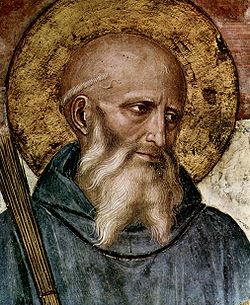 Fra Angelico , St. Benedict of Nursia , a fragment of the frescoes of the monastery of St. Mark, Florence | |
| Birth | about 480 |
| Death | March 21 547 |
| In the face | reverend |
| Main shrine | relics in montecassino |
| Day of Remembrance | March 14 ( March 27 ) - in the Orthodox Church, July 11 - in the Catholic Church |
| Attributes | Statutes, abbot's wand, a bundle of a rod, a cracked cup or a cup with a snake (indicating an attempted poisoning), a raven with a piece of bread in its beak |
| Proceedings | " Charter of St. Benedict " |
Almost the only source of information about the life of St. Benedict is the book "Dialogues" of sv. Gregory the Great , Pope of Rome.
Artistically, it is symbolically depicted either in the black dress of the Benedictine or in the white dress of the Camaldul monks, and holding a whip , a tool to exorcise demons and punish the monks [2] .
Content
Life Story
Benedict was the son of a noble Roman from Nursia . As a young man, he was sent to Rome to study, but without completing his studies, left the city with a group of pious people, escaped from the bustle of the capital, and settled in Affidy (modern Affilia), a place in the mountains near Subiaco . It is known that at that time he was about 20 years old, and that his twin sister Scholastica had already devoted herself to God by that time.
After some time, Benedict realized that he wanted to become a hermit . A chance encounter with a monk Roman from a monastic community located near Subyako helped him. The monk showed Benedict a cave near an artificial lake on the Anio River and agreed to bring food to the hermit. In the three years that Benedict lived in the cave, he was tempered both physically and spiritually. His fame grew, people began to make pilgrimages to the cave to look at the hermit; and the monks from Vicovaro , one of the neighboring monastic settlements, after the death of the abbot, persuaded Benedict to lead their community. Nothing good came of it; Benedict had too strict ideas about monastic life that the community did not like. As a result, he was forced to leave this place and return to the cave after he was nearly poisoned.
Gradually, Benedict had an idea in his head about how the monastic life should be arranged. He divided his pupils, whose number had grown by that time, into 12 groups, each of which was subordinate to its superior, and Benedict was left with the right of general supervision.
Around 530, the envy and intrigues of local monks and clergy forced Benedict to move south to the mountain near Cassino , where they founded the famous Monte Cassino Monastery, which was later recognized as the first official monastery in Europe. The monasteries that existed before were only spontaneous monastic settlements and communities devoid of any organization, structure, and rules. Benedict, for the first time, created the monastery as a systemic institution that had a clear structure, regulations, charter . He converted the pagan sanctuary on the mountain into a Christian church , and converted the local people to Christianity . Soon the fame of the monastery spread all over the region, the number of brothers in the community increased dramatically.
According to legend, Benedict prayer resurrected the son of a peasant from a neighboring village, who brought the deceased boy to the monastery [3] .
It was for the community of Monte Cassino, which initiated the Order, later called the Order of the Benedictines , about the year 540 that Benedict composed his famous " Charter of Saint Benedict ", which became the foundation not only for Benedictines, but also for all Western monasticism. The charter was largely based on the eastern charters of Pachomius the Great and Basil the Great , but contained a number of specific features.
Died sv. Benedict in 547 in the monastery of Monte Cassino founded by him. In 1964, Pope Paul VI proclaimed the Holy. Benedict is the patron saint of Europe . His memorial day in the Catholic Church is on July 11 , in the Orthodox Church (under the name of St. Venedict) on March 27 .
Charter of sv. Benedict
Charter of sv. Benedict ( lat. Regula Benedicti ) creatively incorporates the tradition of ancient Gaul monkhood, monasticism of St.. Augustine and Eastern monasticism, with whom St.. Benedict met through the writings of St.. Basil the Great and St. John Kassian . One of the sources for the Statute of St. Benedict was also the anonymous monastic charter “The Rules of the Teacher” ( lat. Regula magistri ) [4] . In general, the charter of sv. Benedict is very practical, it focuses on the daily needs and duties of the monastic community, both in worship and in economic activities. “We must establish a divine service detachment” - “Constituenda est ergo a nobis dominici schola servitii”. Therefore, the activity of a monk is expressed by the word “militare” - “to serve”; and the charter is nothing but “lex, sub qua militare vis” - the law, inviolable and immutable, as the law of military discipline is immutable. The "holy ordinance" contains all that is necessary for a warrior of the Lord; this is the “charter guide”. The statute of Benedict is intended for the majority, for average people, with the goal of educating them in the spirit of the monastic ideal [5] . The principle of kinovia (communal monasticism) and the principle of monastic autonomy are very strongly emphasized in the statutes. The charter strongly emphasizes the need to cultivate humility , which, according to Benedict, is more important than severe austerity . Departure from the world is also understood as the material independence of the monastery from the outside world, thus the personal poverty of the monks should not mean the poverty of the monastery. The life of monks is determined by worship, physical labor, reading of Holy Scripture and the works of the Fathers of the Church , but the main part of the prayers is defined in detail by the charter, and individual work is constrained to the extreme: only a proven anchorite can rely on its strength.
Charter of sv. Benedict until today is followed by Benedictines , Cistercians , Trappists , Olivetans and, in general terms and spirit, also Cartesians , who have their own special rules.
72 rules from the Charter are widely known.
- To love the Lord God with all your heart, with all your soul, with all your might.
- To love your neighbor as yourself.
- Do not kill.
- Do not indulge in fornication.
- Do not steal.
- Do not be jealous.
- Do not bear false witness.
- Respect all people.
- Do not do to others what we would not wish for ourselves.
- Reject yourself.
- Kill your flesh.
- Do not become attached to what is pleasing to the senses.
- Love the post.
- Relieve the fate of the poor.
- Wear the naked.
- Visit the sick.
- Bury the dead
- Maintain testers.
- Comfort the sad.
- Alien from worldly mores.
- Do not prefer anything to the love of Christ.
- Do not indulge in anger.
- Do not think about revenge.
- Do not keep in the heart of wickedness.
- Do not give a false peace.
- Do not leave mercy.
- Do not swear not to be a perjurer.
- To be a true heart, as well as a mouth.
- Do not give evil for evil.
- Not to tolerate untruths, but with patience to endure the one that will be made to us.
- Love your enemies.
- To respond to a curse is not a curse, but a blessing.
- To suffer persecution for truth.
- Do not be arrogant.
- Do not be addicted to wine.
- Do not be greedy for food.
- Do not be a lover of sleep.
- Do not be lazy.
- Do not grumble.
- Do not slander.
- Putting hope in God.
- To attribute to God the good that you find in yourself.
- In evil, always blame yourself.
- Remember the judgment day.
- Scared of hell.
- With all the forces of the soul to strive for eternal life.
- Always remember about death.
- Always follow your actions.
- To be sure that God sees us everywhere.
- Break all unkind thoughts about Christ as soon as they arise in the heart.
- And to open them to an old man, experienced in spiritual matters.
- Keep the mouth from every evil word.
- Do not like many words.
- Do not speak idle words.
- Do not love too often and laugh out loud.
- Willing to listen to spiritual reading.Image of sv. Benedict brush mantegna
- Often indulge in prayer.
- Every day, in prayer with tears, confess to God past transgressions and continue to be corrected by them.
- Do not fulfill the wishes of the flesh.
- Hate your will. In all obey the instructions of the hegumen, even if — God forbid — he contradicts himself with works, remembering the Lord’s covenant: “What they say, do it, do not act according to their deeds”.
- Do not try to be considered holy before you become one.
- Every day, fulfill the lives of the covenants of the Lord
- To love cleanliness.
- Avoid hate.
- Do not be jealous and do not give in to envy.
- Do not like disputes.
- Avoid honors.
- Honor seniors.
- Loving the younger ones.
- Praying for enemies, in the love of Christ.
- Until sunset, to put up with those with whom we had a feud.
- Never despair of God's mercy.
Iconography
St. Benedict is depicted in black monastic robes. Iconographic symbols: the charter, the abbot's baton, a bundle of a rod, a cracked cup or a cup with a snake (an indication of attempted poisoning), a raven with a piece of bread in its beak. The first images of St. Benedict date back to the eighth century .
Worship worship
Orthodox Church
In the Orthodox Church, the memory of Rev. Benedict takes place on March 14 ( March 27 ) and always falls on the period of Great Lent , therefore the service to Benedict is combined with the service from the Lenten Triodion . The memory of Benedict is one of the daily festivals . The service itself directly to Benedict consists of three verses of the second voice in “Lord, I Cried,” and the canon of the second voice, written in the 9th century by St. Joseph . The boundary of the canon: “I will bring a song to the wise Benedict” (“Ὕμνον προσάξω τῷ σοφῷ Βενεδίκτ”). Troparion is missing. In the March Slavic Minea there is a kontakion of the sixth voice, in the modern Greek Minea there is no kondak.
See also
- Montecassino
- Charter of Saint Benedict
- Scholastica Nursiyskaya
- Subiaco
- Benedictines
Notes
- ↑ Orthodoxy.ru
- L Le langage secret de la Renaissance: le symbolisme caché de l'art italien / Richard Stemp. - National geographic France, 2012. - p. 108. - 224 p. - ISBN 9782822900003 .
- ↑ Saint Gregory of Dvoeslov. Interviews about the life of the Italic fathers and the immortality of the soul. Life of Rev. Benedict (inaccessible link) . The date of circulation is January 8, 2009. Archived April 16, 2009.
- ↑ Benedict of Nursia, Orthodox Encyclopedia
- ↑ Lev Karsavin Monasticism in the Middle Ages
Literature
- Benedict of Nursia / / Brockhaus and Efron Encyclopedic Dictionary : 86 t. (82 t. And 4 add.). - SPb. , 1890-1907.
- The Charter of St. Venedict / / Ancient monastic charters: Pahomiya the Great, St. Basil the Great, St. John Cassian, etc. St. Benedict, collected by Bishop Theophanes / Comp. Bishop Theophan the Recluse ; Reprint ed. 1892 - Riga: Pilgrim-Blagovest, 1995. - p. 585-653. - 654, VIII, [10] p. - 6000 copies - ISBN 5-87310-019-5 .
- A. De Vogue. Saint Benedict, man of God. Paris, 1995.
- Catholic Encyclopedia. Ed. Franciscans. M., 2002.
- Golosova O. E. Rev. Benedict of Nursia: Light of the Dark Ages. - M .: Mite, 2018. - 392 p. - (Saints of the undivided church). - 3000 copies - ISBN 978-5-91173-557-9 .