“The spirit of the dead is not asleep” (Manao Tupapau) - a picture of the French artist Paul Gauguin .
| ||
| Paul Gauguin | ||
| The spirit of the dead is not asleep . 1892 | ||
| Manao tupapau | ||
| Oil on canvas . 72.4 × 92.4 cm | ||
| Albright Knox Art Gallery, Buffalo , New York | ||
| ( inv. ) | ||
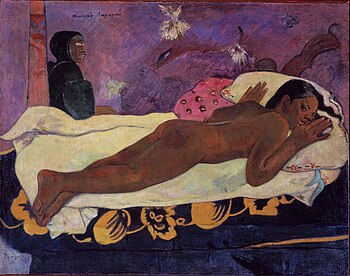
Gauguin wrote "The spirit of the dead does not sleep" in 1892 , in a remote village on the island of Tahiti. In this picture, the artist is characterized by a mixture of fiction with reality, when ancient legends are closely intertwined with the life of Tahitians.
The young girl is deducted from Tehura, the young Tahitian wife of Gauguin. The spirit is depicted as an ordinary little woman. The gloomy purple background of the picture creates an appropriate atmosphere.
Creation History
The impetus for the creation of the canvas was a real event. Gauguin went to Papeete and lingered there until dark. The lamp ran out of oil, and Tehura, who was waiting for the artist, remained lying in the dark. Entering the house, he struck a match to light the room, which frightened Tehura: “Could she not have mistaken me for a demonic ghost - tupapau, legends about which prevent her people from sleeping at night?” [1] . Later, describing the purpose of the picture, Gauguin noted that “the natives are very afraid of ghosts and always leave the lamp lit for the night. On a moonless night they won’t leave the house without a lantern, and no one would dare to go out alone with a lantern ” [2] . Tupapau, the spirit of the dead, is depicted as a female figure in a black cloak and with a face that looks like a mask: “How does a native woman imagine a ghost? She has never been to the theater, never read novels. Therefore, when she tries to imagine a ghost, she thinks about the dead person whom she knew. So, my ghost should look like an ordinary old woman who extended her arms as if in order to grab the prey. The tendency to decorative encourages me to scatter flowers against the background. Flowers are also tupapau, that is, wandering lights; they show that ghosts are interested in us humans. Such is the Tahitian belief ” [2] . The artist gave the painting “Tahitian” the name “Manao tupapau”, which in his translation sounds like “Thought, or Faith and Ghost”, adding that “[name] can be interpreted in two ways. Either she thinks of a ghost, or a ghost thinks of her. ” In fact, in the Tahitian language, the phrase “Manao tupapau” literally sounds like “a ghost thought” and is nonsense [2] .
Gauguin praised this work and depicted it in the background of his self-portrait of 1893.
Attitude to the Olympia by Eduard Manet
Gauguin was a fan of the painting Olympia (1863) by Edward Manet . He saw the picture at the 1889 World's Fair and wrote in his review: “ La Belle Olympia , which once caused such a scandal, is there, and like any beautiful woman, it attracts many grateful looks.” After the French state acquired Olympia from the widow of Manet with funds through an open subscription organized by Claude Monet , Gauguin made a copy of the painting when it was exhibited at the Luxembourg Museum . The copy is not particularly accurate, and, as the researchers believe, Gauguin completed it with a photograph [3] . In 1895, Edgar Degas purchased a copy for 230 francs at the auction of paintings by Gauguin to raise funds for the return of the artist in Tahiti. According to art historian Claire Fresh-Tory, references to Olympia are present in the image of naked bodies and in others in the paintings of the Tahitian cycle: "Te Arii Vahine (Queen. Wife of the King)" and " Never Again . "
When in 1893 Gauguin unsuccessfully presented the painting “The spirit of the dead does not sleep” at the exhibition of collector Paul Duran-Ruel (the painting was never sold for a set amount of 3,000 francs), several critics also noted the similarity of the composition with Olympia . In particular, Tade Nathanson, the founder of the French literary and artistic magazine La Revue Blanche, called it “Tahitian Olympia”, and the French poet and playwright Alfred Jarry more precisely - “dark Olympia” [4] .
Notes
- ↑ Literature, Arts and Medicine Database. Spirit of the Dead Watching (Manao tupapau) Annotated by Bertman, Sandra L.
- ↑ 1 2 3 Danielsson, Bengt . Gauguin in Polynesia. M .: Art, 1969
- ↑ George TM Shackelford and Claire Fréches-Thory, with additional essays by Isabelle Cahn. Gauguin Tahiti. - Boston, MA. MFA Publications, 2004 .-- ISBN 0878466665 .
- ↑ Pollock, Griselda . Avant-Garde Gambits: Gender and the Color of Art History , London: Thames and Hudson, 1993.