Due to the fact that electrical signals are time-varying quantities, in electrical engineering and radio electronics, different ways of representing the voltage and intensity of an electric current are used where necessary.
Values of alternating voltage (current)
Further, for definiteness, we will speak mostly about voltage parameters, although they are also valid for currents.
Instant Value
The instantaneous value is the value of the signal at a certain point in time, whose function is ( 
Amplitude value
- The amplitude (peak) value, sometimes referred to simply as “ amplitude ”, is the largest instantaneous value of voltage or current during a period (not counting the sign):

The peak voltage value is measured using a pulse voltmeter or oscilloscope.
RMS
The root-mean-square value (outdated, effective, effective) is the square root of the mean value of the square of the voltage or current.
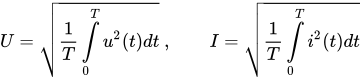
RMS values are the most common, as they are most convenient for practical calculations, because in linear circuits with a purely active load, alternating current with effective values 

When not specifically, they usually mean the RMS values of the voltage or current.
In the RMS values, the indicating devices of most voltmeters and ammeters of alternating current, except for special devices, are graduated, however, these conventional devices give correct readings for RMS values only with a sinusoidal waveform. Non-critical to the form of a signal are devices with a thermocouple, in which the measured current or voltage is transformed by a heater, which is an active resistance, into a further measured temperature, which characterizes the magnitude of the electrical signal. Also insensitive to the form of the signal are special devices that square the instantaneous value of the signal, followed by averaging in time (with a quadratic detector) or ADC , which also square into the input signal with time averaging. The square root of the output signal of such devices is just the rms value.
The square of the RMS value of voltage, expressed in volts, is numerically equal to the average power dissipation in watts on a resistor with a resistance of 1 Ohm.
Average
The average value (offset) is the DC component of the voltage or current
In electrical engineering it is rarely used, but is relatively often used in radio engineering ( bias current and bias voltage ). Geometrically, this is the difference of the areas under and above the time axis divided by the period. For a sinusoidal signal, the offset is zero.
Mean Straightened
The mean straight value is the average value of the signal modulus
It is rarely used in practice, but most of the measuring instruments of the alternating current — the magnetoelectric system (that is, in which the current is rectified before measurement) actually measure this value, although their scale is graduated by the rms values for the sinusoidal waveform. If the signal is noticeably different from the sinusoidal one, the readings of the devices of the magnetoelectric system have a systematic error. Unlike the devices of the magnetoelectric system, the devices of the electromagnetic, electrodynamic and thermal systems of measurement always respond to the actual value, regardless of the form of electric current.
Geometrically, this is the sum of the areas bounded by the curve above and below the time axis during the measurement time. With a unipolar measured voltage, the average and the average rectified values are equal to each other.
Conversion Factors
- The form factor of the AC voltage (current) curve is a value equal to the ratio of the effective value of the periodic voltage (current) to its mean-rectified value. For sinusoidal voltage (current) is .
- The amplitude coefficient of the alternating voltage (current) curve is a value equal to the ratio of the maximum modulo value over a period of the voltage (current) value to the actual value of the periodic voltage (current). For sinusoidal voltage (current) is .
DC Parameters
- The magnitude of the ripple voltage (current) - a value equal to the difference between the highest and lowest values of the pulsating voltage (current) for a certain time interval
- The voltage (current) ripple coefficient is a value equal to the ratio of the largest value of the variable component of the pulsating voltage (current) to its constant component.
- The ripple factor of voltage (current) at the effective value is equal to the ratio of the effective value of the variable component of the pulsating voltage (current) to its constant component
- Voltage (current) ripple coefficient according to average value is equal to the ratio of the average value of the variable component of the pulsating voltage (current) to its constant component
Pulsation parameters are determined using an oscilloscope, or using two voltmeters or ammeters (direct and alternating current)
Literature and Documentation
Literature
- Handbook of electronic devices : In 2 tons; Ed. D.P. Linde - M .: Energy, 1978 (inaccessible link)
- Schulz Y. Electrical measuring equipment: 1000 concepts for practitioners: a Handbook: Trans. with him. M.: Energoatomizdat, 1989
Regulatory and Technical Documentation
Links
See also
- Voltage
- Current strength
- Ac current value
- Voltmeter
- Ammeter
- Oscilloscope